THE SIGNAL IN ONE SENTENCE
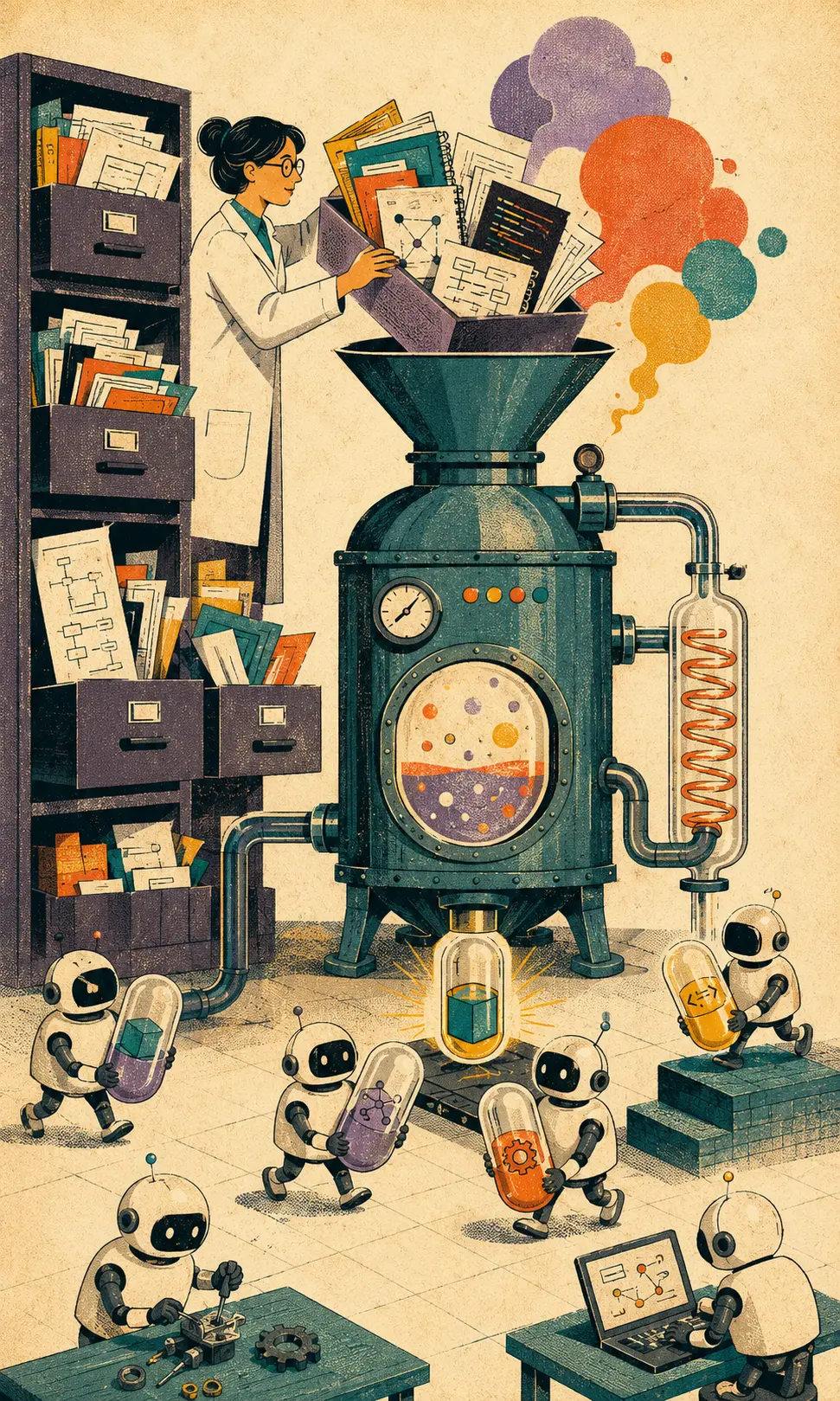
DisCo extracts setup steps, tool usage, file conventions, and failure lessons from technical projects, then packages that knowledge so another agent can reuse it later.
01
WHAT ACTUALLY CHANGED
Researchers introduced DisCo, an AI research agent that converts knowledge embedded in GitHub repositories and technical papers into compact operational skills. Its AREX-Skill Library contains more than 5,000 verified skills distilled from 1,000 widely used machine-learning repositories.
The target is practical knowledge, not merely a summary. A useful skill can preserve the commands, configuration, file layout, tool sequence, assumptions, and failure modes required to make a project work. Those details are often scattered across source files, issue threads, examples, and papers.
With the model, harness, and execution budget held constant, the researchers report that adding the skills improved performance by 134.3 percent on MLE-bench and 34.4 percent on PaperBench, with smaller gains on two additional evaluations.
Holding the base model constant is the interesting experimental choice. It suggests a route to better agents that does not require retraining the underlying model. The system improves by carrying operational knowledge into the task instead of rediscovering the same repository from scratch.
02
WHY THIS MATTERS
Models can often explain an algorithm and still fumble the package that implements it. Software competence lives in mundane details: which command runs first, where the configuration belongs, what output indicates success, and which apparently sensible shortcut breaks the pipeline.
A skill library turns those details into reusable infrastructure. A team could extract knowledge once, review it, and make it available across several agents or future projects. That is closer to an operating manual than an artificial personality trait.
The hard part is trust. Repositories change, instructions can be malicious, and a skill distilled from yesterday’s code can become a confident source of today’s failure. Provenance, versioning, permissions, and verification will matter as much as the extraction model.
03
WHERE IT COULD HELP
- Generate agent skills from unfamiliar open-source projects
- Preserve installation steps, file conventions, and known failure modes
- Build specialized research agents without retraining the base model
- Create reviewed internal skill libraries from company repositories
KEEP A HAND ON THE WHEEL
The evaluation results are author-reported and have not yet been independently reproduced. Teams should also test how the system handles stale repositories, conflicting documentation, prompt injection inside source material, licenses, and skills that require dangerous permissions.
04
TERMS WORTH KEEPING
SOURCES AND VERIFICATION STATUS
This article was written from the materials below. Product claims and dates were checked against those sources on September 3, 2026.
PUBLICATION RECEIPT: Revision 1. Approved by Zak and published September 4, 2026.
THE PUBLICATION ENGINE
WANT A SIGNAL OF YOUR OWN?
We build source-grounded publications, private briefings, and editorial systems for organizations with something useful to say.
WORK WITH US