THE SIGNAL IN ONE SENTENCE
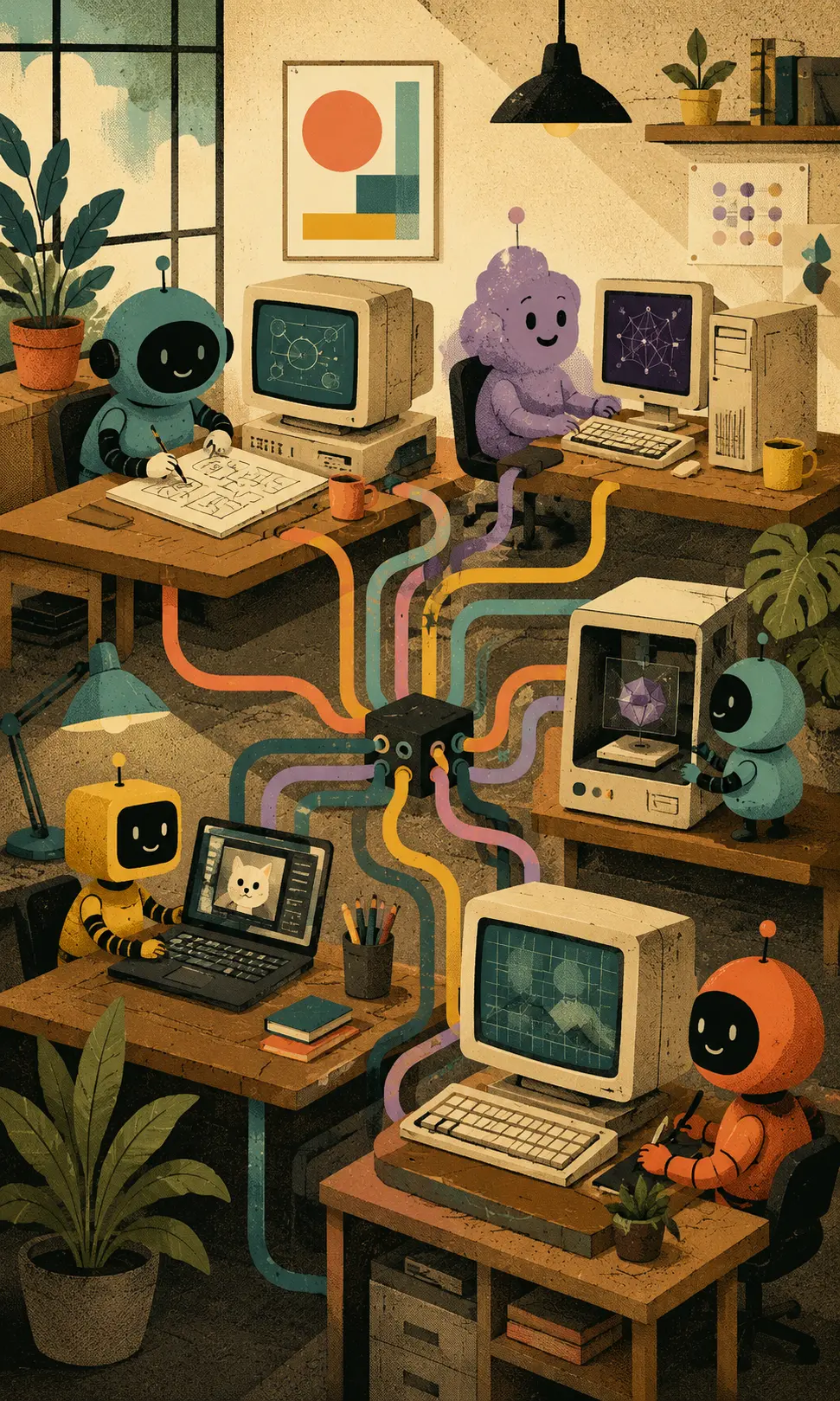
PAIR lets several computers on one local network share independent AI requests, giving parallel agents more places to work without sending private prompts to a remote service.
01
WHAT ACTUALLY CHANGED
Nvidia released the beta of Personal AI Router, or PAIR, a free open-source tool that routes local inference requests across compatible computers on the same network. It works with Ollama and LM Studio without requiring every agent application to adopt a new API.
The supported pool includes recent Nvidia GPUs, DGX Spark systems, and Apple M4 or newer hardware across Windows, macOS, and Linux. PAIR discovers machines locally, establishes secure pairing with mutual TLS, and adjusts when a computer becomes busy or drops off the network.
In Nvidia’s configuration-specific demonstration, five Hermes subagents completed a workload in 8 minutes 48 seconds across three devices, compared with 18 minutes on one RTX Spark laptop. Nvidia labels the comparison as an unofficial demonstration, which is the correct amount of salt for a result tied to one workload and hardware mix.
PAIR does not fuse several graphics processors into one enormous virtual GPU. It sends separate inference requests to different machines. That distinction makes it a natural fit for multi-agent work, batch processing, and several people sharing local models, but not for a single model too large for every individual device.
02
WHY THIS MATTERS
Local AI is usually sold as a purchase decision: buy the biggest machine that fits the desk and budget. PAIR offers another shape. A household or small studio can treat several ordinary computers as a changing pool of workers.
The privacy story is also practical. Prompts, documents, and model requests can stay on the local network while work is distributed to whichever compatible machine is available. That does not eliminate security questions, but it changes who must receive the data.
The catch is coordination. A home cluster inherits every mismatch in model availability, memory, network speed, operating systems, and power use. The useful comparison is not theoretical peak throughput. It is how often real workloads finish faster and more reliably than they did on one machine.
03
WHERE IT COULD HELP
- Run several local coding or research agents at the same time
- Keep sensitive prompts and documents on the local network
- Use an idle workstation while the primary computer handles creative work
- Route requests toward machines that already store the required model
KEEP A HAND ON THE WHEEL
PAIR is a beta and the published speed comparison is an unofficial demonstration. Test discovery, failover, authentication, model placement, network bottlenecks, and energy use on the exact devices that will form the pool.
04
TERMS WORTH KEEPING
OPEN GLOSSARY CARD
Inference
The moment a trained model uses what it learned to produce an answer.
OPEN GLOSSARY CARD
Private deployment
Running a model inside infrastructure controlled for one organization instead of only through a shared public service.
OPEN GLOSSARY CARD
Agent orchestration
Coordinating several agents, tools, or specialist roles across one larger task.
SOURCES AND VERIFICATION STATUS
This article was written from the materials below. Product claims and dates were checked against those sources on September 3, 2026.
PUBLICATION RECEIPT: Revision 1. Approved by Zak and published September 4, 2026.
THE PUBLICATION ENGINE
WANT A SIGNAL OF YOUR OWN?
We build source-grounded publications, private briefings, and editorial systems for organizations with something useful to say.
WORK WITH US