THE SIGNAL IN ONE SENTENCE
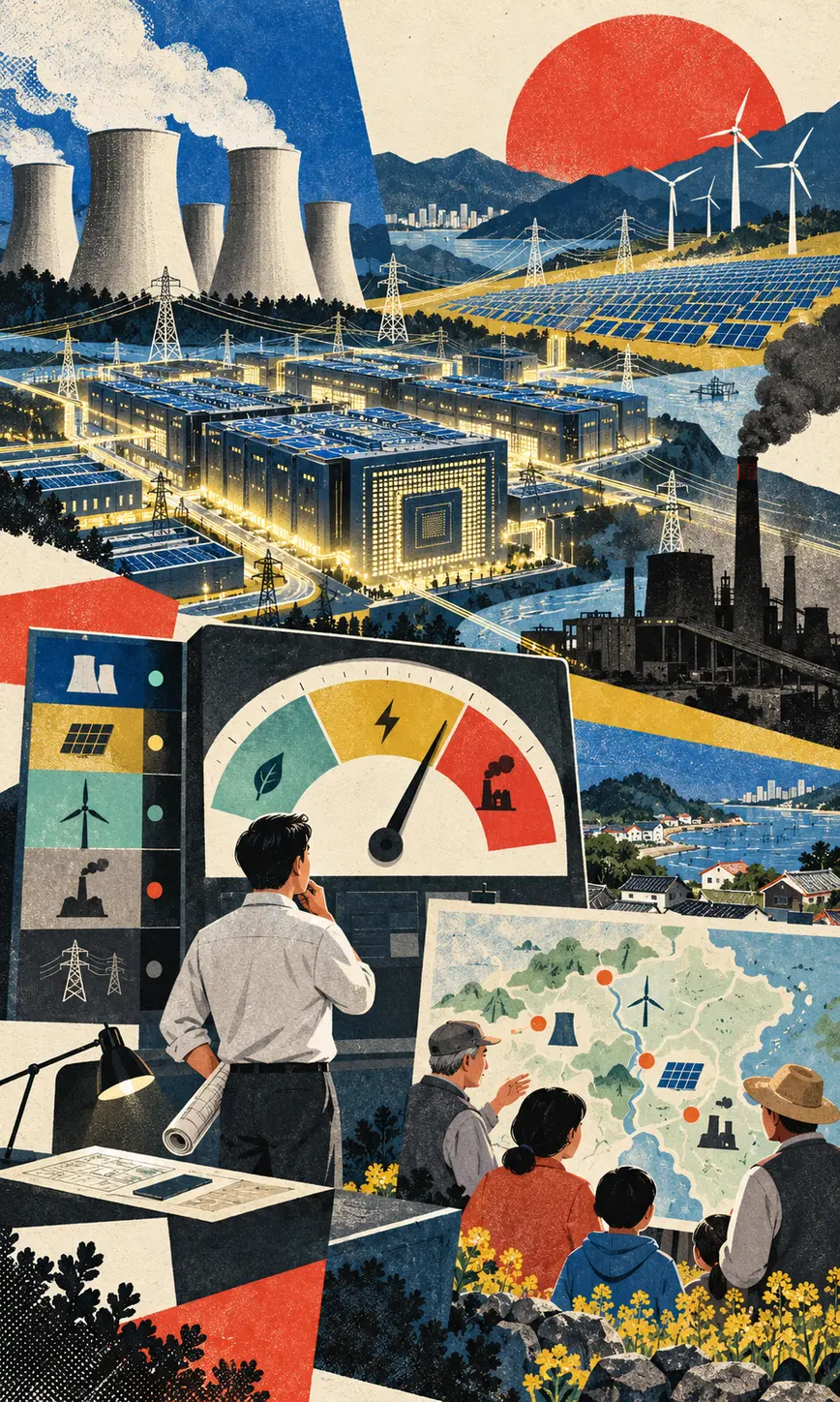
South Korea's plans for AI data centers and enormous new chip factories will require so much additional electricity that supplying the increase entirely with today's Korean nuclear units would take the equivalent output of about twenty reactors.
01
WHAT ACTUALLY CHANGED
South Korea's Minister of Climate, Energy and Environment Kim Sung-whan told Reuters that power demand created by the country's AI expansion could add 25 to 30 gigawatts. That estimate covers new AI data centers and accelerated semiconductor production, before adding the separate demand expected from electric vehicles and the shift from gas heating to electricity.
The scale comparison is arresting but needs its full sentence. If all 25 to 30 gigawatts came from nuclear generation alone, Kim said it would equal the capacity of roughly twenty reactors based on a current South Korean-designed unit. The government has not proposed building twenty reactors. It is reviewing a wider mix of nuclear, solar, wind, gas, transmission, and demand planning.
South Korea currently operates 26 nuclear reactors, which provide just under one-third of its electricity. Reuters reports coal at 29 percent, gas at 27 percent, and renewables at 11 percent. The government intends to phase out coal by 2040, although Kim said some plants could remain available as emergency reserves instead of being dismantled immediately.
The industrial buildout is moving faster than earlier forecasts. Samsung Electronics and SK Hynix have pledged an 800 trillion won semiconductor mega-project in the country's southwest. Kim said facilities once planned for around 2045 are now expected in the early 2030s. Several overseas technology companies, including Nvidia, have also expressed interest in Korean data centers because of the grid's dependable supply.
This is no longer merely a forecast in a spreadsheet. In May, the climate and science ministries signed an agreement to coordinate stable grid access for nationally prioritized AI data centers and created a joint task force for future gigawatt-scale projects. That followed passage of a special act intended to support and ease regulation for the AI data-center industry.
02
WHY THIS MATTERS
AI ambition becomes a physical policy when it reaches the power grid. A country can announce models, chips, and data centers quickly. New generation, transmission lines, substations, cooling systems, and local agreements take years. The glamorous part of the strategy is intelligence. The bottleneck may be ordinary electrons arriving in the correct province at the correct hour.
South Korea's choice is unusually consequential because semiconductors already sit near the center of its economy. The country wants more advanced chip production and more AI computing at home while reducing coal and meeting climate commitments. Those goals can coexist, but only if the electricity plan is built at roughly the same speed as the industrial plan.
Nuclear power offers large quantities of dependable low-carbon electricity, but it also carries construction, cost, waste, safety, and public-consent questions. A state-run agency poll found 79 percent of 2,000 respondents supported including new nuclear plants in the coming roadmap. In Ulsan, a possible site, a civic group collected more than 10,000 signatures opposing additional reactors. National approval can look very different when the map places a plant near home.
Renewables face their own constraints. Solar and wind can be expanded across more locations, but they need land, storage, flexible generation, and stronger transmission. Gas can provide dependable power sooner, but increases fuel dependence and emissions. Coal reserves improve emergency resilience while complicating the promised phaseout. There is no source labeled “AI electricity” that arrives without tradeoffs.
03
WHERE IT COULD HELP
- Plan data centers alongside generation and transmission capacity
- Use regional electricity pricing to steer large loads toward available power
- Match semiconductor construction schedules with grid upgrades
- Evaluate nuclear, renewable, storage, and gas portfolios under the same demand forecast
- Give affected communities a real role before plant and transmission sites are selected
KEEP A HAND ON THE WHEEL
The 25 to 30 gigawatt figure is a government estimate reported from a ministerial interview, not a completed load forecast or construction commitment. The reactor comparison describes equivalent capacity if nuclear supplied the entire increase, not an announced reactor count. South Korea's next long-term energy roadmap is still under expert review and was expected in October when this article was verified.
04
TERMS WORTH KEEPING
OPEN GLOSSARY CARD
Gigawatt
A unit of power equal to one billion watts, commonly used for large power plants and electricity systems.
OPEN GLOSSARY CARD
Generation mix
The combination of energy sources used to produce electricity in a grid.
OPEN GLOSSARY CARD
Firm power
Electricity capacity that planners expect to be reliably available when demand reaches its peak.
SOURCES AND VERIFICATION STATUS
This article was written from the materials below. Product claims and dates were checked against those sources on September 8, 2026.
PUBLICATION RECEIPT: Revision 1. Published September 8, 2026.
THE PUBLICATION ENGINE
WANT A SIGNAL OF YOUR OWN?
We build source-grounded publications, private briefings, and editorial systems for organizations with something useful to say.
WORK WITH US