THE SIGNAL IN ONE SENTENCE
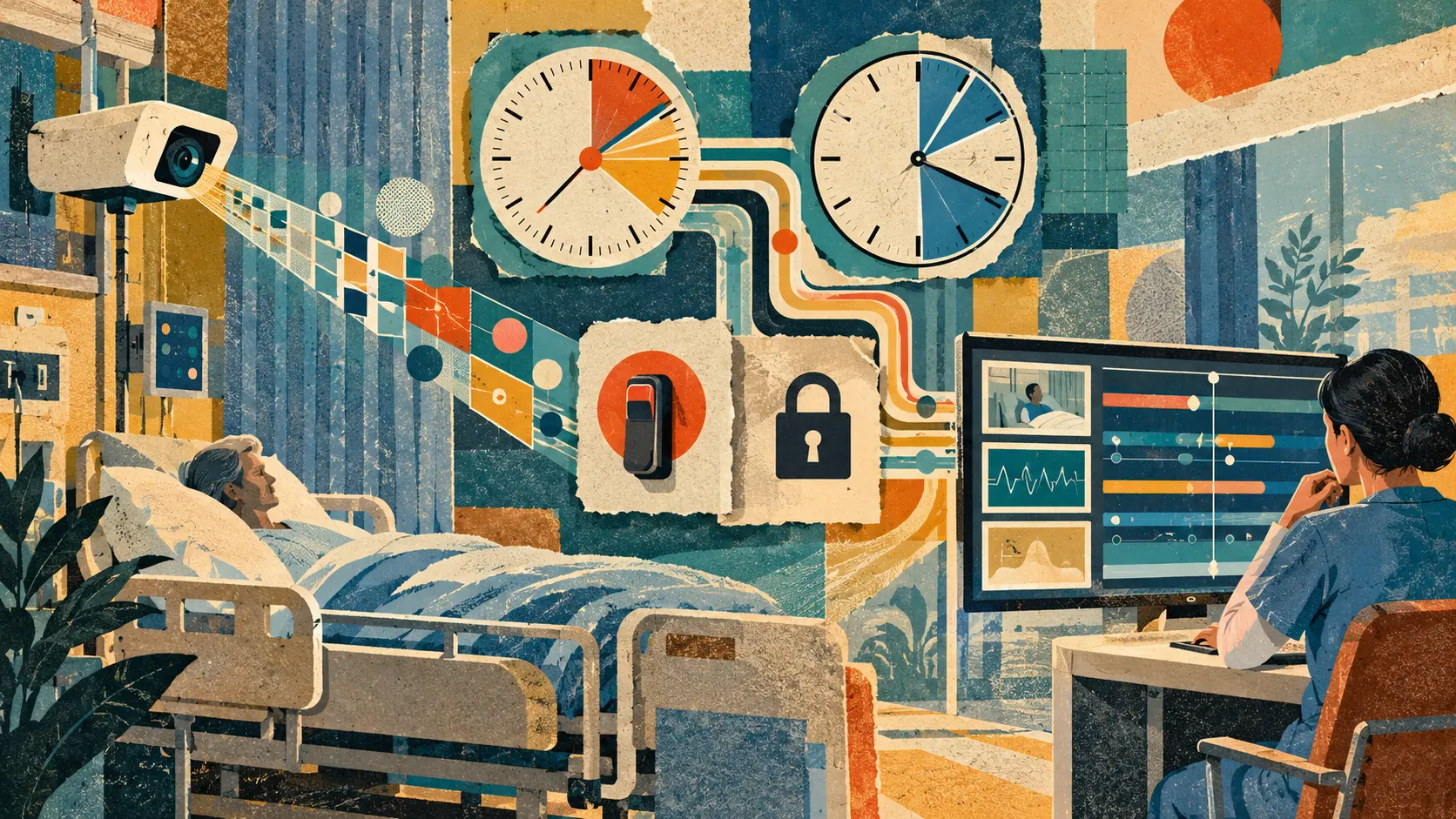
A hospital room already has too many clocks. There is the medication clock, the shift clock, the monitor clock, the sleep clock and the private clock inside the patient's head that has stopped agreeing with the rest of the building. Stanford researchers have added two more useful ones. TRACER, short for Trajectory Reasoning Across Clinical Event Records, converts continuous bedside video into minute-level records of patient activity. It then combines those records with medication changes and other clinical information in hourly reports. A language-model agent can search that hierarchy, inspect relevant moments and return to the underlying video or record when a clinician asks a question. The system is designed for a problem that hospitals know well: a patient's condition unfolds continuously, but human attention arrives in shifts and documentation arrives in pieces. A nurse may see a patient becoming less active. Another nurse arrives twelve hours later. A medication changed between those shifts. A delirium assessment captured one moment. The electronic record contains orders and measurements, while the physical room contains movement, conversation, visitors, restlessness and long stretches of stillness. TRACER tries to put those clocks on one timeline. That is the promise. The responsibility begins with the camera. Stanford's team says the project traces back to sensors installed in intensive-care units in 2021 after an approval process that took more than five years. The setup included depth, infrared and video sensors. Researchers worked with clinicians to define fifteen atomic actions that a vision-language model could attempt to recognize, including head turning, communication, contact with clinicians, bedding adjustment and movement in or out of bed. For every minute, the system records those action signals and produces a short scene caption. It then aggregates the minute records into hourly summaries and adds medication changes. The hierarchy is meant to keep long stays navigable without severing a summary from the finer evidence beneath it. This matters because an ICU stay is not a tidy clip. The median stay in the researchers' cohort lasted more than three days. That is thousands of minutes, enough material to turn a simple question into a small documentary festival nobody has time to attend. The agent does not merely receive the whole archive and improvise. It receives tools for searching the timeline, reading hourly and minute records, retrieving clinical information and inspecting selected video. In the public demonstration, a clinician can ask when a medication was given, what the patient was doing nearby, when the patient last changed position or whether a visitor entered the room. Stanford uses synthetic video and data for that public interface while showing the kinds of outputs produced by the research system. The plain signal is this: hierarchy makes continuous observation queryable. It does not make continuous observation neutral. The evaluation provides a promising but narrow starting point. The researchers created a perception benchmark with 397 human-labeled one-minute clips spanning fifteen action categories. Their reasoning benchmark contains 144 clinician-informed multiple-choice questions grounded in 264 hours of video and clinical records from two ICU patients. Stanford says building the benchmarks required about 750 hours of human work. The paper reports action-detection performance as high as 84.8 percent and question-answering accuracy of 61.0 percent, compared with 49.3 percent for the strongest baseline using the same model backbone. Those figures show that the hierarchy and tools can help models navigate long records. They do not show that TRACER is ready to diagnose a patient, direct care or replace a nurse's judgment. The question benchmark covers two patients. Multiple-choice accuracy leaves plenty of room for error. Action scores vary by model and category. Rare events are difficult to assess. The system can miss movement, misunderstand contact or produce a tidy summary of an untidy scene. In medicine, a fluent answer attached to a timestamp is still only an answer that needs checking. The interface should therefore make evidence review cheap. Every claim should link to the medication record, minute report and video segment that support it. The clinician should be able to mark an answer wrong, correct the event label and see whether later summaries inherited the mistake. A confidence score without a route back to evidence is decorative numerology. The team also used TRACER across 280 patients and roughly 60,000 camera-hours. It found significantly less purposeful activity among patients who had a positive delirium assessment during their stay. That is an association, not a diagnosis and not proof that the system improves outcomes. Purposeful movement can change for many reasons. Sedation, pain, sleep, mobility limits, disease severity, ventilation, staffing and treatment can all affect what a camera sees. A delirium assessment also fluctuates over time. Before activity becomes a clinical biomarker, researchers need prospective testing that separates those factors, measures performance across patient groups and shows whether the signal changes a useful decision. The humane goal is not a new alarm. Stanford says hospital workers repeatedly warned the team about alarm fatigue. TRACER's proposed interface uses a timeline and retrospective chat rather than another stream of automatic alerts. That is a wise instinct. An ICU does not need a machine shouting every time somebody adjusts a blanket. Still, quiet systems can shape care just as strongly as loud ones. A summary may direct attention toward one hour and away from another. A label such as purposeful movement may acquire authority because it looks quantitative. A manager may discover that the same infrastructure can measure staff behavior. A research archive may outlive the clinical question that justified collecting it. The privacy design must be as concrete as the model design. Patients and families should know which sensors are active, what each one records, why the data is needed, who may view raw footage and how long each layer is retained. Consent should not be buried in a stack of admission forms signed during a frightening night. When legally and clinically possible, a visible room control should allow recording to pause for personal care, family conversations, religious practice or simple dignity. That control needs honest boundaries. Some monitoring may be required for immediate safety or research under an approved protocol. A pause may affect what the system can later conclude. The interface should say what stopped, when it stopped and who authorized any override. Different data layers deserve different lifetimes. Raw video is the most revealing and should face the strictest access and shortest practical retention. Minute-level action records reveal less than video but still describe intimate behavior. Hourly summaries can be copied into other systems and may become difficult to correct. Model prompts and tool traces can accidentally reproduce protected information. Deletion and correction must travel through the hierarchy rather than stopping at the first database. Access should be role-based and logged. A bedside clinician may need a selected clip. A researcher may need de-identified action records. A system administrator may need operational metadata without patient content. Nobody needs a general-purpose browse button for the ICU. Security review must include the agent's tools. A model allowed to search records and retrieve video needs a narrow patient scope, short-lived authorization and protection against instructions hidden in notes or captions. It should never gain new access because a generated answer sounds confident. The tool layer should enforce who may retrieve what, not the model. Hospitals also need a policy for secondary use. A system built to understand mobility or delirium should not quietly become a staff productivity monitor, an insurance dispute archive or a training set for unrelated products. New purposes require new review, new notice and, where applicable, new consent. The most useful pilot is smaller than the ambition. Choose one clinical question, one unit and one accountable team. Measure whether clinicians find relevant evidence faster, whether shift handoffs improve and whether errors are caught before they influence care. Record false detections, misleading summaries, missing periods, privacy pauses and the time required for human review. Compare outcomes with the current workflow, not with an imaginary hospital where every note is perfect. Include patients and bedside staff in the review. Ask patients whether the controls are understandable and whether the system changes how the room feels. Ask nurses whether the timeline saves time or creates another chart to reconcile. Ask clinicians which mistakes would be merely annoying and which could cause harm. TRACER is research, not an approved clinical decision system. Its strongest contribution today may be architectural rather than diagnostic. Long care episodes need more than one level of memory. Models need tools that can move from a broad summary back to the minute and the source. Clinicians need evidence rather than a synthetic paragraph floating free of the room. Patients need the same reversibility. They need to know when observation is happening, who can inspect it, when it disappears and where the switch lives. Two clocks can help a hospital remember. A privacy switch helps it remember whom the room belongs to.
01
WHAT ACTUALLY CHANGED
Stanford researchers introduced TRACER on October 16, 2026, following an October 15 paper release
TRACER converts continuous bedside video into minute-level action records and scene captions
It combines those records with clinical information, including medication changes, in hourly reports
A language-model agent receives tools to search the hierarchy and inspect supporting records or video
The action taxonomy contains fifteen clinically informed bedside behaviors
The perception benchmark contains 397 human-labeled one-minute clips
The reasoning benchmark contains 144 clinician-informed questions grounded in 264 hours from two ICU patients
The paper reports up to 84.8 percent action-detection accuracy and 61.0 percent question-answering accuracy
A broader observational analysis spans 280 patients and about 60,000 camera-hours
The researchers found an association between lower purposeful activity and a positive delirium assessment
02
WHY THIS MATTERS
A patient trajectory develops continuously while hospital documentation and human attention arrive in pieces
Minute and hourly layers can make multi-day stays searchable without discarding the supporting evidence
Shift handoffs may benefit from a timeline that connects activity changes with medications and interventions
The reported reasoning benchmark is small and does not establish clinical safety or improved outcomes
Association with delirium is not diagnosis and may be confounded by sedation, illness, sleep and mobility limits
Continuous video in an ICU creates unusually sensitive records of patients, families and workers
Generated summaries can redirect clinical attention even when they do not produce formal alerts
Raw video, derived action records, summaries and model traces each need access and retention rules
Evidence links, correction paths and audit logs can make agent answers reviewable rather than merely fluent
Patient and staff participation is necessary to judge whether the system supports care without erasing dignity
03
WHERE IT COULD HELP
- Build a reviewable timeline for activity changes across long hospital stays
- Support shift handoffs with source-linked summaries rather than free-floating generated prose
- Answer retrospective questions about medication timing and nearby patient activity
- Help mobility teams locate periods that may deserve human review
- Study activity patterns as candidate digital biomarkers under prospective clinical protocols
- Evaluate whether source-linked agents reduce time spent searching fragmented records
- Design visible room controls for privacy pauses and documented overrides
- Separate raw video access from access to derived action records and summaries
- Create correction workflows that propagate through minute records and hourly reports
- Measure false detections, missing periods, review time and downstream clinical effects during pilots
KEEP A HAND ON THE WHEEL
Watch for prospective clinical validation, patient and staff usability studies, subgroup performance, independent replication, detailed consent and retention policies, evidence-link interfaces, correction propagation, false-action rates by category, incident reporting, security testing of the agent tools, limits on secondary use, approved clinical indications and measured effects on handoffs, alarm burden, clinician time or patient outcomes.
04
TERMS WORTH KEEPING
SOURCES AND VERIFICATION STATUS
This article was written from the materials below. Product claims and dates were checked against those sources on October 18, 2026.
PUBLICATION RECEIPT: The article treats TRACER as a research harness, attributes performance figures to the authors, distinguishes association from diagnosis and presents privacy controls as necessary deployment analysis rather than features claimed in the paper.
THE PUBLICATION ENGINE
WANT A SIGNAL OF YOUR OWN?
We build source-grounded publications, private briefings, and editorial systems for organizations with something useful to say.
WORK WITH US