THE SIGNAL IN ONE SENTENCE
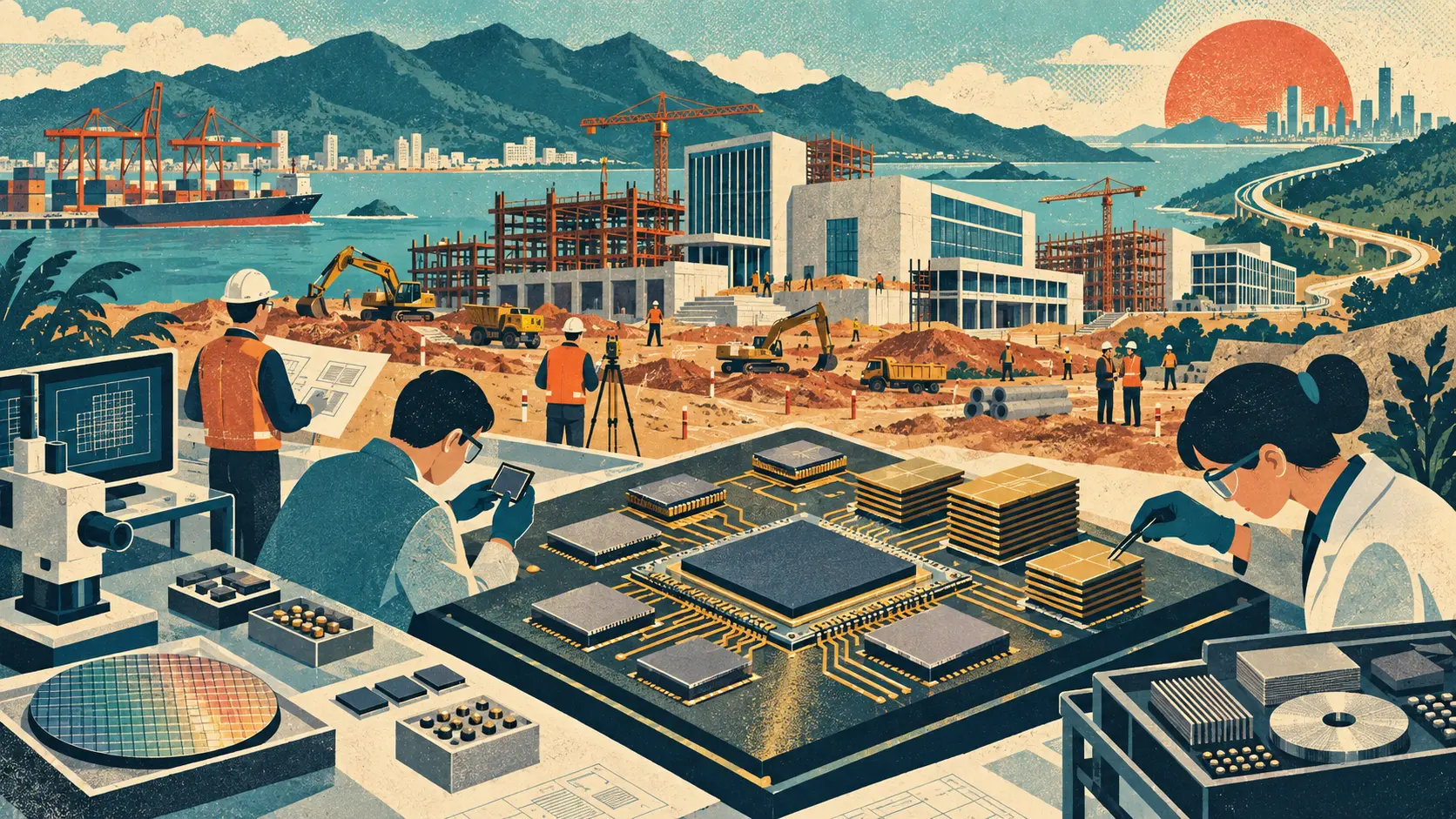
Taiwan has broken ground on Baipu Industrial Park in Kaohsiung, a nearly 89-hectare site designed around the less glamorous and increasingly decisive part of artificial intelligence hardware: turning separate pieces of silicon and memory into one tested system. Reuters reports that TSMC plans a technology-validation laboratory and a talent-training center at the park, with operations targeted for the fourth quarter of 2029. Taiwan's presidential office describes Baipu as the country's first testing and verification base dedicated to advanced semiconductor equipment and materials. That phrase deserves a little unpacking. A leading AI processor is no longer just one heroic chip. It can be a collection of compute dies, input-output pieces and stacks of high-bandwidth memory joined through dense wiring, substrates and packaging processes. Every material, tool and interface has to behave under heat, power, mechanical stress and huge data flows. A supplier with a promising chemical, inspection tool or bonding process cannot simply roll it into mass production on optimism. It needs a place to test, qualify and improve the thing alongside the manufacturers that may use it. Baipu is meant to shorten that loop and connect it to Kaohsiung's existing semiconductor cluster. The government projects annual output of NT$300 billion and more than 4,000 jobs. Those are forecasts, not receipts. TSMC's two planned buildings are not a packaging factory, and a groundbreaking is not delivered capacity. No final tenant roster, public construction ledger, validated output, production yield, customer allocation or facility-level water and electricity record exists yet. The plain signal is that advanced packaging has become strategic enough to shape land, training and industrial policy. Taiwan is building the test bench around the factory. Whether that bench becomes a durable ecosystem will be decided by what passes through it, what fails there and whether the region can support the power, water, people and suppliers required long after the ceremonial shovels go home.
01
WHAT ACTUALLY CHANGED
Taiwan held a groundbreaking ceremony on September 21 for Baipu Industrial Park in Kaohsiung. Reuters reported the event the same day, and material supplied by Taiwan's presidential office described the park as part of a southern semiconductor corridor.
The site covers nearly 89 hectares. Reuters gives a total of 88.7 hectares, including 53.6 hectares designated for industrial use. A groundbreaking means site work has begun. It does not mean the industrial buildings, utilities or validation equipment are complete.
TSMC plans two facilities at Baipu: a technology-validation laboratory and a talent-training center. Reuters says the company expects those facilities to begin operating in the fourth quarter of 2029. That target is more than three years away and remains a plan.
The presidential office calls Baipu Taiwan's first base focused on testing and verifying advanced semiconductor equipment and materials. The intended job is to help suppliers research, test and qualify products before those products enter mass-production lines.
Kaohsiung's city government is responsible for developing factory facilities at the park. The site is meant to complement the nearby Nanzih Technology Industrial Park rather than replace it or function as another leading-edge wafer fab.
Official material describes a regional chain connecting advanced-process manufacturing in Nanzih, packaging and testing in Renwu, materials and components in Ciaotou and the new equipment-and-material validation work at Baipu. That map is an industrial-policy design, not proof that every link already works at the proposed scale.
Advanced packaging joins logic dies, chiplets, high-bandwidth memory and interconnects into a usable computing package. As AI systems demand more memory bandwidth and communication between components, the package itself affects performance, power, reliability and production cost.
TSMC presents its 3DFabric family as a set of technologies for integrating components in two and three dimensions. Its public advanced-packaging material supports the basic technical role of combining different dies and memory. It does not establish how much new capacity Baipu will add.
Validation is a gate between invention and production. Equipment must repeatedly perform its intended process. Materials must meet chemical, thermal, electrical and mechanical specifications. The complete result must survive inspection, reliability testing and the customer's qualification rules.
A local validation center can shorten the trip between supplier, laboratory and production engineer. That can make failure faster and cheaper to discover. It cannot abolish failure, guarantee adoption or turn every local supplier into an approved vendor.
Taiwan's government projects that the park will support more than 4,000 jobs and NT$300 billion in annual output. Those numbers were presented as expected economic effects. No public methodology, tenant-by-tenant model or audited outcome exists because the park is not operating.
President Lai Ching-te said Taiwan has assessed electricity demand through 2035 and that supply will be stable. He also cited a planned reserve margin of 10 to 15 percent. These are government assurances about the wider power system, not a public facility-level study proving Baipu's future load, uptime or carbon profile.
The announcement places training beside validation. That matters because packaging depends on process integration, metrology, materials science, equipment maintenance, thermal design and quality control, not only on adding more machines.
The development adds a physical location to a supply-chain strategy, but it does not add shipping product today. Until the buildings open, suppliers qualify tools and materials, customers adopt them and production results are published, Baipu is infrastructure under construction.
02
WHY THIS MATTERS
AI hardware is often discussed as though the processor were a solitary engine. Modern accelerators behave more like a tightly planned city. Compute dies, memory stacks, power delivery, substrates and links must fit together, move data quickly and shed heat without breaking the neighborhood.
Shrinking transistors remains important, but packaging creates another route to performance. Designers can combine specialized pieces made with different processes instead of forcing every function onto one enormous die. That flexibility only works when the interfaces are manufacturable and reliable.
High-bandwidth memory sits close to the processor because moving data is one of AI computing's central constraints. The electrical paths, physical spacing, thermal behavior and assembly yield of that arrangement can decide whether an impressive design becomes an affordable product.
More pieces create more opportunities for one bad part or weak connection to spoil an expensive package. Yield therefore belongs in the economic story. A diagram full of chiplets may look modular, but the final product still has to pass as one system.
Validation capacity is a form of industrial infrastructure. A supplier that can test near its customer gets quicker feedback, reduces travel and shipping and can adjust a process before attempting a high-stakes production qualification. The value is the learning loop, not the ribbon cutting.
That loop can widen access for smaller Taiwanese equipment and materials companies. A credible path from prototype to qualification may help them compete with established international vendors. It can also expose where a promising local product still falls short.
Co-location does not erase concentration risk. Taiwan remains exposed to earthquakes, typhoons, water constraints, grid stress and geopolitical tension. Adding another cluster in southern Taiwan changes the map inside the island but does not make the global supply chain geographically independent.
The park may deepen Taiwan's advantage by gathering tools, materials, process knowledge and trained people around a leading manufacturer. That same density can make disruption more consequential. Resilience needs alternate suppliers, recoverable data, spare parts, emergency utilities and qualified production paths elsewhere.
Electricity reliability is not a decorative footnote. Validation tools, clean environments, metrology systems and computing infrastructure need stable power. A national reserve-margin promise must eventually become a transparent connection plan with load, redundancy, outage and generation data.
Water deserves the same treatment. Semiconductor facilities use water differently depending on their process, but construction and operation still create local demand and discharge. The public record available for this announcement does not quantify Baipu's future withdrawal, recycling or drought plan.
Jobs projections should be read by occupation and timing. Construction work, laboratory research, equipment service, process engineering and training roles arrive at different stages and require different preparation. A single headline number can hide whether local residents can enter the new labor market.
A training center is useful only if its curriculum follows the actual bottlenecks and creates portable skill. Vendor-specific instruction can prepare someone for one tool. A stronger program also teaches measurement, safety, statistics, materials behavior and problem solving that survive a product cycle.
Public development can reduce the cost of coordination, but it can also socialize infrastructure risk around private demand. Contracts, land terms, environmental conditions, utility obligations and performance milestones matter if the public is underwriting roads, factories or services.
For AI buyers, this is a reminder that a model's hardware dependency extends far past a GPU brand. Packaging tools, substrates, bonding materials, memory, inspection systems and trained technicians can become the limiting part even when wafer supply improves.
For other countries, Baipu is a lesson in ecosystem policy. Subsidizing one factory may attract a headline. Building a durable manufacturing capability requires places where suppliers can fail safely, validate honestly, train people and connect evidence to production decisions.
03
WHERE IT COULD HELP
- Publish a construction dashboard for Baipu with permits, utility connections, building milestones, spending, delays and the operational target for each facility
- Name participating suppliers and describe which equipment or material categories can be tested without disclosing customer trade secrets
- Create shared validation protocols with measurable entry criteria, failure reports, corrective action and independent audit rights
- Track qualification time from supplier prototype to production decision and report whether local testing actually shortens the cycle
- Measure packaging yield by process stage while protecting customer data, so improvements are not confused with gross installed capacity
- Build secure data rooms where suppliers can share test results with customers while keeping product recipes and sensitive design information compartmentalized
- Offer training in metrology, bonding, materials science, thermal management, statistical process control, equipment maintenance and cleanroom safety
- Connect universities and technical schools to paid apprenticeships with published completion, placement and wage outcomes
- Reserve pathways for small and medium suppliers to use shared laboratories without allowing one anchor company to absorb every available test window
- Publish Baipu's projected electricity load, connection capacity, backup design, outage assumptions and actual energy mix before operations begin
- Set water withdrawal, recycling, discharge and drought-response targets, then report measured performance at the park and tenant level
- Require environmental and emergency planning for chemicals, waste, earthquakes, typhoons, fires and interrupted utilities
- Map dependencies on imported tools, chemicals, substrates, memory and replacement parts, then qualify alternatives for the most fragile links
- Separate public economic forecasts from observed outcomes by reporting actual tenants, operating jobs, wages, output and tax receipts after opening
- Test whether validated tools and materials can transfer across more than one customer or package type, reducing dependence on a single production program
KEEP A HAND ON THE WHEEL
Baipu has moved from a plan to a construction site, not from a plan to production. TSMC's technology-validation laboratory and talent center are targeted for the fourth quarter of 2029. Neither building is an announced high-volume packaging line, and no public source states the amount of packaging capacity that the park will add. The official NT$300 billion annual-output estimate and more than 4,000 jobs are government projections without an available tenant-level model. The nearly 89-hectare footprint includes 53.6 hectares of industrial land, but land area does not reveal equipment count, usable cleanroom space, throughput or yield. A supplier test that succeeds in a shared laboratory still faces customer qualification, integration, reliability and production economics. TSMC's general packaging portfolio explains why chiplets, memory and interconnects matter, but it does not verify a specific Baipu production result. President Lai's electricity statement is an assurance about planning through 2035, not a disclosed facility-level power study. Water demand, recycling, emissions, chemical handling, habitat effects and emergency capacity were not quantified in the material reviewed for this article. Watch for signed tenant commitments, environmental and utility documents, construction milestones, open access rules, qualification protocols, independent performance data, curriculum details and a clear distinction between validated technology, installed capacity and shipped packages.
04
TERMS WORTH KEEPING
OPEN GLOSSARY CARD
Yield
The share of manufactured units that work well enough to meet a defined specification.
OPEN GLOSSARY CARD
Chiplet
A smaller functional piece of a processor package that is connected with other pieces instead of building every function on one large die.
OPEN GLOSSARY CARD
Advanced packaging
Manufacturing techniques that connect several dies, memory stacks, substrates, and interconnects into one high-performance electronic package.
SOURCES AND VERIFICATION STATUS
This article was written from the materials below. Product claims and dates were checked against those sources on September 21, 2026.
PUBLICATION RECEIPT: Revision 1. Published September 21, 2026.
THE PUBLICATION ENGINE
WANT A SIGNAL OF YOUR OWN?
We build source-grounded publications, private briefings, and editorial systems for organizations with something useful to say.
WORK WITH US