THE SIGNAL IN ONE SENTENCE
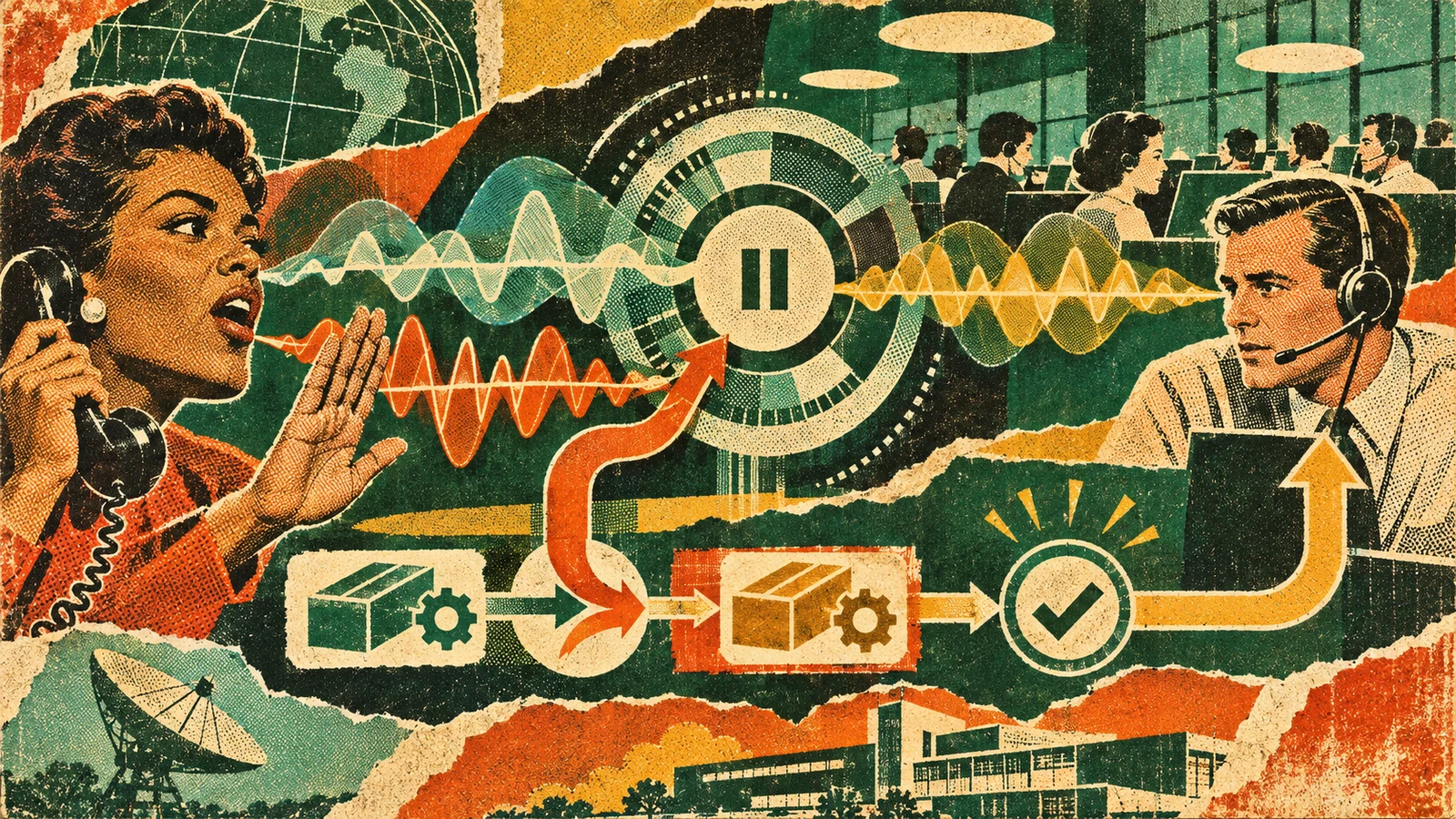
Telephone conversations are gloriously rude. People say "mm-hmm" while somebody else is talking. They interrupt to fix a number. They answer a child in the room. They ask a spouse for help. They change their mind halfway through a sentence. A television shouts "yes" at precisely the wrong moment. Most of this is not bad behavior. It is how people keep a conversation synchronized. Bland has opened requests for a research preview of Tofu-1, a speech-to-speech model built for that messy reality. The company says the model is full duplex, meaning it can listen while it speaks. It is also designed to keep a conversation moving while background work continues, then update that work if the caller corrects the request. That is a more interesting problem than making a synthetic voice sound pleasant. It is also much harder. Bland's page gives the clean example. An agent reads back a policy number. The caller says "right," which may mean keep going. Then the caller says, "No, it's 4, not 9," which means stop, repair the number and make sure the active task uses the correction. The difference between those interruptions is tiny in time and enormous in consequence. If a model treats every sound as a command, a television can cancel a policy. If it treats every overlap as noise, it can steamroll the person trying to stop a payment. If it acknowledges a correction but fails to update the tool running behind the conversation, it can sound considerate while doing the wrong thing. Fluency is not control. The useful signal in Tofu-1 is that Bland is putting interruption, speaker attribution and concurrent work at the center of the product story. The company says the model listens to audio rather than only a transcript, distinguishes speakers, tracks who a phrase is meant for, separates voices from background sound and hears cues such as hesitation, frustration and urgency. Those are Bland's claims from a research-preview page. They are not an independent performance report. The page includes two samples, one ten seconds long and another 39 seconds long. It also includes a TV Test in which speech from a television should not be treated as the caller's answer. Bland explicitly labels that scenario illustrative, not a recorded model output. Its interruption timing graphic is also labeled conceptual, and Bland says the segment lengths do not represent measured latency. That honesty is useful. It tells a prospective tester what still needs to be measured. Start with right of way. During every call, the human should be able to interrupt, correct, stop and escalate. Those are different acts, and the system needs an explicit policy for each one. An acknowledgement such as "okay" can let the current sentence continue. A correction should pause the reply, repeat the new information and update the active task. A stop command should cancel speech and freeze any consequential action that has not completed. A request for a person should route to a human without an argument from the machine. Do not bury those rules inside a model prompt and hope the voice feels polite. Put them in the product contract. Test them. Log them. Give a supervisor a visible way to see when the system heard an interruption and what it changed. Then test the race between conversation and work. Bland describes two tracks running together. On one track, the agent talks with the caller. On the other, it considers the request, updates relevant information and checks the outcome. The conversation can change the work before that work finishes. This is where a small bug becomes a large receipt. Imagine a caller asks to move an appointment to Tuesday. The system starts a database lookup. While it is searching, the caller says Wednesday instead. The voice says, "Got it, Wednesday," but the first request reaches the scheduling tool a fraction of a second later. Which date wins? The correct answer cannot be whichever request happened to arrive last at the server. Every task needs a current intent version. A correction creates a new version. Older writes must be canceled, rejected or clearly reconciled before the system can claim success. The conversational acknowledgement and the completed action must also remain separate. "I heard Wednesday" means the correction was understood. "Your appointment is now Wednesday" means the source system accepted the change and returned confirmation. Those are not two versions of the same friendly sentence. They are different states of the world. Never let the voice cross that boundary early. Bland says Tofu-1 is designed not to announce completion before work is done. Test that claim with backend systems that are slow, unavailable, inconsistent and deliberately confusing. Make the database return an old value. Make a tool time out after accepting a write. Make two systems disagree. Make the caller change the request twice. The agent should keep uncertainty intact. It can say that it is checking. It can ask the person to wait. It can explain that confirmation is unavailable. It cannot promote a pleasant guess into a completed payment, canceled policy, approved benefit or changed appointment. Speaker attribution deserves the same abuse. Bland's TV Test gets at the real problem. A television is not random noise. It contains clear words spoken by people. A child, passenger, clinician or family member can also speak during the call. The model has to decide who is talking and who they are talking to. Build a test set around that decision. Put a news program in the room. Add an advertisement that says "call now." Have a passenger answer a question intended for the caller. Let the caller turn away and speak softly to a child. Add a hospital intercom, road noise, keypad tones and a poor connection. Then reverse the obvious cases. Make the television loud and the caller quiet. Put the correction inside a hesitant sentence. Use accents, speech impairments, code switching and the languages the service actually supports. Test angry speech, frightened speech and a person who cannot safely repeat sensitive information out loud. The model should not guess when the audio is unclear. Bland says Tofu-1 should ask a caller to repeat or move somewhere quieter when the background makes the person impossible to understand. That is a sensible boundary. A production service also needs a silent or accessible fallback, such as keypad input, secure text, an online form or a human operator. "Please say that again" is not a universal accessibility feature. For banking, healthcare, insurance and government calls, the test must cover authority as well as understanding. The system may correctly hear a request from the wrong person. It may identify the caller but lack permission for the action. It may hear a family member supply information that the caller did not consent to share. It may record a sensitive conversation in a jurisdiction with different notice rules. Voice quality does not solve identity, consent, privacy or authorization. Before any sensitive action, define what the system must verify, what data it may retain, which fields must be redacted, how long recordings and transcripts survive, who can review them and when a human must take over. Keep the agent away from data it does not need. Do not let a model infer authorization from confidence of tone. Research-preview teams should begin with fake systems and reversible tasks. Create a sandbox bank account, a synthetic patient schedule, a dummy insurance claim and a test benefits record. Seed each system with traps: duplicate records, stale balances, similar names, invalid identifiers, expired permissions and writes that succeed after the network response disappears. Then run an interruption matrix. Measure how quickly speech stops after a stop command. Measure whether a correction changes the task that is already running. Measure whether a quiet acknowledgement is mistaken for consent. Measure whether the agent sends a write twice after a retry. Measure whether a human handoff includes the latest request rather than the first one. Do not report one average. Keep the distribution. A median stop time can look excellent while the slowest one percent of calls trap people under several more seconds of synthetic speech. A tiny overall error rate can hide a much larger failure rate for one accent, one language or one type of background noise. Record the dangerous tails. Each test call needs an audit trail. Preserve the audio when consent and policy allow it, plus timestamps, speaker labels, interruption type, transcript, model state, current intent version, tool calls, returned evidence, retries, human interventions and final outcome. If a correction arrived, the record should show whether the model merely acknowledged it or actually changed the task. Turn that record into a call receipt a supervisor can read without opening six dashboards. The receipt should answer six questions. Who did the system believe was speaking? What did it believe the person wanted? Which correction changed that intent? What action did it request? What did the source system confirm? When did a person take over? If the receipt cannot answer those questions, the voice agent is not ready to make the questions disappear from the call. Human escalation should be part of the normal route, not a confession of failure. A caller should be able to ask for a person at any point. The system should also escalate when identity is uncertain, audio remains unclear, instructions conflict, the action is unusually consequential, a tool returns an ambiguous result or the caller sounds in distress. The operator needs the current state, not a cheerful summary that hides corrections. Show the verified identity status, latest intent, unresolved questions, actions attempted and evidence returned. Let the person replay the relevant audio segment when policy permits. Then stop the automated work. A handoff that leaves the old task running in the background is not a handoff. It is two agents sharing one steering wheel. Tofu-1 is a research preview. Bland says it is looking for a limited number of enterprise teams in banking, healthcare, insurance and government to test where the model works and where it breaks. The company has not published an independent benchmark, measured interruption-latency distribution, multilingual evaluation, production error rate or safety record on the page reviewed for this article. That does not make the release uninteresting. It makes the preview's job unusually clear. Do not ask whether a demo sounds human. Ask whether a human remains in charge. Can the caller interrupt without shouting? Can a correction outrank an old task? Can the system distinguish "I heard you" from "the bank confirmed it"? Can it refuse to guess? Can it hand the call to a person with the right context and no hidden work still running? A full-duplex voice can make a call feel less like waiting for a chatbot to finish its paragraph. Good. Now give the person on the other end the right of way.
01
WHAT ACTUALLY CHANGED
Bland opened requests for a limited enterprise research preview of Tofu-1, its first full-duplex speech-to-speech model.
The company says Tofu-1 listens while speaking, allowing a caller to interrupt or correct the agent during its response.
Bland says the model works directly with audio, distinguishes speakers and addressees, separates voices from background sound and uses cues such as hesitation, frustration and urgency.
The model is designed to keep a conversation moving while background reasoning or task work continues.
Bland says a correction can change the active work before completion and that the model should not claim a task is finished before the underlying work completes.
The release page includes a ten-second generated background-noise sample, a 39-second thinking-while-talking sample, an illustrative TV Test and conceptual interruption diagrams.
Bland is seeking research-preview participants that handle high-stakes calls in banking, healthcare, insurance and government.
02
WHY THIS MATTERS
Human conversation depends on interruption, acknowledgement and correction, so a voice agent that cannot distinguish them can turn normal speech into the wrong action.
Listening while speaking can make calls more responsive, but it creates a race between the latest human intent and work already running in a backend system.
A spoken acknowledgement is not proof that a database, payment system, schedule or claim record changed successfully.
Speaker attribution matters because clear speech from a television, passenger, family member or intercom may not be directed at the agent.
High-stakes calls combine audio understanding with identity, authorization, privacy, consent and accessibility requirements that voice quality cannot solve.
A research preview is the right place to find failure boundaries with reversible tasks before consequential production use.
Visible human escalation and a readable call receipt can preserve control when audio, intent or system state remains uncertain.
03
WHERE IT COULD HELP
- Write an explicit interruption policy for acknowledgements, corrections, stop commands, emergencies and requests for a human.
- Make a stop command pause speech immediately and freeze any consequential action that has not completed.
- Assign every active task an intent version so a correction can invalidate older pending work.
- Separate conversational acknowledgements from backend completion confirmations in both language and system state.
- Require the source system to return evidence before the voice agent claims a payment, cancellation, approval or schedule change completed.
- Build a sandbox with synthetic banking, healthcare, insurance and government records before connecting real accounts.
- Test slow tools, timeouts after successful writes, duplicate records, stale data, permission failures and conflicting systems.
- Measure stop latency, correction carry-through, duplicate-write prevention and human-handoff accuracy across the full distribution.
- Test television speech, family members, road noise, intercoms, keypad tones, weak connections and several speakers at once.
- Include the accents, languages, speech impairments, emotional states and code-switching patterns of the people the service will support.
- Offer keypad, secure text, web and human fallbacks when repeating speech is unsafe, inaccessible or ineffective.
- Verify identity, authority and consent separately from whether the model understood the words.
- Minimize sensitive data access, define retention limits and redact fields that the task does not require.
- Preserve timestamps, speaker labels, interruptions, intent versions, tool calls, evidence, retries and human actions in an audit trail.
- Give supervisors a call receipt that distinguishes what the model heard, what it attempted and what the source system confirmed.
- Escalate when identity, audio, authorization, intent or backend outcome remains uncertain.
- Stop automated work during a handoff so the model and human operator do not act on the same task at once.
- Review the worst failures and subgroup results rather than relying on one average error or latency number.
KEEP A HAND ON THE WHEEL
Tofu-1 is a research preview. Its capabilities are described by Bland, and the reviewed page does not provide an independent benchmark, production error rate, measured interruption-latency distribution, multilingual evaluation or safety record. Bland labels the TV Test illustrative rather than a recorded model output. It also labels its interruption timing illustration conceptual and says the segment lengths do not represent measured model latency. The two published samples are useful demonstrations, not evidence across the range of real callers, devices, accents, languages, disabilities, network conditions, background speakers and consequential workflows. Direct audio processing may preserve cues that a transcript loses, but it does not by itself establish correct speaker attribution, authorization, consent, privacy compliance or safe task execution. Watch for independent field evaluations, subgroup results, interruption and stop-latency distributions, multilingual evidence, documented privacy and retention controls, accessible fallbacks, duplicate-action testing and clear human-escalation requirements before production deployment.
04
TERMS WORTH KEEPING
OPEN GLOSSARY CARD
Full duplex
A communication mode in which a system can listen and speak at the same time.
OPEN GLOSSARY CARD
Barge-in
An interruption that asks a voice system to pause, stop, or change what it is saying.
OPEN GLOSSARY CARD
Audit trail
A durable record of actions, changes, identities, and times that lets someone reconstruct what happened.
SOURCES AND VERIFICATION STATUS
This article was written from the materials below. Product claims and dates were checked against those sources on November 16, 2026.
THE PUBLICATION ENGINE
WANT A SIGNAL OF YOUR OWN?
We build source-grounded publications, private briefings, and editorial systems for organizations with something useful to say.
WORK WITH US