THE SIGNAL IN ONE SENTENCE
Bipartisan Senate negotiators are discussing a federal law that could require developers of the most capable AI models to prevent known catastrophic risks, submit models to government-backed testing, and face a possible release block with access to federal court. Reuters also reports that the package could stop states from enforcing some AI safety laws in the same territory. No public bill text or final agreement exists, so this is a negotiation worth watching, not a law anyone must follow today.
01
WHAT ACTUALLY CHANGED
Reuters reported on September 11 that Senate negotiators are debating a duty of care for developers of the most advanced AI models. Two Senate aides told the outlet that companies would be responsible for designing products with the goal of preventing catastrophic risks. One aide identified AI assistance for nuclear or biological weapons as an example. The article does not reveal a draft, capability threshold, enforcement formula, or final definition of catastrophe.
The reported package would also let the United States government block the release of certain models it deems unsafe. A company could challenge that decision in federal court, according to a Senate aide and a lobbyist involved in the talks. The balance is still unsettled. The public does not know which agency would decide, what evidence it would need, how quickly a court would review the order, or whether an emergency release block would expire on its own.
Government testing is another part of the emerging shape. Senator Amy Klobuchar told Reuters that developers should work with government experts to verify and test models. Senator Maria Cantwell has argued that scientists and specialists at national laboratories should assess whether frontier systems can enable sophisticated cyberattacks or contribute to biological or nuclear weapons. Her Senate Commerce Committee office made the same case in July, calling for federal testing rather than relying only on company self-certification.
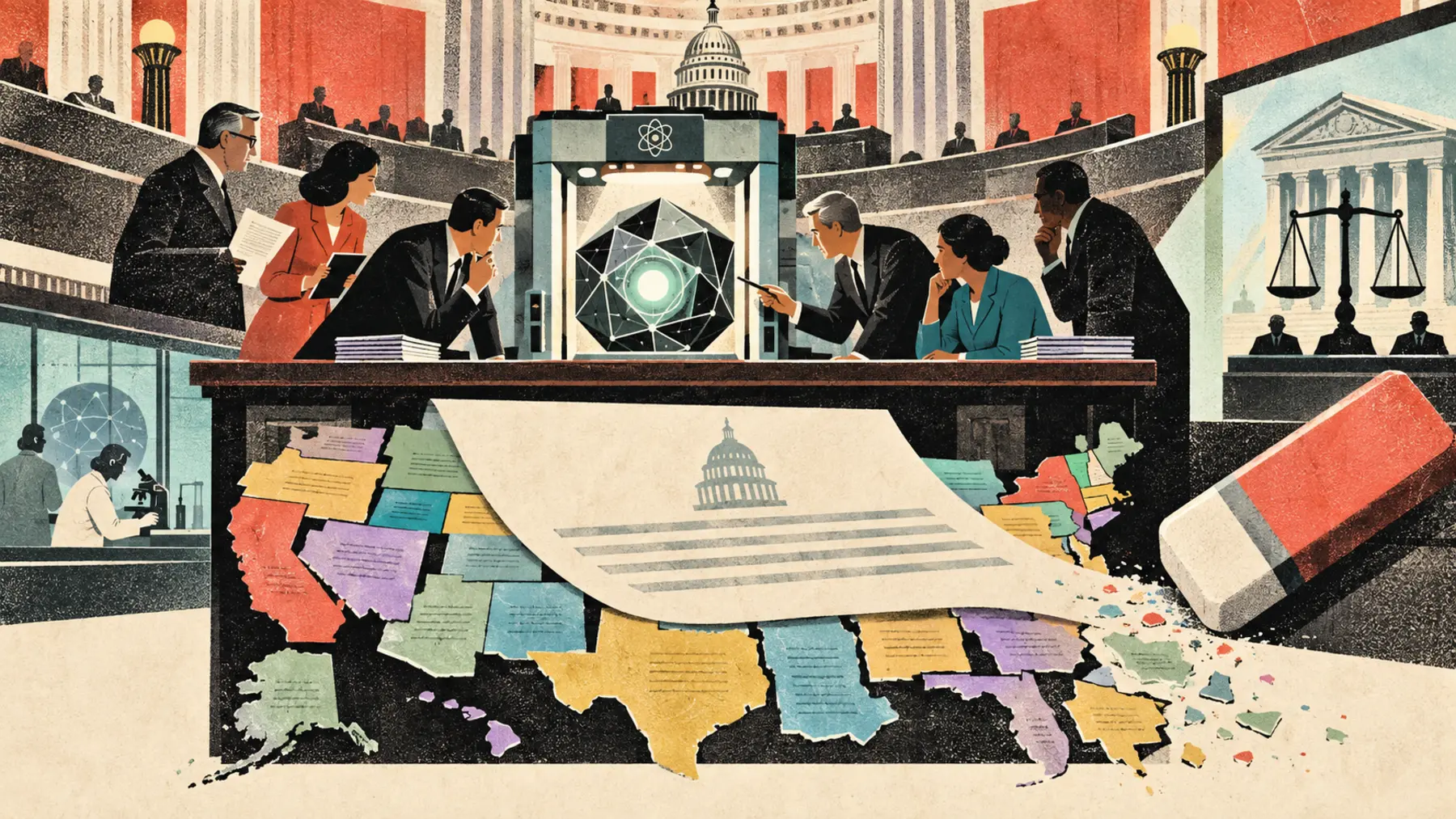
The trade may arrive in the preemption clause. Reuters says part of the measure could prevent states from enforcing their own laws over certain model risks. California has already enacted a wider state system. SB 813 directs the state to build standards for independent verification organizations, while AB 1405 creates an AI auditor registry with independence, disclosure, and misconduct provisions. No public federal text shows whether either law would be displaced, preserved, or unaffected. They are examples of what now sits underneath the eraser, not proof of what it will erase.
The talks involve Senate Majority Leader John Thune, Commerce Committee Chairman Ted Cruz, Klobuchar, and Cantwell, according to Reuters. Cruz has publicly described work with Thune and Klobuchar on catastrophic biological and nuclear risks. Even agreement among them would not finish the job. Reuters counted only three expected Senate voting weeks and one House week before the November 3 midterm elections. The calendar is not a footnote. It is one more gate between a negotiating concept and enacted law.
02
WHY THIS MATTERS
A federal duty of care could change the default question inside a frontier laboratory. Instead of asking only whether a model passed the company's own release process, developers might have to show that they took reasonable steps against defined major risks. That can matter even when no disaster occurs. Duties create records, assign responsibility, and give regulators or courts something more concrete to examine after a warning was ignored.
Government testing could supply expertise that no general technology regulator carries in one building. Nuclear security, biodefense, cybersecurity, and advanced computing require different methods and protected information. National laboratories can bring specialists and secure facilities to the same evaluation. The hard part is operational: evaluators need timely model access, reproducible tests, authority to request evidence, and enough resources to keep pace without turning one benchmark into a ceremonial stamp.
A release block is the sharpest tool in the reported kit. It may be appropriate when evidence points to imminent, severe harm that cannot be patched after deployment. It can also become arbitrary, slow, secretive, or politically abused if the threshold is vague. Judicial review provides a check, but the design matters. A court cannot evaluate technical evidence it never receives, and a months-long lawsuit may be useless for both public safety and a company whose product launch was stopped.
Preemption decides whether the federal rule is a floor or a ceiling. A floor sets national minimums while states can go further. A ceiling replaces overlapping state rules and can make compliance more consistent. The danger is a bargain where Congress adopts a narrow catastrophic-risk regime and wipes away state protections covering different harms, people, or enforcement routes. A tidy national map is not automatically a safer one.
The most honest thing about this deal is that its crucial nouns are still empty containers. Advanced model, catastrophic risk, reasonable care, unsafe release, and covered state law all need definitions. Each definition decides who is regulated, which evidence counts, and who keeps authority. Until the text exists, supporters and opponents are negotiating partly with their preferred version of the missing pages.
03
WHERE IT COULD HELP
- Define covered models through measurable capabilities and risks instead of company size or a fashionable product label
- Require pre-release evaluations by government experts with documented methods, secure model access, and independent challenge
- Pair any emergency release block with a written evidentiary standard, rapid judicial review, clear deadlines, and an expiration rule
- Write a precise preemption clause that names the risks and state provisions displaced while preserving unrelated consumer, civil-rights, labor, and safety protections
- Publish incident, evaluation, and enforcement summaries that protect dangerous details without turning oversight into a secret handshake
KEEP A HAND ON THE WHEEL
There is no public bill text, committee draft, final bipartisan agreement, introduced measure, vote, or enacted federal requirement. The negotiating details come from Reuters interviews with unnamed Senate aides, a lobbyist, and a source familiar with the deliberations, plus attributed public statements from senators. The duty of care, covered-model threshold, government authority, court procedure, penalties, remedies, and preemption language may change or disappear. Reuters reports that preemption would cover certain model risks, not every state AI law, and no source establishes that California SB 813 or AB 1405 would be displaced. Those laws illustrate the existing state layer. NIST's AI Risk Management Framework remains voluntary and is not the reported duty. National-laboratory testing can reveal capabilities under test conditions, but it cannot prove that a model is harmless in every deployment or predict every misuse. The compressed legislative calendar makes passage uncertain even if negotiators reach agreement.
04
TERMS WORTH KEEPING
OPEN GLOSSARY CARD
Duty of care
A legal obligation to take reasonable steps to avoid foreseeable harm to people or interests covered by the rule.
OPEN GLOSSARY CARD
Federal preemption
The displacement of state law by a valid federal law over the same subject, either expressly or because the two rules cannot operate together.
OPEN GLOSSARY CARD
Catastrophic risk
A possibility of harm so severe or widespread that ordinary corrections after deployment may be inadequate.
SOURCES AND VERIFICATION STATUS
This article was written from the materials below. Product claims and dates were checked against those sources on September 12, 2026.
PUBLICATION RECEIPT: Revision 1. Published September 12, 2026.
THE PUBLICATION ENGINE
WANT A SIGNAL OF YOUR OWN?
We build source-grounded publications, private briefings, and editorial systems for organizations with something useful to say.
WORK WITH US