THE SIGNAL IN ONE SENTENCE
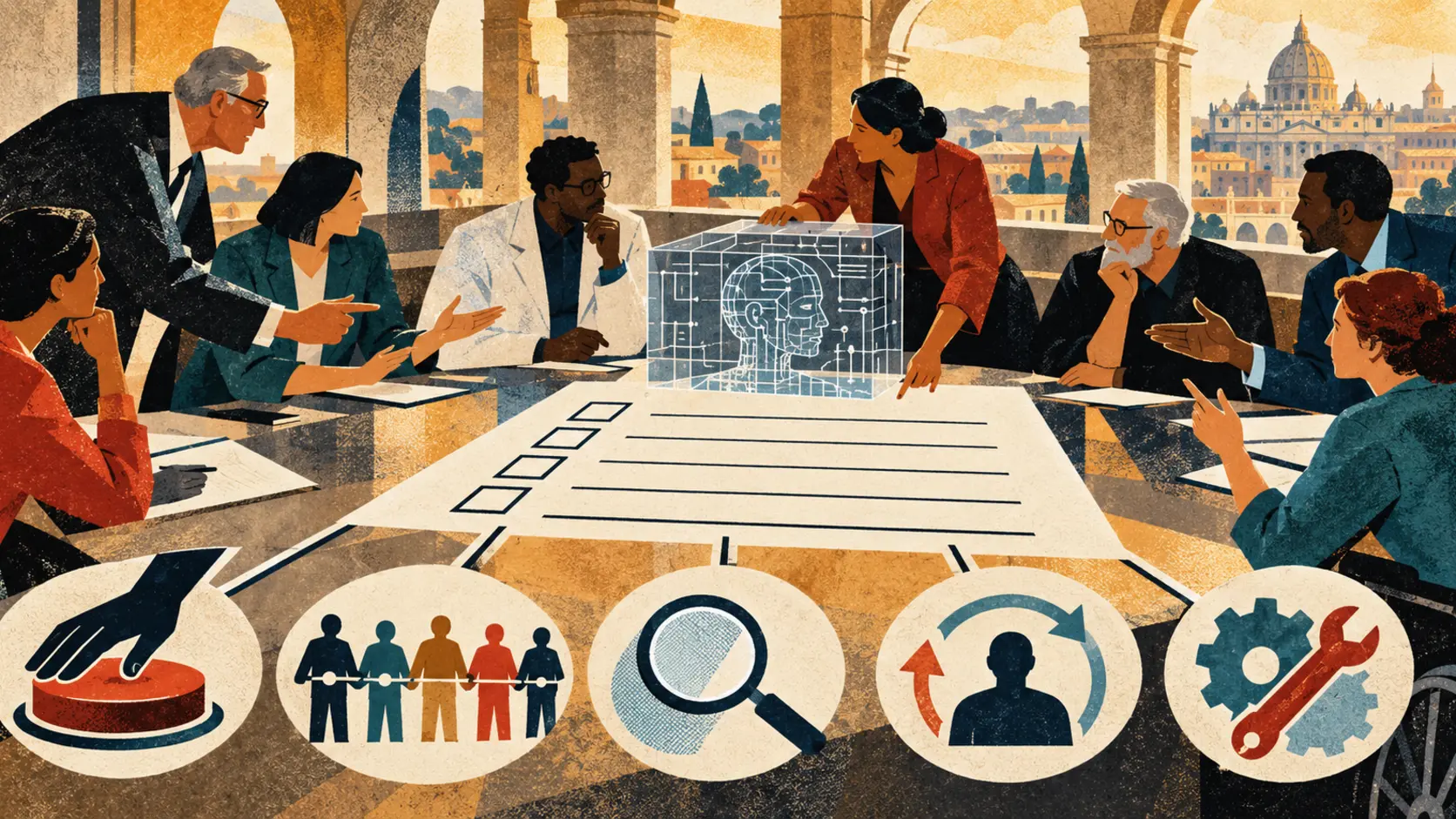
Ethical principles have a recurring workplace problem. Everybody nods. Then the meeting ends and the software ships. On October 30, the Pontifical Academy for Life and the Future of Life Institute convened international AI researchers, governance specialists and Vatican representatives at the Casina Pio IV in Vatican City. The meeting was called The Future of AI: A Dialogue Between the Vatican and the Scientific World on the Developments and Applications of Intelligent Technologies. The official account says the discussion centered on meaningful human control, safety, reliability, identifiable human responsibility, verification, governance, work, freedom, concentrated technological power, inequality and human dignity. Participants also met Pope Leo XIV at the Apostolic Palace. This was not a technical standards meeting wearing a nicer jacket. The Pontifical Academy for Life says the participants presented a plurality of views, not a common position. The event produced questions, arguments and institutional priorities. It did not produce a binding rulebook, law, benchmark or certification. That distinction matters. The event is worth covering precisely because the official materials do not pretend that one room solved AI governance. Instead, they keep returning to the same practical problem. How does a principle become something people can test? Pope Leo XIV organized his address around five considerations. First, the future of AI is shaped by human choices. People can guide, change and reject applications. Second, machines are tools, not persons. Giving a system a human-like legal or moral identity can blur the responsibility of the people and institutions behind it. Third, some decisions must never be delegated. The address specifically points to decisions involving human life, freedom and force, which must remain under effective, informed and responsible human oversight. Fourth, intelligent technologies should serve the common good, with access to benefits rather than concentration among a privileged few. Fifth, familiar principles need institutions that can put them into practice through shared standards, independent oversight, clear accountability, challenge and remedies. That final point is the hinge. We do not have a shortage of AI ethics posters. We have a shortage of evidence showing that a real person can interrupt a real system before a real harm becomes an automated shrug. The useful artifact is an AI human-control verification sheet. Not a manifesto. Not a values page with pleasant verbs. A sheet that travels with each system and forces the operator to show its work. Start with the decision. Write down what the system actually changes in a person's life. Does it rank a job applicant? Flag a traveler? Recommend a medical follow-up? Decide which benefits case receives extra scrutiny? Aim a weapon? Draft a classroom assessment? Optimize a worker's schedule? If the answer is only that the system provides insights, keep going until the sentence contains a decision, a person and a consequence. Insights do not remain decorative for long. The next box is purpose. What public or organizational goal is the system supposed to serve? What is it forbidden to optimize? What tradeoffs are unacceptable even if performance improves? A hiring tool can be asked to reduce review time without being allowed to narrow the workforce to people who resemble past hires. A hospital tool can help prioritize records without being allowed to silently turn missing data into lower urgency. A border system can assist document review without being allowed to convert uncertainty into suspicion. The purpose box should be narrow enough that a reviewer can recognize mission creep. Then name the accountable human. Not the team. Not governance. Not the vendor. Name a role with authority to inspect the evidence, pause the system, order a correction and answer to the people affected. The person does not need to perform every review personally. The institution does need a clear chain of responsibility. If the named person can apologize but cannot stop the system, that is public relations, not control. The verification sheet should record the model, version, data sources, evaluation date, deployment environment and intended population. It should also list what has not been tested. That second list is often more useful. Which languages are missing? Which disabilities? Which age groups? Which local conditions? Which rare events? Which failure modes? Which kinds of people were represented only by a handful of examples? A system can perform well on average and still fail exactly where a person most needs an institution to notice them. Now test human control as a capability rather than a promise. Can the reviewer see the relevant inputs? Can the reviewer understand why the case was escalated? Can the reviewer change the result? Can the reviewer stop a batch that is already running? Can the organization disable one feature without taking down an essential service? Can the prior version be restored? How long does each action take? Run the test. Record the date, operator, result and failure. A stop button that works only during a scheduled demonstration is a stage prop. The affected person needs a box too. What notice do they receive? Can they refuse automated processing where the context allows it? Is a non-automated path available? Can they challenge the result? Who reviews the appeal? How quickly? Can that reviewer see evidence the first system did not? What happens while the appeal is pending? A challenge process is not meaningful if the same automated score is simply returned with a different font. Accessibility belongs inside this process. Notice, refusal and appeal should work across language, disability, literacy, device access and time constraints. If the only route is a tiny web form available during a short window, the institution has designed a right that many people cannot use. Independent oversight needs evidence of independence. Who selects the reviewer? Who pays them? Can they inspect logs, data lineage and evaluation methods? Can they publish criticism? Can they require a pause? Does the operator have to respond publicly or only acknowledge receipt? Independence is not a label attached to the same reporting chain. The sheet should include a labor-impact row. AI systems do not merely produce outputs. They redistribute attention, discretion, monitoring and blame. Which workers gain authority? Which workers lose it? Who must correct the system's mistakes? Is that correction work measured and paid? Does automation create a quota that makes human review impossible in practice? Can a worker refuse an unsafe recommendation without being penalized by another metric? Human control disappears quickly when the person holding it is given twelve seconds per case. Distribution matters too. Who receives the benefit? Who carries the error? Who supplies the data? Who can leave? Who has no realistic alternative? The Vatican materials frame AI in relation to the common good and inequality. A verification sheet can make that frame inspectable by requiring outcome measures across groups, regions and access conditions. Do not bury those results inside one global accuracy number. Remedy is the row most ethics documents politely wave at. If harm occurs, what can the institution actually repair? Can it correct a record? Restore a benefit? Reopen a decision? Notify downstream systems? Compensate a person? Delete an invalid inference? Explain the incident? Prevent repetition? The official address calls for decisions to be examined, challenged and accompanied by appropriate remedies. That means the operator needs an incident path before launch, not after someone becomes a cautionary anecdote. The verification sheet should finish with stop conditions. What evidence would block deployment? What error rate triggers a pause? What kind of incident requires immediate shutdown? What change in model, data, vendor, law or population forces reapproval? Who can invoke the stop condition? Who cannot overrule it? When will the system be reviewed again? These thresholds should be set before the results arrive. Otherwise every failure becomes an invitation to invent a friendlier denominator. This structure works differently across domains. For a classroom writing assistant, human control may mean a teacher can inspect sources, correct feedback, protect student data and offer an equivalent non-AI route. For an employment system, it may mean an applicant receives notice, a trained reviewer can reverse the recommendation, correction work is tracked and protected groups are evaluated separately. For healthcare, it may mean clinicians can inspect the underlying record, uncertainty is visible, recommendations are advisory, overrides are frictionless and incidents reach clinical governance. For border control or the use of force, the threshold is far higher. The papal address argues that decisions affecting life, freedom and force must remain under effective, informed and responsible human oversight. It also calls for concrete steps toward banning lethal autonomous weapons. A verification sheet cannot make an unacceptable use acceptable. Sometimes the correct result of verification is no. That is an important feature. The sheet should not score every system into eventual approval. It should expose uses that cannot provide meaningful control, legitimate purpose, independent challenge or adequate remedy. The official materials do not settle the technical definitions behind these ideas. They do not specify how much explanation is enough, how independent oversight should be funded, which uses should be prohibited in law, or what remedies fit each harm. The Academy explicitly records disagreement. That is not a weakness in the source. It is a warning against turning moral language into fake consensus. The verification sheet makes disagreement useful. One group can argue that a system has enough human control. Another can point to the failed stop test. One institution can claim that an appeal exists. An accessibility audit can show who cannot use it. A vendor can cite average accuracy. A local evaluation can show where the errors land. The conversation moves from whether everyone supports dignity to whether a named person can challenge a particular decision and obtain a remedy. That is a much less comfortable conversation. Good. Comfort is how principles become wallpaper. The Vatican dialogue put human control, responsibility and dignity on the same table as safety, verification and governance. The next move belongs to institutions deploying the technology. Name the decision. Name the person affected. Name the accountable human. Show the evidence. Run the stop test. Open the challenge path. Fund independent review. Prepare the remedy. Write down what makes the answer no. That is how a principle starts behaving like a safeguard.
01
WHAT ACTUALLY CHANGED
The Pontifical Academy for Life and the Future of Life Institute convened an international AI dialogue in Vatican City on October 30
The official record centers meaningful human control, safety, reliability, identifiable responsibility, verification, governance, work, inequality and dignity
Pope Leo XIV called for shared standards, independent oversight, clear accountability, challenge mechanisms and remedies for harm
The papal address says decisions involving human life, freedom and force must remain under effective, informed and responsible human oversight
The Academy describes the participants as offering a plurality of views rather than adopting one common position
02
WHY THIS MATTERS
Broad ethical principles are easy to endorse and difficult to verify inside a deployed system
Human control is meaningful only when a person has information, authority, time and a tested way to change or stop an outcome
Naming an accountable role prevents vendors, institutions and automated systems from passing responsibility in a circle
Appeals, independent oversight and remedies turn governance from a promise into a process people can actually use
A verification sheet preserves disagreement by making competing claims testable rather than pretending that one meeting produced consensus
03
WHERE IT COULD HELP
- Require a human-control verification sheet before public agencies procure or renew an AI system
- Test stop, override, rollback and incident-response controls during deployment reviews
- Document notice, refusal, accessible alternatives, appeals and remedies for people affected by automated decisions
- Evaluate outcomes separately across languages, disabilities, regions and groups rather than relying on one average score
- Audit whether workers have enough time, authority and protection to exercise meaningful review
- Set predeployment stop conditions and reapproval triggers for model, data, vendor, legal or population changes
KEEP A HAND ON THE WHEEL
Watch for a published participant record, technical follow-up, shared definitions of meaningful human control, independent oversight models, verification methods, concrete institutional commitments, lethal autonomous weapons negotiations in Geneva, procurement rules, appeal standards, accessibility requirements, worker protections, public incident reporting, enforceable remedies and evidence that any organization applies these principles to a system people already encounter.
04
TERMS WORTH KEEPING
SOURCES AND VERIFICATION STATUS
This article was written from the materials below. Product claims and dates were checked against those sources on October 31, 2026.
THE PUBLICATION ENGINE
WANT A SIGNAL OF YOUR OWN?
We build source-grounded publications, private briefings, and editorial systems for organizations with something useful to say.
WORK WITH US