THE SIGNAL IN ONE SENTENCE
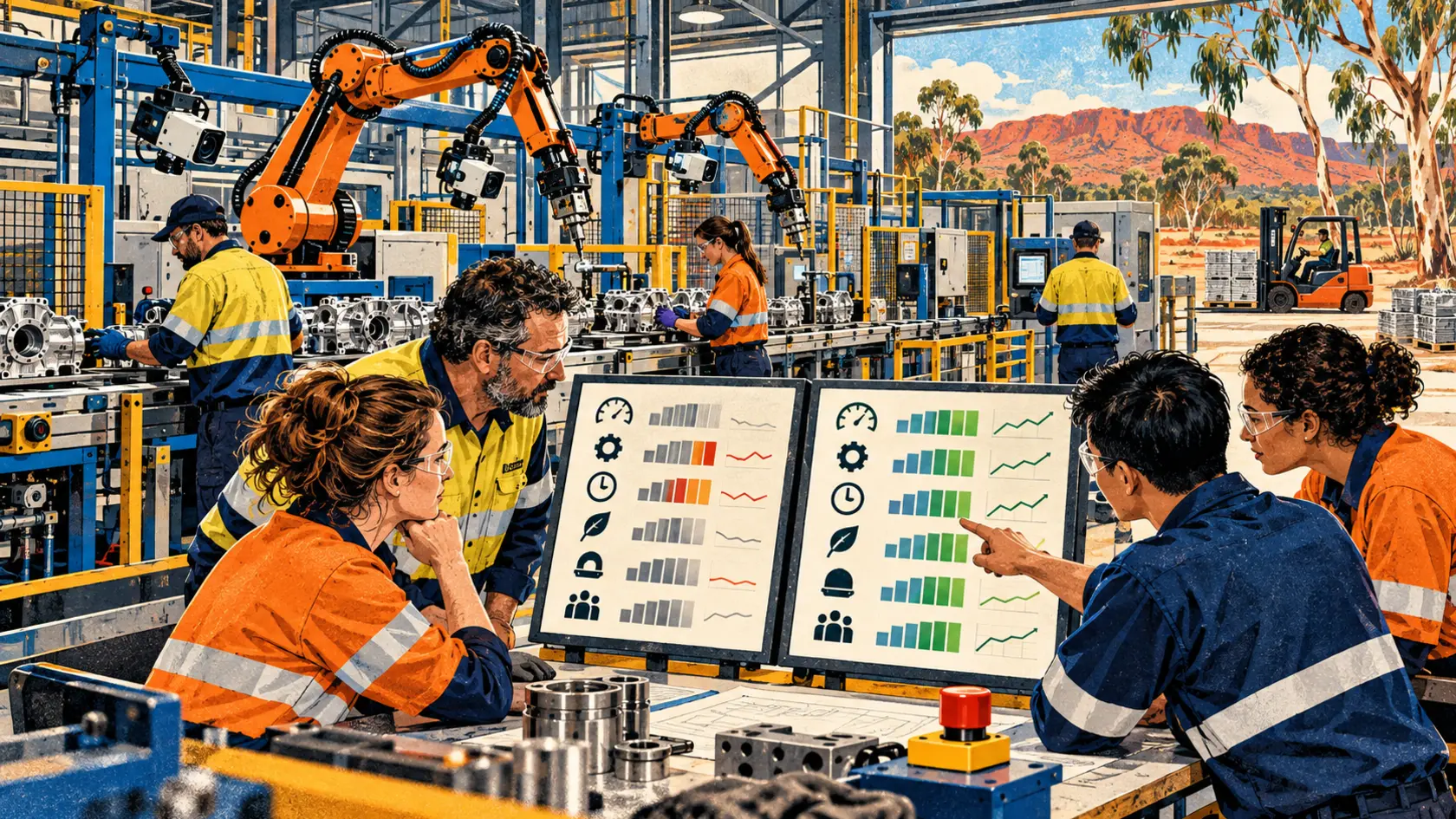
A factory does not care whether a model gives an impressive demo. It cares whether the line keeps moving. On October 13, Australian Industry and Innovation Minister Tim Ayres used a national policy forum in Canberra to make the case for industrial artificial intelligence. He described it as AI applied to physical work, production processes and a company's own operational data. That definition is useful because it drags AI out of the chat window and onto the factory floor. Industrial AI can watch machine vibration, inspect parts with cameras, predict maintenance, help schedule production, coordinate logistics or guide a robot through work that changes from item to item. It deals with steel, heat, weight, timing, tolerances and the inconvenient fact that a mistake may become a broken machine rather than an awkward paragraph. Ayres pointed to Brisbane's ARM Hub, one of Australia's AI Adopt Centres. He said it had worked with more than 300 small and medium firms over eighteen months, from Echuca in Victoria to Gladstone in Queensland. The government plans to launch a A$50 million AI Accelerator through the Cooperative Research Centres program in early 2027, with decisions from a smaller funding round expected before then. The policy goal is not merely more Australian AI research. It is to turn research into deployed systems, productive businesses and good jobs. The plain signal is that productivity must be measured before the machine is switched on. Otherwise, every pilot can declare victory. A camera finds defects faster, but workers spend two hours investigating false alarms. A scheduling model increases output, but the line consumes more energy and maintenance failures move to the night shift. A robot shortens one task, but a new bottleneck appears at packing. A predictive system reduces downtime, but experienced technicians lose the time and authority to challenge it. All of those projects can produce a handsome slide titled productivity. Only a baseline can show what changed. Before deployment, record the current system for long enough to capture ordinary variation. Measure output per shift, good units, scrap, rework, unplanned downtime, planned maintenance, energy, water, material use, delivery performance and total cost. Record injuries, near misses, overtime, staffing, wages, training time and the amount of work pushed onto contractors. The period matters. A factory may run differently on Monday morning, during a heat wave, at the end of a maintenance cycle or when a large order arrives. Comparing one unusually bad week before AI with one unusually good week after it is not evaluation. It is a magic trick with a calendar. Use a representative window. Note seasonal demand, equipment changes, staffing changes and other investments. Keep the raw definitions stable. Then define productivity. More units per hour may be useful. It may also hide a growing pile of defective parts. Fewer worker hours per unit may reflect better tools, or it may reflect unpaid troubleshooting after the shift. Lower downtime may look wonderful until deferred maintenance sends a machine into a longer failure three months later. Publish a balanced set of measures rather than one convenient number. Throughput belongs beside first-pass yield. Speed belongs beside safety. Labour savings belong beside wages, staffing, workload and training. Energy per unit belongs beside total energy. Maintenance predictions belong beside avoided failures, false alarms and missed failures. The comparison needs a denominator too. If a company says an AI system cut defects by 30 percent, readers should know whether defects fell from one hundred to seventy or from ten to seven. If downtime dropped, report hours, causes and production volume. If a pilot saved money, count sensors, integration, data cleaning, model fees, secure infrastructure, retraining, maintenance and the staff time required to keep the system honest. Industrial AI is not a software subscription dropped from the sky. ARM Hub's current guide makes the physical-data problem plain. A model cannot detect a change in vibration, sound, heat or force unless the right sensor exists, the signal is recorded and the data reflects the actual machine and process. A system trained on another plant's equipment may carry assumptions that do not survive contact with an Australian workshop. That makes the data sheet part of the productivity sheet. For each deployment, name the machines, product types, shifts and operating conditions represented in the training and evaluation data. Record missing sensors, data gaps and changes in equipment. Separate model confidence from the quality of the physical signal underneath it. When a sensor drifts, the AI can become precisely wrong. Worker knowledge belongs in the baseline as well. An experienced operator may hear a bearing change before a dashboard does. A technician may know that a temperature spike is normal after a particular cleaning cycle. A line worker may see that a camera is rejecting good parts because glare changed at sunset. Treat that knowledge as operational evidence, not resistance to innovation. Workers should help choose the problem, define the measures and test the system. They need a clear way to flag false alarms, correct labels, stop unsafe action and document local conditions. If a system affects pace, scheduling, surveillance, performance assessment or staffing, consultation must happen before deployment, not after the first grievance. Human control should be measurable. Report how often workers overrode a recommendation, how long approval took, whether an override was later judged correct and whether the person faced pressure for using it. Record occasions when the system was unavailable and whether the process could continue safely without it. A red stop button is not worker control if pressing it ends a career. The same rule applies to safety. Manufacturing systems can move, cut, heat, lift and apply force. An AI recommendation may change a robot path, inspection threshold, maintenance interval or production sequence. Every system needs a defined safe state, bounded permissions, isolation from unrelated equipment and a tested manual fallback. Do not evaluate safety solely by counting injuries after deployment. Serious events are rare, thankfully. Track near misses, unsafe commands, emergency stops, unexpected robot movement, sensor failures and cases in which a human caught a dangerous recommendation before execution. Near misses are free warnings. Waste them and the invoice may arrive later. Public funding creates a public evidence obligation. The planned A$50 million accelerator and the smaller CRC project pool are intended to help move ideas into commercial use. That can be worthwhile. Smaller manufacturers often cannot hire a full data, robotics and safety team for one experiment. But grants should buy reusable knowledge as well as private advantage. Require every publicly supported project to publish a compact before-and-after card. It can protect commercial secrets while reporting the problem, baseline period, deployment cost, measures, results, failures, worker involvement and whether the system remained in use six and twelve months later. Publish failed projects too. A project that discovers dirty data, unreliable sensors, poor economics or an unsolved safety problem may save ten other factories from repeating the mistake. Failure hidden inside a confidential final report teaches only the people who already paid for it. The government should also separate adoption from outcomes. The number of firms attending workshops, receiving advice or starting pilots shows reach. It does not show productivity. The number of models deployed shows activity. It does not show that output improved, jobs became better or national capability grew. Use a ladder. At the first rung, a firm completes an assessment. At the second, it prepares data and defines a problem. At the third, it tests a prototype. At the fourth, it deploys in production. At the fifth, the system remains in service and produces verified gains. At the sixth, the firm can maintain, modify or replace it without permanent dependence on one vendor. Report how many firms reach each rung and how long it takes. That final rung matters for Australian capability. A local project can still create foreign dependence if the model, cloud service, sensors, robot controls and maintenance tools cannot be changed or exported. Before a grant-funded deployment begins, require an exit plan. State who owns the data, code, configurations and model outputs. Test whether the company can retrieve its records and continue operating when a supplier changes terms or disappears. Local capability is not a sticker on the machine. It is the ability to understand, maintain and change the system. Ayres also connected industrial AI with good jobs. That promise needs its own ledger. Count roles created, removed and redesigned. Track wages, classifications, apprenticeships, contractor use, training hours and who receives the training. Ask whether workers gained decision-making authority or merely inherited another queue of alerts. Report whether productivity gains were shared through better pay, safer work, shorter hours or investment in new capacity. Do not assume that a more productive factory automatically produces a better job. Management choices sit between the two. Australia's industrial AI push could solve real problems. Predictive maintenance can catch gradual changes that people cannot monitor around the clock. Vision systems can inspect repetitive details. Better scheduling can reduce idle equipment and wasted material. Robotics can move people away from hazardous tasks. The evidence will be stronger when each claim comes with the old number, the new number and the cost of moving between them. That is the productivity baseline. Record the factory as it is. Define the outcome before buying the system. Let workers shape the measures. Count hidden costs, safety events and failed trials. Recheck the result after the pilot team has left. Then, if the line runs better, Australia can say so without squinting at a demo.
01
WHAT ACTUALLY CHANGED
Australia's industry minister used the October 13 National Innovation Policy Forum to argue for broader industrial AI adoption
The speech defined industrial AI as AI applied to physical work, production processes and firms' operational data
The minister said ARM Hub had worked with more than 300 small and medium firms over eighteen months
ARM Hub is one of Australia's national AI Adopt Centres and focuses on manufacturing, robotics and physical systems
The government plans to launch a A$50 million AI Accelerator through the Cooperative Research Centres program in early 2027
Outcomes from a smaller CRC Projects AI Accelerator funding pool are expected before that launch
The policy argument connects AI diffusion with industrial investment, productivity and good jobs
The speech did not announce a new factory deployment or measured productivity result
02
WHY THIS MATTERS
Industrial AI acts on physical systems where mistakes can damage equipment or harm people
Smaller manufacturers may lack the staff and capital to test complex systems independently
A productivity claim can hide defects, rework, energy use, maintenance debt or extra human labour
Physical models depend on sensors and local operating data that may not transfer between factories
Experienced workers hold context that automated systems may not capture
Public funding can create reusable evidence instead of isolated private case studies
Adoption counts do not prove lasting deployment or verified gains
Vendor dependence can undermine the goal of building Australian industrial capability
Productivity gains become good jobs only through choices about wages, safety, training and worker control
03
WHERE IT COULD HELP
- Record throughput, yield, scrap, rework, downtime and delivery performance before deployment
- Measure energy, water and material use per good unit and in total
- Track injuries, near misses, overtime, staffing, wages and training time
- Use a representative baseline period and document seasonal or equipment changes
- Count sensors, integration, data cleaning, model fees, maintenance and staff time
- Document the machines, products, shifts and conditions represented in the data
- Give workers a protected way to correct labels, reject recommendations and stop unsafe action
- Report overrides, emergency stops, unsafe commands and recovery from system failure
- Publish before-and-after cards for publicly funded projects, including failures
- Track firms from assessment through production deployment and twelve-month retention
- Require data ownership, portability and vendor-exit plans before funding
- Report how gains affect roles, wages, apprenticeships, contractors and worker authority
KEEP A HAND ON THE WHEEL
The October 13 source is a ministerial policy speech, not a new deployment result. The minister described ARM Hub activity and a planned A$50 million accelerator, but the speech does not provide a project list, adoption timetable, evaluation design or measured factory-level productivity impact. ARM Hub publishes practical guidance and program information, but provider case studies and promotional claims still require independent baselines and follow-up. Watch for funding decisions, project-level measures, worker consultation and results that remain after pilots end.
04
TERMS WORTH KEEPING
SOURCES AND VERIFICATION STATUS
This article was written from the materials below. Product claims and dates were checked against those sources on October 13, 2026.
PUBLICATION RECEIPT: The article treats the ministerial address as a policy argument, separates announced funding plans from deployed results and labels the proposed baseline and worker safeguards as analysis.
THE PUBLICATION ENGINE
WANT A SIGNAL OF YOUR OWN?
We build source-grounded publications, private briefings, and editorial systems for organizations with something useful to say.
WORK WITH US