THE SIGNAL IN ONE SENTENCE
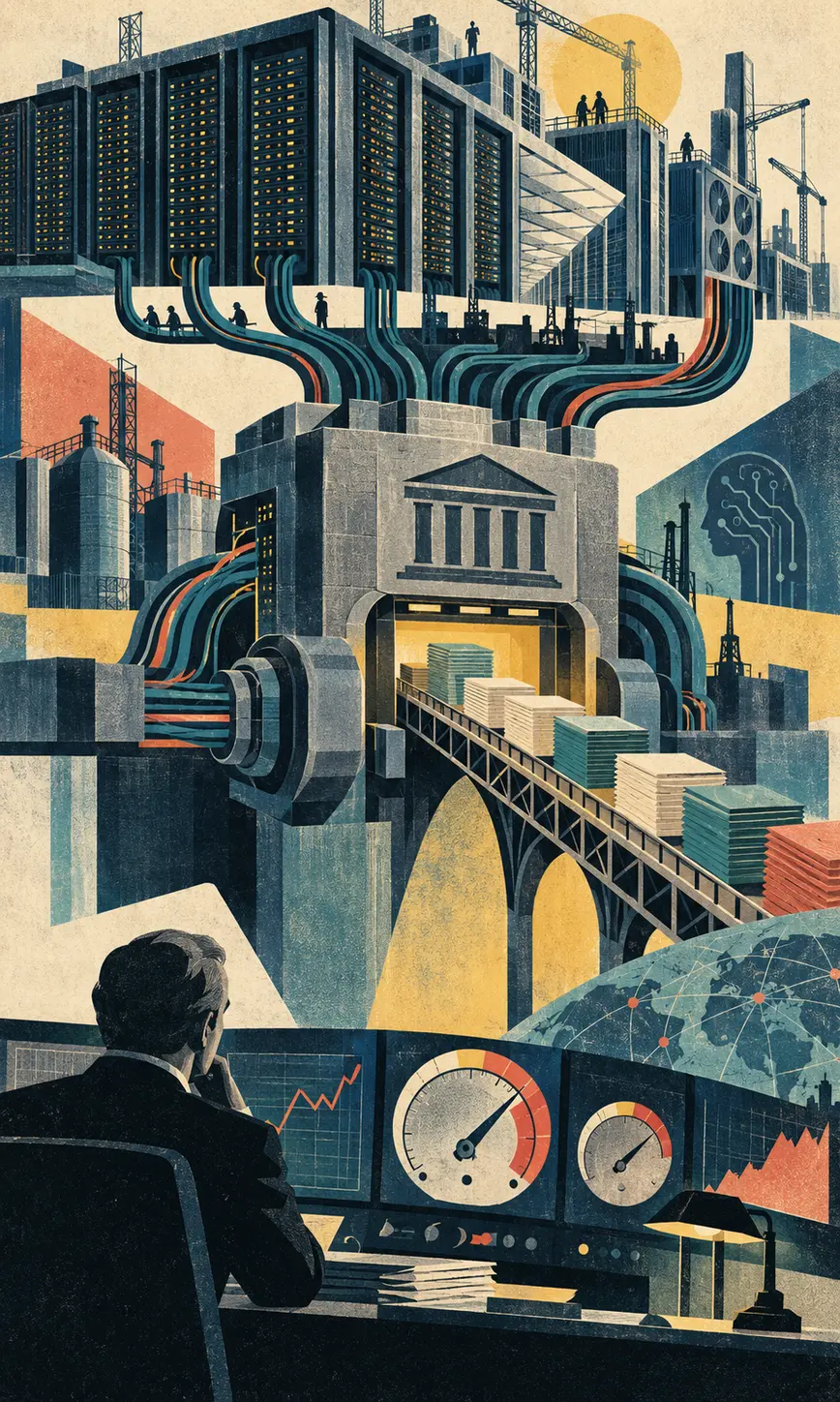
The institution that coordinates central banks says the AI building spree has become big enough to affect the wider economy. The concern is not simply high spending. It is the combination of concentrated investment, expensive expectations, and financing that can be difficult to see.
01
WHAT ACTUALLY CHANGED
Pablo Hernández de Cos, general manager of the Bank for International Settlements, put the AI infrastructure boom squarely on the central-bank agenda on September 10. Reuters reported his remarks from a conference in India, where he said AI is already influencing demand, supply, trade, labor, and financial markets at the same time. That combination makes the economy harder for monetary policymakers to read.
The scale explains the attention. The BIS estimates that the five largest global technology companies will invest more than $1 trillion in AI across 2025 and 2026. Reuters separately described industry forecasts that put worldwide AI investment at roughly $500 billion now and possibly $3 trillion to $4 trillion by 2030. The first number is a BIS estimate. The larger 2030 range is an industry forecast, not a BIS promise or a completed pile of servers.
The financing is changing too. Hernández de Cos said capital spending is moving beyond what companies can comfortably cover from earnings and is increasingly drawing on debt and private credit. He described parts of that financing as opaque and interconnected. In plain English, the money can travel through lenders, funds, chipmakers, cloud operators, and customers in arrangements that are harder to value than a normal bond sitting in daylight.
None of this means the technology is imaginary. Hernández de Cos pointed to studies reporting productivity improvements of 10 percent to 65 percent on specific tasks, especially coding, consulting, and professional writing. He said current estimates suggest AI could add roughly half a percentage point a year to total factor productivity growth, depending on adoption and how effectively workers and capital move into new uses.
That is exactly why the signal is awkward. A technology can be useful and still be financed badly. Railways connected cities and left wrecked investors. The internet reorganized commerce and survived the dotcom crash. A productive machine does not guarantee that every data center, bond, forecast, or share price built around it will earn the return printed in the spreadsheet.
02
WHY THIS MATTERS
Central banks do not set model prices or approve server purchases. They do care when one investment cycle becomes large enough to change economic growth, borrowing costs, asset prices, and inflation. A giant data-center buildout can raise demand for construction, power, chips, cooling equipment, and skilled labor long before the promised productivity appears in official statistics.
Concentration turns a company story into a system story. When a small group of hyperscalers accounts for a large share of investment and market value, the same earnings disappointment can hit stock indexes, suppliers, lenders, household portfolios, and business confidence at once. The danger is not merely that one ambitious campus earns less than expected. It is that many balance sheets may be leaning on the same forecast.
Private credit makes the map fuzzier. These loans are negotiated outside public bond markets and often disclose less about borrowers, collateral, pricing, and links to banks. That does not make every private loan reckless. It does mean supervisors may discover a concentration only after several funds and banks try to reduce exposure to the same asset at the same time.
The labor side matters to monetary policy as well. Hernández de Cos said job losses remain limited but signs are appearing in customer service, programming, and administrative work. If AI improves output while displacing routine cognitive tasks, economists must estimate how quickly workers move, how wages respond, and whether productivity gains spread beyond a narrow set of firms. Interest-rate decisions are difficult when the speed limit of the economy is moving under the car.
The practical response is not to call the boom a bubble and go home pleased with the metaphor. Supervisors need a better map of who is lending, what backs the loans, which revenue assumptions repeat across deals, and how a correction would travel. Companies need to show utilization, contracted demand, refinancing schedules, and cash returns instead of presenting capital expenditure as proof of future profit.
03
WHERE IT COULD HELP
- Map bank, bond, and private-credit exposure to AI infrastructure projects
- Stress-test loans against lower utilization, delayed power delivery, and weaker model revenue
- Separate announced capital spending from completed assets and cash-generating capacity
- Track concentration across hyperscalers, chip suppliers, cloud customers, lenders, and household portfolios
- Improve economic measures for AI investment, imported hardware, productivity, wages, and job transitions
KEEP A HAND ON THE WHEEL
These are risk scenarios, not a BIS prediction that the AI investment boom must crash. The official speech or conference transcript was not publicly available when this article was verified, so the remarks and numerical estimates are attributed to Reuters reporting from September 10. The $3 trillion to $4 trillion figure for 2030 is an industry forecast, not a BIS estimate. Task-level productivity results do not automatically become economy-wide gains. Debt and private credit are financing tools, not evidence of distress by themselves. The systemic risk depends on leverage, concentration, collateral, interconnections, refinancing needs, and whether projected revenue arrives.
04
TERMS WORTH KEEPING
OPEN GLOSSARY CARD
Financial stability
A condition in which the financial system can keep providing payments, credit, and risk management even when markets or institutions come under stress.
OPEN GLOSSARY CARD
Private credit
Loans negotiated by investment funds or other non-bank lenders rather than issued as publicly traded bonds or ordinary bank loans.
OPEN GLOSSARY CARD
Hyperscaler
A very large technology company that operates computing infrastructure at enormous scale and expands it rapidly across regions.
SOURCES AND VERIFICATION STATUS
This article was written from the materials below. Product claims and dates were checked against those sources on September 10, 2026.
PUBLICATION RECEIPT: Revision 1. Published September 10, 2026.
THE PUBLICATION ENGINE
WANT A SIGNAL OF YOUR OWN?
We build source-grounded publications, private briefings, and editorial systems for organizations with something useful to say.
WORK WITH US