THE SIGNAL IN ONE SENTENCE
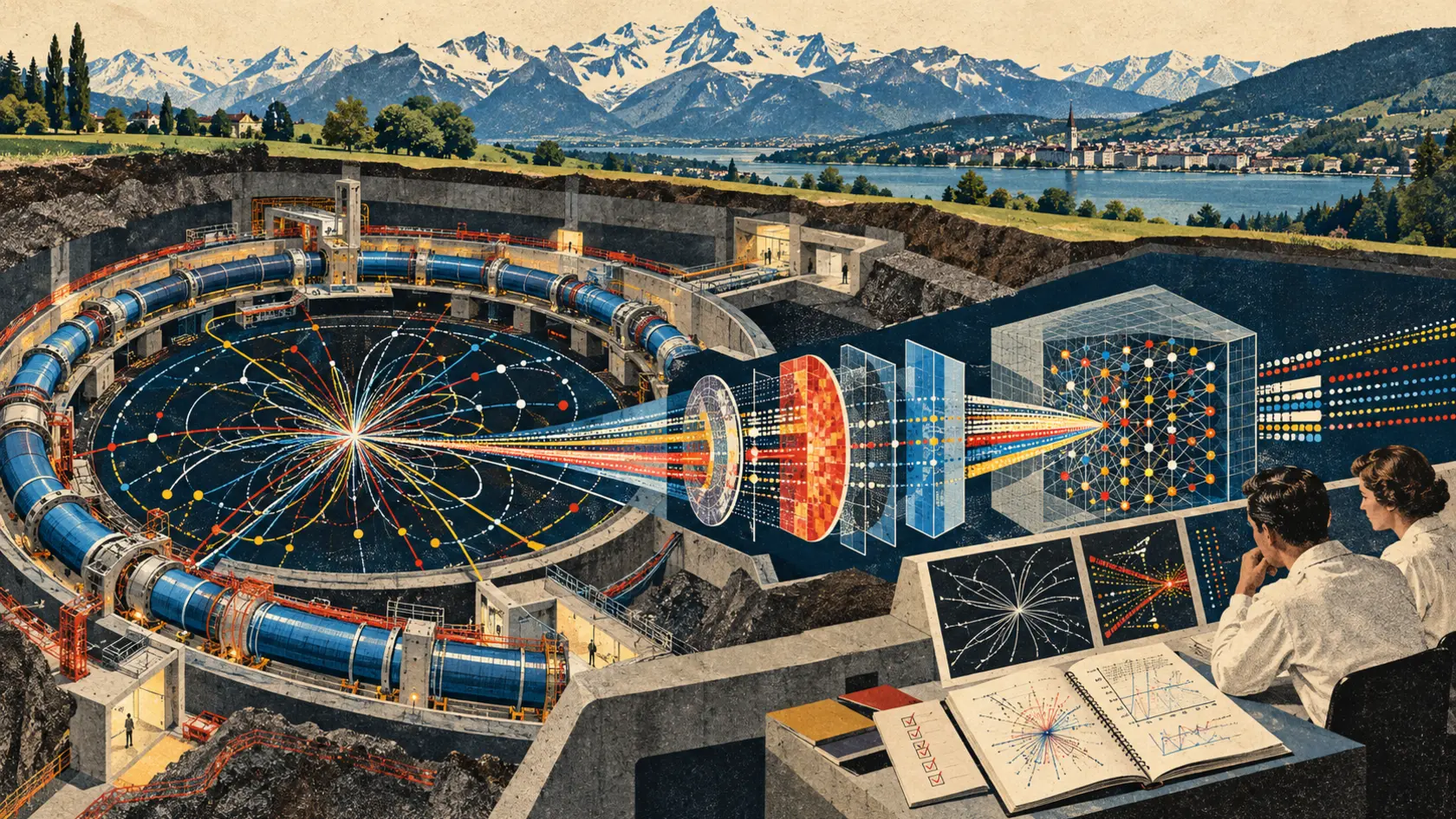
Particle physics already asks computers to perform an extraordinary act of translation. A collision inside the Large Hadron Collider lasts less than a blink. Layers of detectors record electrical traces, light and energy. A chain of specialised algorithms turns those raw signals into tracks, particles and the objects physicists use in an analysis. CERN and Mistral now want to teach one model across much more of that chain. The organisations signed a statement of intent for a long-term partnership focused on foundation models for scientific discovery. Their first ambition is a Large Physics Model trained on billions of simulated proton-proton collisions from the LHC. CERN describes it as the first foundation model for collider physics. The proposed system is meant to support several jobs: reconstruct collisions, identify particles, flag unexpected signals and help evaluate future detector designs. That is a bigger idea than adding machine learning to one well-bounded classifier. It asks a shared pretrained model to learn patterns across tasks that are currently handled by specialised tools. The plain signal is that a general physics model needs an unusually specific public lab notebook. Not a glossy model card written after the interesting decisions are over. A living record that shows what entered the model, what changed between versions, which conventional methods it was compared with, where it failed and what evidence would justify trusting it in each scientific role. CERN has an unusually strong reason to build that record in public. The lab says it has stored around one exabyte of experimental LHC data. The High-Luminosity LHC, expected to begin operating around 2030, is set to increase the number of collisions tenfold. More events can sharpen science, but only if the reconstruction machinery keeps up without quietly smearing away rare behavior. The announcement is an intent, not a result. No model has been released. The statement does not provide a training recipe, architecture, parameter count, compute budget, licence, benchmark table or independent validation result. It does not say which experiments will supply simulated data, how detector conditions will be represented or how the system will separate ordinary statistical fluctuation from something worth a physicist's attention. Those gaps are normal at the beginning of a partnership. They are also the table of contents for the lab notebook. Start with the data lineage. The model will train on simulated collisions, which means it will learn from software representations of physics and detectors rather than from nature alone. Simulations are indispensable, but they carry assumptions about particle interactions, detector geometry, calibration, noise and the processes chosen for generation. Every training slice should therefore have a receipt: generator and version, physics configuration, detector simulation, reconstruction software, calibration period, selection rules, event counts and known mismatches with recorded data. Without that lineage, a model can become very good at reproducing a simulation's habits. That is useful until the habit is wrong. Recorded collision data should remain an adversarial referee. Validation needs control samples where the underlying physics is well understood, stress tests across changing detector conditions and explicit checks for performance gaps between simulated and real events. Then define the jobs separately. Reconstruction, particle identification, anomaly flagging and detector design are not one risk category. A model that proposes candidate tracks can be checked against established reconstruction. A model that ranks detector layouts could influence years of engineering work. A model that flags unusual events could shape which patterns receive scarce human attention. One shared model may support all of them, but each task needs its own acceptance threshold, baseline, uncertainty measure and fallback. The temptation will be to publish one impressive average score. Resist it. Report performance by particle type, energy range, detector region, collision density and operating condition. Show common events and rare ones. Include calibration error, compute cost and latency. Publish the cases where a specialised algorithm still wins. Physics does not need a foundation model to be universally best. It needs to know where the model is useful and where it should get out of the way. Anomaly detection deserves extra suspicion. The phrase unexpected signal can sound like a discovery machine. In practice, a detector or reconstruction bug can also look unexpected. So can a badly modelled background, a changed beam condition or a gap in the training distribution. Every alert should carry a reason and a reproducible route back to the detector inputs. Physicists need to see which features moved the score, which reference population was used, how similar events behaved and whether other reconstruction paths agree. An alert without provenance is not a discovery. It is a brightly coloured request for more work. The notebook should preserve negative results too. If an architecture performs beautifully on simulation and degrades on recorded data, publish that. If a unified model underperforms a specialist tool in a detector region, keep the comparison. If a training change improves one task and damages another, record the trade. Failed approaches are not embarrassing debris. In science, they are part of the evidence. Mistral's wider physics-AI work provides useful context but not proof for this collider project. The company describes models that learn from numerical solver outputs and predict physical fields much faster than traditional simulation. It explicitly says these systems are not replacements for first-principles solvers in every regime and should reserve conventional methods for verification and edge cases. That boundary is healthy. Collider reconstruction needs one of its own. The Large Physics Model should not silently become the only route from detector signal to physics object. Maintain reference pipelines. Run shadow comparisons. Freeze enough old software and data to reproduce decisions. Make it possible to rerun an analysis after a model update without discovering that yesterday's event definition has dissolved. Versioning is not clerical work here. It is scientific memory. Every published result that relies on the model should name the checkpoint, data recipe, calibration inputs, inference code and uncertainty treatment. If a later model changes an event, the collaboration should be able to explain why. Access also matters. CERN says the capabilities can serve the whole physics community and be shared. The reviewed statement does not define what shared means. It could mean papers, an API, downloadable weights, open training code, evaluation datasets or access limited to participating experiments. Those choices will shape who can test the work. A useful release ladder would begin early. Publish task definitions and baseline evaluations before the full model. Release small representative datasets where policy permits. Provide reference code and fixed test suites. Document compute requirements. Invite independent teams to reproduce failure modes, not only leaderboard scores. Some collision data and computing systems have access constraints. That does not excuse an empty public record. Sensitive or operational details can stay protected while methods, aggregate tests, simulation recipes, model changes and known limitations remain visible. The partnership also needs governance that survives good intentions. Name who decides a model is ready for each task. Separate builders from validators. Record conflicts of interest. Define how experiment collaborations can challenge a result. Give outside researchers a route to report flaws. State what happens when a serious problem is found after a checkpoint has informed an analysis. The point is not to slow the project until the High-Luminosity LHC arrives without it. The point is to make speed cumulative. A public notebook lets one experiment reuse another's test. It prevents each research group from rediscovering the same simulation mismatch. It gives students a map of what is known. It gives engineers evidence about where more compute buys better physics. It gives the public a way to distinguish a partnership announcement from a scientific instrument. The Large Physics Model could become genuinely important. It may help compress a brittle chain of specialised systems into a shared representation that learns across the detector. It may help physicists search huge event streams, design future instruments and notice patterns that current tools overlook. But a model that touches the evidence chain cannot be assessed like a clever demo. The collisions are brief. The record of how we interpreted them needs to last.
01
WHAT ACTUALLY CHANGED
CERN and Mistral signed a statement of intent for a long-term strategic partnership on foundation models for scientific discovery
The initial project aims to build what CERN calls the first foundation model for collider physics
The proposed Large Physics Model will train on billions of simulated proton-proton collisions from the Large Hadron Collider
CERN lists collision reconstruction, particle identification, unexpected-signal flagging and future-detector evaluation as intended tasks
CERN says around one exabyte of experimental LHC data has been stored to date
The lab expects the High-Luminosity LHC to increase the number of collisions tenfold around 2030
The announcement does not release a model, training recipe, architecture, licence, benchmark, compute budget or independent validation result
02
WHY THIS MATTERS
A shared pretrained model could reduce repeated work across several collider-physics tasks
Simulation-trained systems can inherit modelling assumptions and mismatches with recorded data
Reconstruction choices shape the scientific objects used in later analyses
Anomaly scores can elevate detector faults or simulation gaps as well as interesting physics
A tenfold growth in collisions raises pressure on computing and reconstruction systems
Model versioning becomes part of the reproducibility chain for any result that depends on its outputs
Public methods and tests can let the wider physics community inspect, reproduce and improve the work
Task-specific baselines and fallbacks are safer than one blended performance claim
03
WHERE IT COULD HELP
- Publish a versioned manifest for every simulated training dataset and detector configuration
- Compare each task with current specialist algorithms using fixed public protocols
- Report results by particle type, energy, detector region, collision density and operating condition
- Validate simulation-trained behavior against recorded collision control samples
- Attach provenance and an explanation path to every anomaly alert
- Keep conventional reconstruction available as a reference and fallback
- Record model checkpoint, calibration, inference code and uncertainty treatment in scientific analyses
- Publish negative results and regressions alongside improvements
- Separate model builders from acceptance reviewers for consequential uses
- Release representative evaluation data, reference code and smaller checkpoints where policy permits
- Run shadow evaluations before allowing a model to influence live reconstruction or detector decisions
- Maintain archived checkpoints and rerunnable environments for long-term reproducibility
KEEP A HAND ON THE WHEEL
This is a statement of intent and a research ambition, not a released model or demonstrated scientific gain. Watch for a project timeline, named participating experiments, architecture and compute details, simulation lineage, real-data validation, task-specific baselines, licences for weights and code, uncertainty methods, access rules, independent review, negative-result reporting and a clear boundary where conventional reconstruction remains authoritative.
04
TERMS WORTH KEEPING
SOURCES AND VERIFICATION STATUS
This article was written from the materials below. Product claims and dates were checked against those sources on October 15, 2026.
PUBLICATION RECEIPT: The article distinguishes the confirmed partnership and stated research ambition from analysis about the validation, access and governance needed before scientific use.
THE PUBLICATION ENGINE
WANT A SIGNAL OF YOUR OWN?
We build source-grounded publications, private briefings, and editorial systems for organizations with something useful to say.
WORK WITH US