THE SIGNAL IN ONE SENTENCE
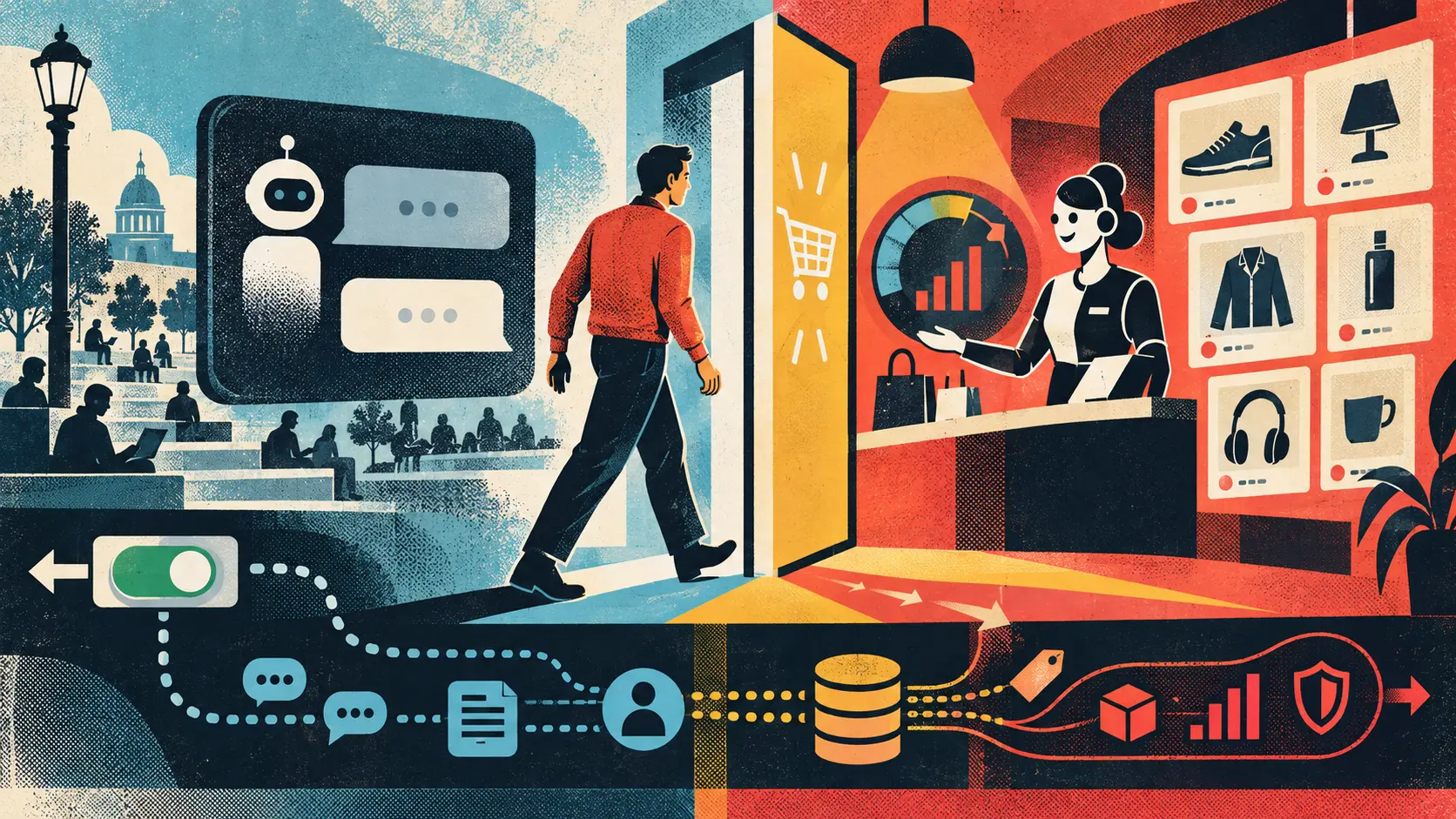
OpenAI is testing Sponsored Agents with selected advertisers in the United States. A person who sees an ad in ChatGPT can choose to open a clearly labeled, separate conversation with an agent sponsored by that business, ask follow-up questions, and then visit the company website. OpenAI says the sponsored conversation is distinct from ChatGPT's independent answers and separate from the original chat. The company is also adding campaign creation, analysis, contextual text customization, translation, and connections to HubSpot and Shopify. This is more than a friendlier banner ad. A fixed message is becoming an adaptive sales conversation that can respond to questions, objections, preferences, and timing. The plain signal is that the product needs a boundary people can see, understand, inspect, and leave at every turn. Otherwise, a useful shopping assistant and a persuasive salesperson can occupy nearly identical chat bubbles while answering to different interests.
01
WHAT ACTUALLY CHANGED
OpenAI announced Sponsored Agents on September 16 and says it is testing them with selected United States advertisers. The interaction begins after a person sees a relevant ad and chooses to start a conversation. OpenAI describes that conversation as clearly labeled, sponsored by the business, separate from the user's original chat, and distinct from ChatGPT's independent answers. The company has not published the participating advertisers, test size, eligibility rules, interface variants, or results.
The sponsored agent can answer follow-up questions about a product or service and provide a link to the business website. That turns one advertising impression into a multi-turn exchange. The announcement does not say which model runs the agent, who writes or approves its instructions, what business data grounds its answers, how current that information must be, which claims are prohibited, or whether the business can inspect the complete conversation.
Advertisers also gain a ChatGPT Ads Manager plugin that can create, update, and analyze campaigns from natural-language prompts. OpenAI says the system can turn a website or brief into a campaign, summarize performance, and recommend next steps. Ads Manager can suggest copy and images from a landing page and campaign objective, while the advertiser reviews and edits the material before adding it to a campaign.
An optional text-customization feature can adapt existing headlines and descriptions to the context of a conversation and translate them into a user's preferred language. This may make an ad more relevant and readable. It also means the exact message may vary from person to person and moment to moment. OpenAI does not publish how those variants are archived, tested for prohibited claims, compared for fairness, or shown later to a user who wants to challenge what they saw.
OpenAI named HubSpot as its first customer-relationship-management partner and Shopify as its first ecommerce partner. The Shopify app can sync a product catalog, create campaigns, run a Shopify pixel and conversion events, and track performance. Shopify's listing says the app can view names, email addresses, IP addresses, browsing behavior, device details, product records, and analytics while editing marketing events and pixels. United States merchants can use it now, and OpenAI says international availability in supported ChatGPT Ads markets begins September 23.
02
WHY THIS MATTERS
Conversation changes the persuasive surface. A conventional ad presents a bounded message. A sponsored agent can listen, personalize, answer objections, compare options, and continue until the person leaves. That can be genuinely helpful for complicated purchases. It also makes disclosure, claim verification, vulnerable-user protections, and stopping rules more important because the pitch adapts while it is being delivered.
The border between independent and sponsored speech has to survive every turn. A label at the entrance is easy to forget after ten messages, a product comparison, and a recommendation. The sponsor identity, commercial purpose, data sources, and exit should remain visible. If the system returns to an independent answer, that transition should be equally explicit rather than quietly blending the two modes.
Separation is a technical claim as well as a design promise. People need to know whether the original chat informed ad selection, what context enters the sponsored conversation, what returns to the original chat, who can read the exchange, how long it is retained, whether it affects later advertising, and how to delete or correct it. OpenAI's launch post states the conversations are separate but does not publish that complete data-flow map.
Grounding and responsibility become inseparable. A business-sponsored agent may discuss dimensions, warranties, pricing, health claims, eligibility, availability, or returns. The useful question is not only whether an answer sounds good. It is which catalog, policy, contract, or approved claim supports it, how recently that source changed, and whether OpenAI, the advertiser, or both repair the harm when the answer is wrong.
The advertising tools also move generation upstream. Campaign text, images, translations, targeting choices, analysis, and recommendations can all be assisted by AI before a user sees anything. Human review is a helpful control, but it is not proof of careful review. A credible platform needs version history, approval identity, policy tests, representative-language checks, complaint links, and records that connect a generated variation to the person who authorized it.
03
WHERE IT COULD HELP
- Keep a persistent sponsor bar on every sponsored turn showing the paying business, commercial purpose, active data sources, responsible contact, report control, leave button, and a one-click return to independent ChatGPT
- Publish a conversation-boundary receipt before entry that lists which original-chat signals are used, which information crosses into the sponsored session, who can access the exchange, how long it is retained, whether it changes later ads, and how deletion works
- Require answer-level provenance for price, availability, dimensions, warranty, return, eligibility, safety, and comparative claims, with the supporting catalog or policy, its effective date, and a clear notice when the agent is estimating rather than retrieving
- Archive every generated ad variation, translation, instruction change, sponsor approval, audience rule, model version, complaint, correction, and withdrawal so a disputed message can be reconstructed instead of disappearing into personalization
- Test sponsored conversations with minors, older adults, distressed users, impulsive shoppers, accessibility users, price-sensitive households, and multiple languages, measuring recognition of sponsorship, pressure, accuracy, exit success, complaint resolution, and harmful targeting
KEEP A HAND ON THE WHEEL
Sponsored Agents are a limited United States test announced by OpenAI, not a finished standard or independently evaluated consumer-protection system. The company says conversations will be clearly labeled, separate from independent answers, and entered by user choice. It has not published comprehension testing, the interface variants, participating advertisers, model and instruction controls, grounding requirements, prohibited-claim enforcement, sponsor access, retention, data-sharing boundaries, targeting logic, complaint volumes, correction times, conversion results, or evidence that users consistently understand the transition. Shopify's app listing documents broad permissions used for catalog sync, pixels, conversion events, analytics, and customer-related data, but those permissions do not by themselves establish how every sponsored conversation uses information. The listing's ratings and reviews are early and changeable, so they are not evidence of overall product quality. Watch for a complete data-flow diagram, persistent disclosure design, advertiser contracts, sensitive-category rules, child and vulnerability protections, independent audits, public enforcement statistics, user controls, and examples of disputed answers being corrected.
04
TERMS WORTH KEEPING
OPEN GLOSSARY CARD
Sponsored Agent
A conversational system paid for or backed by a business and used to answer questions or guide users toward that business's products, services, or website.
OPEN GLOSSARY CARD
Conversation boundary
A visible and technical separation between chats that have different purposes, data rules, speakers, or incentives.
OPEN GLOSSARY CARD
Contextual advertising
Advertising selected or adapted using the subject and circumstances of the current interaction rather than only a fixed generic message.
SOURCES AND VERIFICATION STATUS
This article was written from the materials below. Product claims and dates were checked against those sources on September 17, 2026.
PUBLICATION RECEIPT: Revision 1. Published September 17, 2026.
THE PUBLICATION ENGINE
WANT A SIGNAL OF YOUR OWN?
We build source-grounded publications, private briefings, and editorial systems for organizations with something useful to say.
WORK WITH US