THE SIGNAL IN ONE SENTENCE
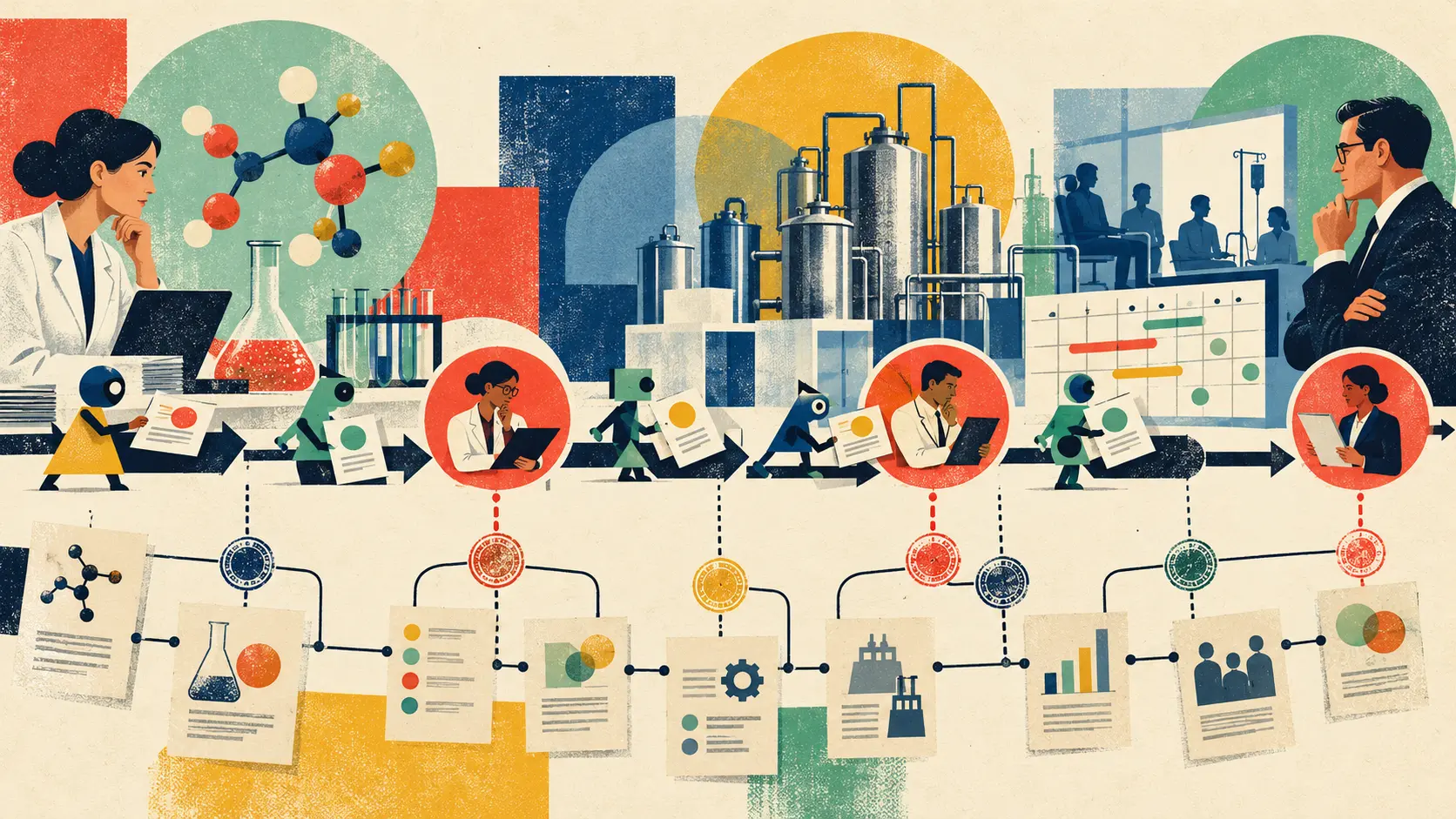
A drug program can lose months because one batch failed, one study slipped or one team learned something that never reached the next team. It can also lose the plot because somebody turned a tentative finding into a confident plan. OpenAI announced on October 20 that it has acquired Orchestra Bio, a platform built to help biopharma teams coordinate drug development. Orchestra's team and technology are joining Rosalind, OpenAI's collection of models, tools and workspaces for life sciences research. The intended connection is easy to see. GPT-Rosalind can reason across biology and chemistry. Rosalind Workbench can connect questions, tools, analyses and evidence. Orchestra has focused on the operational layer: planning programs, monitoring studies, tracking dependencies and helping teams respond when one part of the plan changes. Put those layers together and an agent could move from this result matters to these five activities now need attention. That is useful. It is also the moment when provenance can disappear. The plain signal is this: every drug-development agent needs a decision trail. The trail should connect the original evidence to the interpretation, the proposed action, the responsible human, the approval, the affected dependencies and the final outcome. If an agent changes a study plan, raises a risk, moves a milestone or recommends stopping work, a reviewer should be able to walk backward through every link. OpenAI's announcement describes Orchestra as a place where people and AI agents work together. Scientists and program leaders can delegate the monitoring and tracking of studies and campaigns while keeping responsibility for decisions. The company gives a concrete example. A failed manufacturing batch can delay the start of a clinical trial. Orchestra's agents are meant to identify which activities and timelines are affected, gather relevant information and compare possible responses. The human team then decides what to do. That division sounds sensible. It is not automatically safe. An agent can faithfully detect that a batch failed and still misunderstand which material, protocol, region or patient cohort depends on it. It can locate a schedule and miss the amendment that replaced it. It can propose a technically plausible recovery that conflicts with a quality agreement, budget, supply constraint or decision already made in another system. The problem is not just hallucination. The problem is authority. A drug program contains facts, interpretations, forecasts, commitments and decisions. They do not deserve the same visual weight. A lab result is not a program decision. A model score is not a validated endpoint. A draft timeline is not an approved timeline. A suggested mitigation is not authorization to execute it. The decision trail should preserve those distinctions. Start with the evidence object. What triggered the agent? Record the source system, study or campaign, sample or batch identifier, protocol version, timestamp, data version and responsible owner. Preserve the original artifact or a stable reference to it. A sentence saying manufacturing issue detected is not enough. Next, record the interpretation. What did the agent conclude, which evidence did it use, what assumptions did it make and what alternatives did it consider? If a model transformed a lab report into a risk classification, keep the model version, prompt or workflow, tools called and confidence or uncertainty that the system actually produced. Do not manufacture confidence after the fact. If the system did not calculate a calibrated probability, the interface should not decorate the conclusion with one. Then show the proposed action. An agent might recommend repeating an assay, contacting a contract manufacturer, shifting a milestone, opening a deviation, revising a budget or preparing a protocol change. Every action should state its scope, intended benefit, expected cost, affected programs and reversible point. That last field matters. Send a reminder is easy to undo. Cancel a production slot is not. The human decision comes next. Name the person or role that approved, rejected or edited the proposal. Record the time, rationale and evidence they reviewed. If approval requires more than one function, do not compress three signatures into a green check mark. Scientific, clinical, manufacturing, quality, regulatory and finance teams may be looking at the same change for different reasons. The trail should preserve each decision boundary. Finally, carry the outcome forward. Did the repeated assay confirm the concern? Did the new supplier slot arrive in time? Did the mitigation merely move risk downstream? Link the real result back to the original proposal so teams can evaluate whether the agent's recommendation helped. Without that loop, the system learns what people clicked, not what worked. Orchestra says drug development spans thousands of decisions and dependencies across discovery, preclinical work, manufacturing and clinical development. That scale is why agents are tempting. It is also why a single giant activity log will become useless. The decision trail needs structure. Give every consequential recommendation a stable identifier. Let one recommendation link to several evidence objects and several downstream tasks. Keep superseded versions rather than overwriting them. Show which tasks came from a human, which came from an agent and which were modified after generation. Build dependency maps from explicit relationships, not proximity in a calendar. A clinical milestone may depend on material release, site readiness, data review, enrollment assumptions and a decision by a governance committee. The agent should name the relationship and its source. It should not infer causality merely because two events usually occur in sequence. The same principle applies to scientific reasoning. OpenAI says GPT-Rosalind supports evidence synthesis, hypothesis generation, experimental planning and tool-heavy workflows across molecules, proteins, genes and pathways. Rosalind Workbench is designed to keep plans, intermediate results and supporting evidence connected. In its sequencing workflow, the system prepares an analysis plan for researcher approval and returns traceable, reviewable outputs. That is the right foundation for research. Program coordination adds a second layer of decisions that needs the same discipline. A well-sourced analysis can still become an unsourced operational instruction when copied into a project tracker. The handoff between layers should be explicit: Here is the scientific finding. Here is what the model thinks it means. Here are the program activities that may be affected. Here are the assumptions behind that map. Here is the human who decided what to do. Here is what happened next. The acquisition announcement does not say how Orchestra will be integrated, which customers will use the combined system, what the transaction cost or what measured results existing deployments produced. OpenAI says its goal is to help discoveries become treatments sooner. That is a goal, not an observed outcome. The current Rosalind materials also describe controlled access and organizational governance for advanced life sciences work. Those controls matter, but access control alone does not create scientific or operational accountability. The system needs authority limits inside the workflow. An agent may be allowed to gather evidence, draft a dependency map and prepare options. It may not be allowed to change a validated record, approve a study, release a batch, contact a regulator or commit money. Those boundaries should be machine-readable, versioned and visible beside the recommendation. When an agent cannot resolve conflicting records, it should stop and name the conflict. When source data changes, it should mark earlier outputs stale. When a protocol or plan is superseded, it should show which open tasks were created under the previous version. When an owner changes, it should not quietly inherit that person's authority. These are ordinary operational controls. Agents make them more important because they can create and update work much faster than a committee can notice a mistake. Speed changes the failure mode. A human project manager might misread one report and create two bad tasks. An agent can propagate the same error across a portfolio, update dependent dates, notify partners and summarize the new plan before anybody opens the source document. That is why bulk actions need previews, thresholds and rollback. Before an agent changes several programs, show the exact records, dependencies and owners that will be affected. Require a second review for actions beyond a defined scope. Preserve the previous state. Make the rollback a tested operation rather than a promise in a policy document. Teams should evaluate the combined system on more than time saved. Measure whether recommendations cite the correct evidence. Count stale-source errors, missing dependencies, false escalations and changes reversed by humans. Track how often reviewers open the source material, how much generated work they edit and whether downstream outcomes support the original rationale. Report where the agent abstained. An honest system should have cases where it says the source is incomplete, the programs cannot be joined safely or the decision belongs to a named human function. The most useful acquisition question is not whether AI will accelerate drug development. That claim is too large to answer with a transaction. The useful question is whether this integration can keep scientific reasoning attached to the operational decisions it creates. Drug development already has enough dashboards. What it needs from agents is a legible chain from evidence to action, with the human decision still visible in the middle. If OpenAI and Orchestra can build that, the product will not merely move tasks faster. It will help teams remember why they moved at all.
01
WHAT ACTUALLY CHANGED
OpenAI announced the acquisition of Orchestra Bio on October 20
Orchestra Bio and its technology are joining OpenAI Rosalind
OpenAI describes Orchestra as a platform for coordinating complex drug-development programs
The intended combined system connects scientific findings with studies, decisions and next steps
Orchestra agents are designed to monitor studies, track dependencies, gather information and compare responses
Scientists and program leaders are described as retaining responsibility for decisions
Rosalind already combines a life sciences model, scientific tools and reviewable research workflows
Rosalind Workbench keeps analysis plans, intermediate results and supporting evidence connected
The acquisition announcement does not disclose transaction terms or measured deployment outcomes
OpenAI states a goal of helping treatments reach patients sooner but does not establish that outcome
02
WHY THIS MATTERS
Drug programs connect scientific evidence to operational work across many teams and external partners
An agent can propagate one mistaken assumption across several dependent activities
Scientific findings, model interpretations, draft plans and approved decisions require different authority labels
A traceable research output can still become an untraceable task when it crosses into a project system
Protocol, data and plan versions determine whether a recommendation still applies
Human approval is meaningful only when the responsible person and reviewed evidence are recorded
Bulk automation increases the speed and reach of scheduling or coordination errors
Outcome links are needed to learn whether an agent recommendation actually helped
Access controls limit who can use a system but do not prove that its decisions are accountable
A structured decision trail makes review, correction, rollback and evaluation possible
03
WHERE IT COULD HELP
- Assign a stable identifier to every consequential agent recommendation
- Link recommendations to original evidence, source systems and protocol versions
- Separate observed facts, model interpretations, forecasts and approved decisions
- Record the workflow, model, tools, assumptions and alternatives behind each proposal
- Name the responsible human and preserve approval, rejection or edit rationale
- Map downstream tasks through explicit, sourced dependency relationships
- Mark outputs stale when underlying data, protocols or plans change
- Preview bulk changes and require additional review above a defined scope
- Keep prior states so consequential updates can be rolled back
- Connect real outcomes to the recommendation that caused the work
KEEP A HAND ON THE WHEEL
Watch for integration details between Orchestra and Rosalind; customer deployments; evidence that timelines or decision quality improve; published error, abstention and rollback rates; role-based authority limits; versioning across scientific and operational systems; treatment of validated records; data-use and retention terms; independent evaluation against experienced program teams; and proof that an agent can preserve the evidence trail when one change affects several programs.
04
TERMS WORTH KEEPING
SOURCES AND VERIFICATION STATUS
This article was written from the materials below. Product claims and dates were checked against those sources on October 21, 2026.
THE PUBLICATION ENGINE
WANT A SIGNAL OF YOUR OWN?
We build source-grounded publications, private briefings, and editorial systems for organizations with something useful to say.
WORK WITH US