THE SIGNAL IN ONE SENTENCE
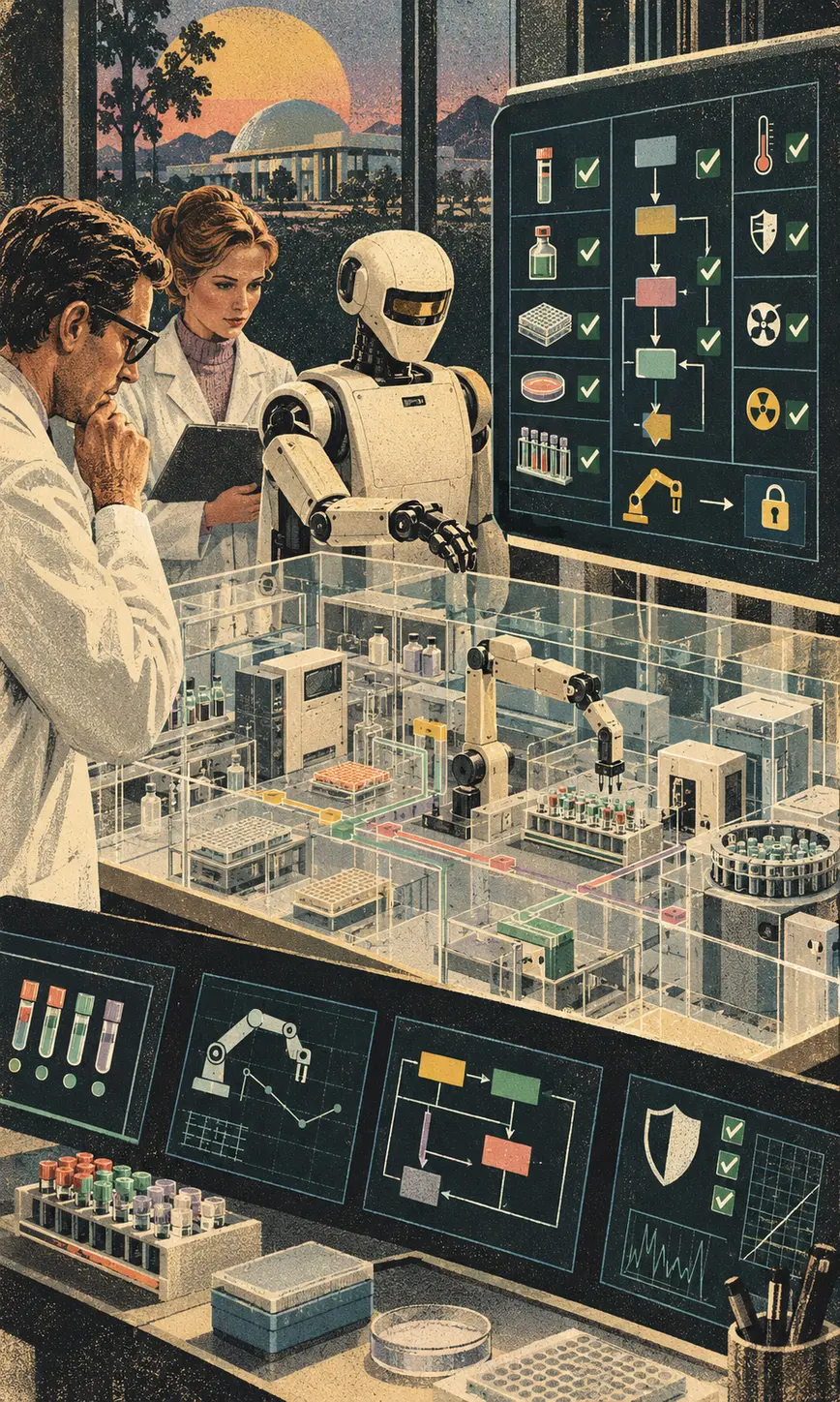
A new system represents laboratory equipment, samples, operations, and changing physical state in a form an AI agent can check before commanding real machines.
01
WHAT ACTUALLY CHANGED
Researchers created a formal representation of a physical laboratory using typed research objects, capability-bound operations, and a workflow language. The objects describe materials and equipment. The operations specify what each piece of equipment can actually do. The workflow expresses order, dependency, iteration, decisions, and concurrent activity.
The representation was implemented inside a modular robotic laboratory. Agent-generated workflows could be compared with available capabilities rather than accepted simply because the procedure sounded plausible in natural language.
Before an operation was dispatched, a stateful simulation propagated the proposed changes through the laboratory. It checked prerequisites, object transformations, equipment limits, and other constraints. A sample used in one step therefore changes the state seen by later steps instead of remaining an imaginary unlimited resource.
The researchers connected the formal operations to executable Function Skills. This provides an interface between an agent's reasoning and bounded physical actions, allowing the same high-level scientific goal to produce different valid workflows depending on the actual laboratory.
02
WHY THIS MATTERS
Language models can understand a scientific procedure while remaining dangerously vague about the room where it will happen. They may request unavailable equipment, assume a material exists, overlook calibration, schedule incompatible operations together, or consume a sample twice.
A computable laboratory gives the agent something more useful than a long warning prompt. It creates a world with explicit objects, capabilities, state transitions, and gates. The procedure must survive that world before a robot arm, pump, incubator, or instrument receives a command.
The deeper idea extends beyond laboratories. Any agent operating physical equipment needs a representation of what exists now, what actions are permitted, what each action changes, and which conditions must remain true. Fluency is not a substitute for a model of the room.
03
WHERE IT COULD HELP
- Validate automated experiments before execution
- Track samples and materials across multistep procedures
- Match scientific plans to equipment actually available
- Coordinate several instruments without violating dependencies
KEEP A HAND ON THE WHEEL
The paper describes an implemented framework, not universal proof of safe autonomous science. Laboratories use different equipment, data systems, physical processes, and safety standards. Interoperability, failure recovery, external validation, and performance on genuinely novel experiments remain open questions.
04
TERMS WORTH KEEPING
OPEN GLOSSARY CARD
Agent
An AI that can choose steps and use tools to pursue a goal.
OPEN GLOSSARY CARD
Model Hardware Standard
A shared way for AI agents to understand and operate physical equipment.
OPEN GLOSSARY CARD
Production gate
A control that blocks a development version from reaching real users until an authorized person approves it.
SOURCES AND VERIFICATION STATUS
This article was written from the materials below. Product claims and dates were checked against those sources on September 6, 2026.
PUBLICATION RECEIPT: Revision 1. Approved by Zak and published September 6, 2026.
THE PUBLICATION ENGINE
WANT A SIGNAL OF YOUR OWN?
We build source-grounded publications, private briefings, and editorial systems for organizations with something useful to say.
WORK WITH US