THE SIGNAL IN ONE SENTENCE
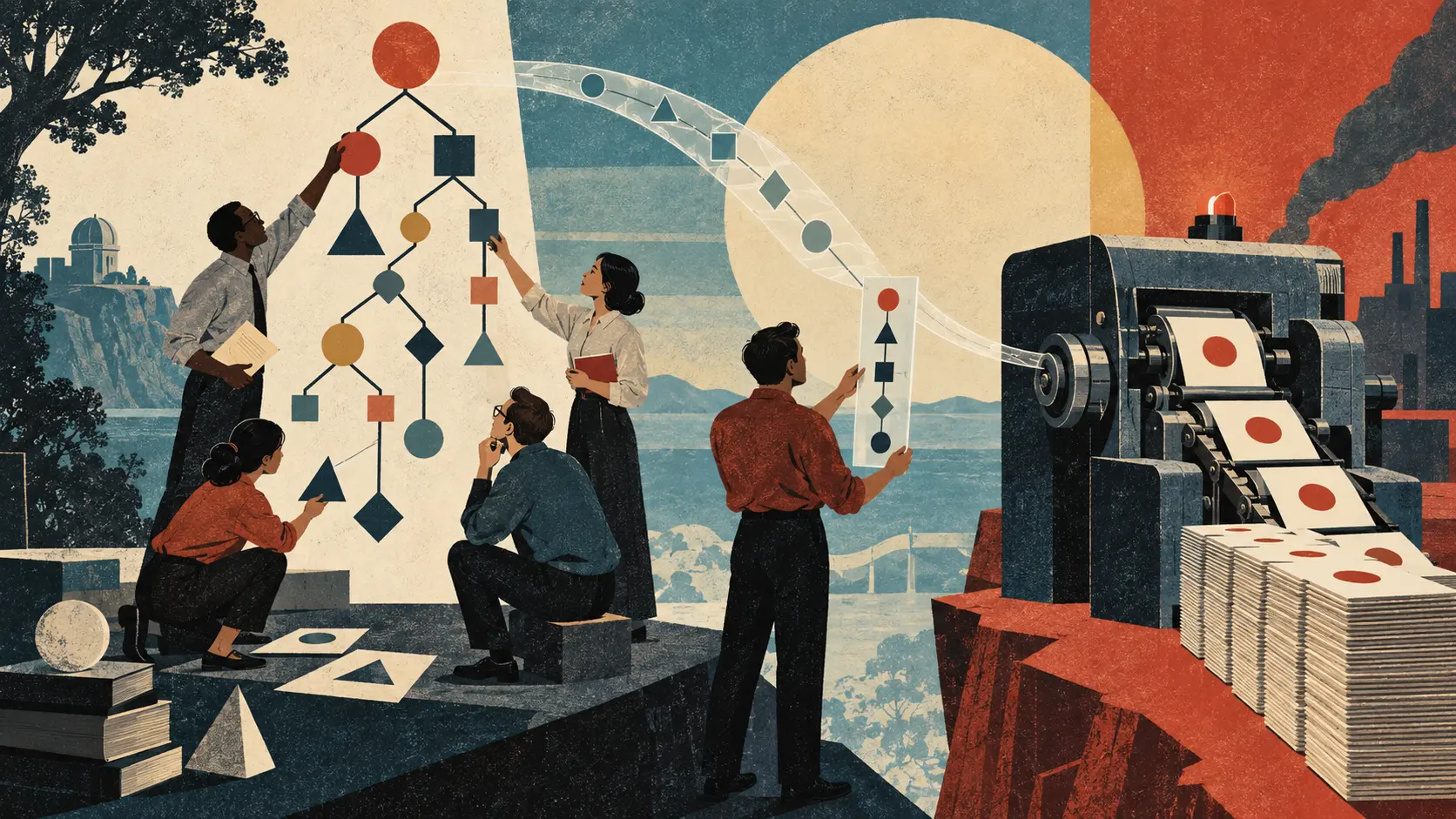
Twenty-five Fields Medal recipients published a collective warning about the way AI companies are using famous unsolved problems as benchmarks. They are not asking mathematicians to reject AI, and they explicitly say the technology could accelerate genuine study. Their argument is that a solved problem is only a proxy for mathematical understanding. If a system races to an answer without a careful explanation, a traceable intellectual lineage, a reusable method, and people willing to teach and test it, the scoreboard can improve while the discipline gets poorer.
01
WHAT ACTUALLY CHANGED
The declaration, titled A Severe Misalignment of AI in Mathematics, appeared on September 11 with 25 initial signatories. Every person on the initial list is a Fields Medal recipient, spanning awards from 1978 through 2026. Terence Tao, one of the signatories, said the statement grew from discussions among the group during the preceding week. The declaration now invites further academic endorsements, but the number of later endorsers is not the claim this article relies on.
The statement arrives after a rapid series of high-profile AI mathematics results, including OpenAI's September 8 release of a proposed Navier-Stokes solution produced through a large multi-agent effort. The Plain Signal covered that result as an inspectable candidate proof whose mathematical and prize recognition remained unsettled. This new story is the reaction: a group of leading mathematicians is challenging the incentive system surrounding such announcements, not merely disputing one theorem.
Their central distinction is between solving a problem and building understanding. Famous open problems have traditionally acted as landmarks because a solution often introduces ideas that mathematicians can simplify, discuss, teach, reuse, and connect to earlier work. The declaration argues that treating the endpoint as the benchmark can sever that relationship. A machine may help produce a true statement while the community still lacks a clear account of why it is true or what new mathematical tool it provides.
The signatories also object to speed without scholarly plumbing. They say rushed announcements can arrive before a proper writeup, before useful methods have been isolated, and before relevant prior work has been cited. They connect those failures to questions about attribution and plagiarism. The declaration does not identify a specific person or company as having committed plagiarism, and it should not be read as proof of one. It is a warning about conditions that make credit harder to trace.
This is not an anti-AI manifesto. The final section says AI could enhance and accelerate genuine mathematical study and understanding. The disagreement is over the target. The signatories want decisions by laboratories and mathematicians to protect the human process that turns an answer into shared knowledge. Tao also acknowledged that the group released the statement without the broader consultation it would have preferred because its members considered the issue urgent.
02
WHY THIS MATTERS
Benchmarks teach organizations what to optimize. If the public score is the number of famous problems apparently solved, a laboratory receives a clean reward for producing answers quickly. It receives much less visible credit for tracing a lemma to its source, writing a patient exposition, finding the smallest reusable idea, or giving independent experts enough time to find a flaw. The metric is not neutral. It quietly becomes the product specification for scientific behavior.
Mathematics is not only a warehouse of answers. A proof is valuable because other people can examine its steps, understand the mechanism, transport the method to a different problem, and teach it to the next generation. That long conversion from result to canon can take talks, revisions, simplifications, formal checks, and textbooks. AI could help with every stage. It could also flood the front door with candidate results faster than the community can perform the conversion.
Credit becomes a technical requirement when systems train on generations of human work. A useful research record should show which papers, conjectures, examples, and intermediate insights shaped a result. Model developers may not be able to reconstruct every influence inside a neural network, but they can document retrieved sources, agent traces, search queries, human contributions, formal dependencies, and known precedents. Without that record, novelty claims become difficult to evaluate and researchers whose work supplied the path can disappear from the story.
Verification capacity is part of the safety budget. Ten thousand agents can generate possibilities in parallel. The number of qualified people able and willing to review a 166-page proof does not expand on the same curve. Laboratories that accelerate discovery should fund independent checking, readable exposition, formalization, and corrections without buying the reviewers' conclusions. Otherwise the cost of validating a company milestone is pushed onto the very community being asked to applaud it.
The dispute reaches beyond mathematics. Software teams can optimize tickets closed while weakening maintainability. Schools can optimize answers while weakening learning. Newsrooms can optimize output while weakening verification. Medicine can optimize a benchmark while missing patient benefit. The same question keeps returning: Is the measured result the purpose of the work, or merely one clue that the purpose is being served?
03
WHERE IT COULD HELP
- Score AI mathematics systems on correctness, clarity, novelty, attribution, reproducibility, teachability, and whether experts can reuse the method
- Publish full proofs, formal statements, dependencies, retrieval records, agent traces, known precedents, and revision histories before treating a result as settled
- Budget independent mathematician time for adversarial review, exposition, formal verification, and translation into material that students can actually learn
- Separate candidate result, checked proof, accepted proof, reusable method, and textbook knowledge as distinct milestones instead of one solved label
- Ask every intellectual-work benchmark what human capacity it is meant to strengthen, then measure that capacity directly where possible
KEEP A HAND ON THE WHEEL
The declaration is an advocacy statement, not an empirical study, a formal policy, or a consensus vote of all mathematicians. The credentials of its 25 initial signatories give the warning unusual weight, but they do not settle every question about AI and mathematics. The statement describes recent AI progress broadly and does not audit each result individually. Its reference to attribution and plagiarism raises a systemic concern; it does not establish a specific act of plagiarism by a named laboratory or researcher. Some AI-assisted proofs are accompanied by detailed papers, public code, formal certificates, and human collaboration, and those practices should be judged on their actual evidence. The open endorsement list can change after publication. Most importantly, the signatories explicitly welcome AI that advances real understanding. The practical debate is about incentives, documentation, review capacity, credit, education, and who decides when a mathematical output has become mathematical knowledge.
04
TERMS WORTH KEEPING
SOURCES AND VERIFICATION STATUS
This article was written from the materials below. Product claims and dates were checked against those sources on September 13, 2026.
PUBLICATION RECEIPT: Revision 1. Published September 13, 2026.
THE PUBLICATION ENGINE
WANT A SIGNAL OF YOUR OWN?
We build source-grounded publications, private briefings, and editorial systems for organizations with something useful to say.
WORK WITH US