THE SIGNAL IN ONE SENTENCE
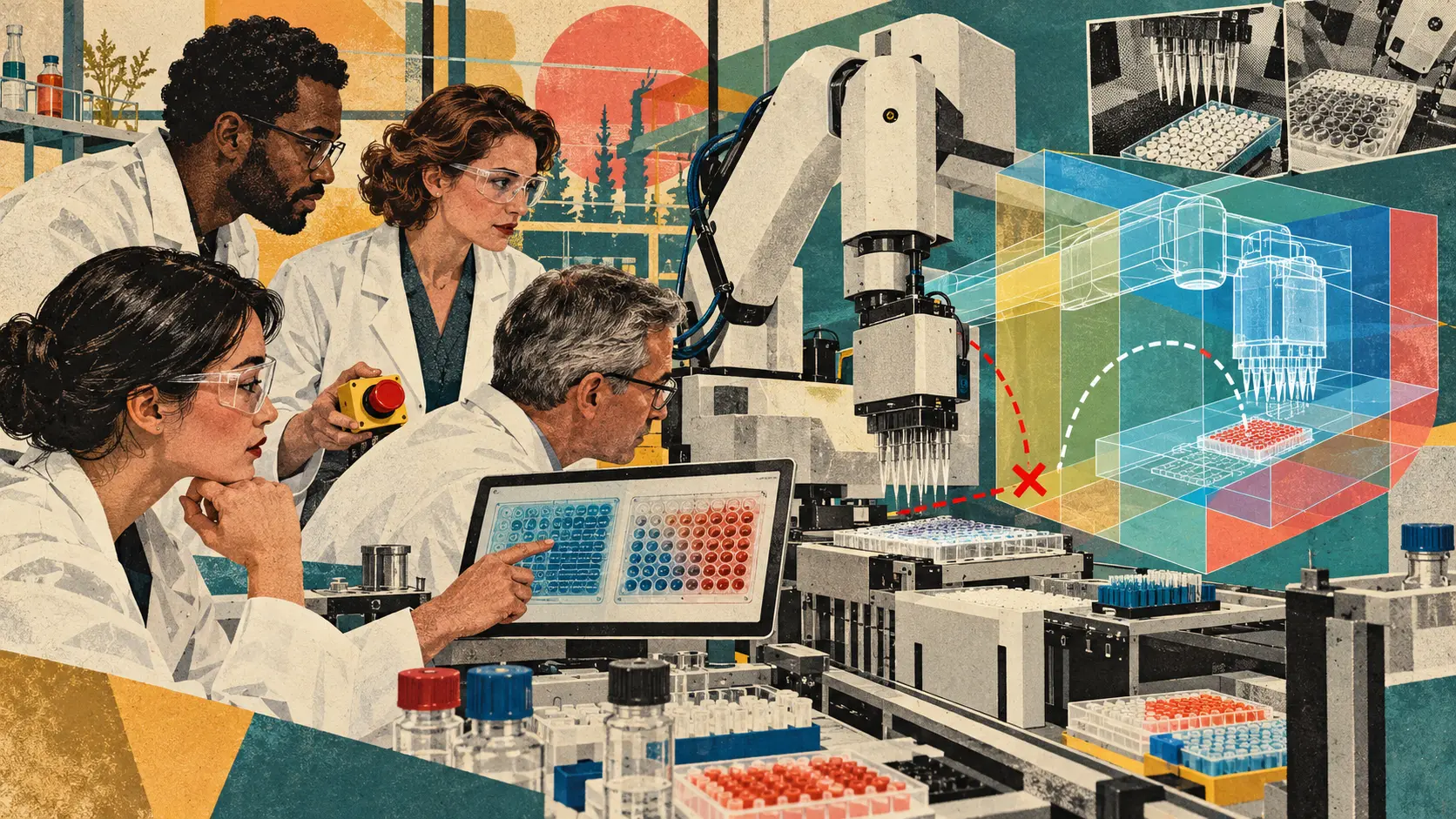
The robot wanted to lower eight pipette tips into a reagent trough. The code was valid. The geometry was not. Google Research's laboratory system knew the eight tips spanned at least 72 millimetres. The trough was 71.2 millimetres long. So the simulation rejected the move before a machine could translate a small arithmetic problem into broken hardware, spilled material or a ruined experiment. The agent replanned with seven channels. That tiny refusal is the most useful idea in Google's October 16 report on AI agents and wet-lab biology. The system does not ask a language model to imagine the laboratory correctly. It gives the agent a persistent digital twin of the equipment and makes physical state the bouncer at the door. Reality gets veto power. Google's announcement connects three research projects. One builds the infrastructure between an agent and laboratory robots. A second runs three-round design, test and improve loops for DNA aptamers. A third uses agents and a human scientist to make computational protein-binder design less expensive, then checks selected designs in the lab. Together they are meaningful progress toward human-directed autonomous research. They are not one general autonomous laboratory, a clinical result or proof that a model can safely choose its own scientific goals. The infrastructure is called VERID, short for VERified Infrastructure for Discovery Laboratories. Its core is a live semantic model of the workcell. The model tracks spatial coordinates, container geometry, operational state, reagent identity, liquid volume, liquid height, available pipette tips and relationships such as whether a lid blocks access to a well. This is more than a decorative three-dimensional copy of a machine. Before a command block reaches the hardware, VERID clones the current state and runs the proposed operation against the virtual workcell. The simulation checks mass balance, time, deck geometry, tip inventory, volumetric limits, mechanical trajectories and chemical-compatibility rules. It can catch a request to aspirate from an empty well, overflow a destination, reach through a lid or move hardware through space it cannot occupy. If the proposal survives that gate, the physical system may execute it. The digital twin is then updated from the real equipment and the next action is checked again. The researchers call this verify then execute. It is a fine phrase for any agent with access to a physical machine. VERID also builds what the paper calls a trace dossier. It synchronizes state snapshots, code, low-level hardware commands, instrument telemetry, top-down images and side-view video against a common clock. That turns an experimental run into something another scientist can inspect rather than a confident summary produced after the fact. The distinction matters because laboratory failure is often irritatingly physical. In one case study, a dilution protocol looked sensible in code but produced uneven results. Video showed that pipetting too close to the bottom left dense dye stratified in the wells. Small height differences also pushed some tips against the floor and partly blocked their openings. The protocol was changed to keep clearance and mix across the liquid column. The revised run recovered near-ideal twofold dilution. When a plate-reader error interrupted the revised experiment, the persistent state let the system resume without repeating the liquid handling. The laboratory did not have to pretend the failure never happened. It knew where the experiment had stopped. Another campaign found a concentration discrepancy that initially looked like a weak eighth channel. The agent designed a factorial diagnostic. The resulting evidence pointed instead to residue on the inner wall of tips that had been used for mixing. The apparent weak channel moved when the dry-tip assignment moved. That is the kind of boring truth a biological discovery system must love. The three VERID case studies used dye and deionized water, deliberately avoiding biological complexity while the researchers tested fluid handling, optical measurement, fault recovery and self-play. Google reports that a closed-loop agent reconstructing blinded dye mixtures improved accuracy by more than fivefold. Useful result, narrow test. The next project moved into molecular design with aptamers, short DNA sequences that can fold into shapes and bind proteins. The team gave agentic pipelines three design, test and improve rounds against myoglobin and alpha-thrombin. Each round included roughly 1,000 candidates. Designs were synthesized, screened against target proteins and sequenced so the next round could use actual binding data. The important part was not a smooth march upward. On myoglobin, the Round 2 strategy chased raw binding and enriched G-quadruplex motifs. Many of those sequences were sticky. They attached to off-target proteins or the magnetic beads used in the assay. On-target specificity fell from 75.0 percent to 19.1 percent, and the measured hit rate among newly designed candidates dropped from 10.2 percent to 3.7 percent. The wet lab had found the shortcut. Using that evidence, the pipeline changed its design rules, subtracted bead binders and shifted toward other structural families. In Round 3, specificity recovered to 72.4 percent and the bead-corrected on-target hit rate reached 33.5 percent. On alpha-thrombin, the measured hit rate moved from zero in Round 1 to 26.0 percent in Round 2 and 42.1 percent in Round 3, with 98.5 percent specificity in the reported Round 3 screen. These are results inside a particular experimental setup, target pair and statistical definition. They are not a universal success rate for AI-designed molecules. The paper says strictly de novo alpha-thrombin scaffolds showed low-micromolar binding in the follow-up assay, while literature-derived motifs modified by the agents produced stronger preliminary apparent affinities. The distinction keeps a useful result from turning into a magic trick. The third project tackles the compute bill behind protein-binder design. Predicting whether a designed binder fits a large target can spend most of its time repeatedly processing protein regions far from the proposed binding site. The researchers tested an epitope-excision method that crops the target to a local interface window. Across 15 targets and 3,666 designs, the paper reports that the cropped windows preserved local interface geometry closely enough to cut GPU hours by 88 percent in the fibroblast activation protein alpha campaign. The team then compared three ways to allocate the remaining work under a shared compute cap. A human investigator alone produced a 5.06 percent computational hit rate. A human-agent hybrid, with the scientist choosing the high-level target region and the agent making tactical decisions, reached 9.33 percent while using about 58 percent of the GPU budget. A fully autonomous agent explored more distinct target sites but finished at 6.18 percent. More autonomy found more territory. Human direction spent the budget more efficiently. That is not an embarrassment for the machine. It is a useful division of labor. The researchers screened a 5,000-member library with yeast-surface display and found 571 enriched unique sequences after three sorting rounds. Four representative clones showed apparent binding affinities from 3.0 to 9.1 nanomolar. The paper also lists the work still required, including soluble expression, domain-specificity testing and inhibition assays. A binder in a controlled assay is not a medicine. It is a promising molecule with a long queue of reality checks ahead. Google says these workflows used well-controlled, non-infectious systems without gain-of-function risk. Designed sequences underwent biosecurity screening. Protocols were simulated before execution. Humans authorized and reviewed sequences, verified protocols and supervised robot runs. Those boundaries belong in the headline, not the footnote. An AI lab agent can make at least three kinds of mistake. It can misunderstand the scientific objective. It can choose a proxy that rewards a shortcut, as the sticky aptamers demonstrated. It can issue a physically invalid command. A serious system needs a separate control for each failure. Scientific objectives need a named human owner. Optimization needs counter-screens, negative controls and tests that expose gaming. Physical execution needs a state model, a mandatory simulation gate and hardware interlocks that do not rely on the agent agreeing with them. The trace dossier matters just as much. Every candidate, prompt, model version, protocol, reagent lot, instrument state, image, exception, human approval and result should remain connected. If a later team cannot reconstruct why a sequence was designed or why a robot skipped a step, the system has produced output without producing evidence. That record also needs to include the failures. Biological models learn from published successes while much of the useful negative evidence stays inside laboratories. A closed-loop platform could capture those dead ends systematically. It could also bury them behind a private interface and repeat the old problem at machine speed. Research organizations should decide early which protocols, traces, benchmark tasks and failure patterns can be released without exposing sensitive biological detail. The practical applications arrive well before a fully autonomous laboratory. A digital twin can validate a human-written protocol. A trace dossier can make ordinary automation easier to debug. Persistent state can help a lab recover from an instrument fault. Agents can compare experiment plans inside a sandbox before consuming reagents. A scientist can delegate parameter sweeps and compute allocation while retaining the authority to choose the biological question and stop the work. That is enough to be interesting. The next proofs should travel beyond Google's workcell. Independent laboratories need to reproduce the protocols on different robots, labware and targets. Researchers should measure false blocks as well as caught errors. Safety teams should test stale state, mislabelled reagents, camera failure, adversarial instructions, sensor disagreement and the moment when the physical system and its digital twin tell different stories. The hardest question is not whether the agent can keep going. It is whether the system knows when continuing would turn uncertainty into evidence-shaped nonsense. Give the agent room to propose. Make the simulator check the move. Make the instrument report what really happened. Make the scientist own the goal and the stop control. Keep the whole receipt. Then let reality vote last.
01
WHAT ACTUALLY CHANGED
Google Research published a connected account of three agentic wet-lab research projects on October 16
VERID maintains a persistent semantic digital twin of laboratory geometry, materials, volumes, tip inventory and instrument state
Every VERID command block passes a mandatory virtual simulation before physical dispatch
The system records synchronized state snapshots, hardware commands, telemetry, images and video in a trace dossier
Three-round aptamer campaigns used experimental feedback to diagnose target-specific failure modes and revise molecular designs
Reported Round 3 hit rates reached 33.5 percent on myoglobin and 42.1 percent on alpha-thrombin under the paper's bead-corrected definition
An epitope-excision workflow reduced the reported GPU hours for a large protein-target campaign by 88 percent
In a fixed-compute comparison, a human-agent hybrid achieved a higher computational hit rate than either the human baseline or the fully autonomous agent
Google says the work used non-infectious test systems, sequence screening, simulation gates and direct human authorization
02
WHY THIS MATTERS
A physical agent needs an external state model because valid code can still request an impossible or destructive movement
Mandatory simulation can prevent some mechanical, volumetric and inventory failures before reagents or hardware are touched
Synchronized traces connect an agent's plan to the actual instrument state and make failures easier to reproduce and debug
The aptamer campaign shows why real measurements must be allowed to overturn a persuasive computational strategy
Human direction and machine-scale tactical search can complement each other without pretending that more autonomy is always better
Compute-saving methods may let researchers explore more candidates, but cheaper prediction does not replace laboratory validation
Wet-lab agents increase the importance of biosecurity screening, clear goal ownership and a physical stop authority
Negative results can become valuable training evidence if laboratories preserve and responsibly share them
03
WHERE IT COULD HELP
- Dry-run liquid-handling protocols against live geometry, inventory and volume constraints before execution
- Create trace dossiers that align code, robot commands, video, telemetry, measurements and human approvals
- Resume experiments from a verified state after plate-reader, network or instrument failures
- Use agents to design factorial diagnostics when a physical result disagrees with the expected protocol
- Run iterative molecular-design campaigns in which every computational proposal returns to a controlled assay
- Delegate parameter sweeps and compute allocation while scientists retain authority over targets, constraints and stop conditions
- Counter-screen designs for off-target binding and physical shortcuts before rewarding apparent performance
- Test whether protocols transfer across robots, labware, reagent lots and laboratory environments
- Preserve failed runs and rejected hypotheses as structured evidence rather than discarding them from the record
- Build independent interlocks for biological scope, mechanical motion, chemical compatibility and credentialed tool access
KEEP A HAND ON THE WHEEL
Watch for independent replication outside Google, transfer to different robots and labware, public code and benchmark protocols, rates of false simulation blocks, tests involving stale or incorrect digital-twin state, sensor disagreement, adversarial instructions, reagent mislabelling, broader biological targets, reproducibility across reagent lots, soluble-expression and inhibition results for the reported binders, transparent biosecurity review, incident reporting, and evidence that human authorization remains meaningful as the loops become faster and more autonomous. These are research prototypes and controlled experiments, not clinical systems or general autonomous scientists.
04
TERMS WORTH KEEPING
SOURCES AND VERIFICATION STATUS
This article was written from the materials below. Product claims and dates were checked against those sources on October 17, 2026.
PUBLICATION RECEIPT: The article separates Google's measured prototype results from analysis about deployment controls. It does not describe the systems as clinical tools, general autonomous scientists or proof that every laboratory task can be safely automated.
THE PUBLICATION ENGINE
WANT A SIGNAL OF YOUR OWN?
We build source-grounded publications, private briefings, and editorial systems for organizations with something useful to say.
WORK WITH US