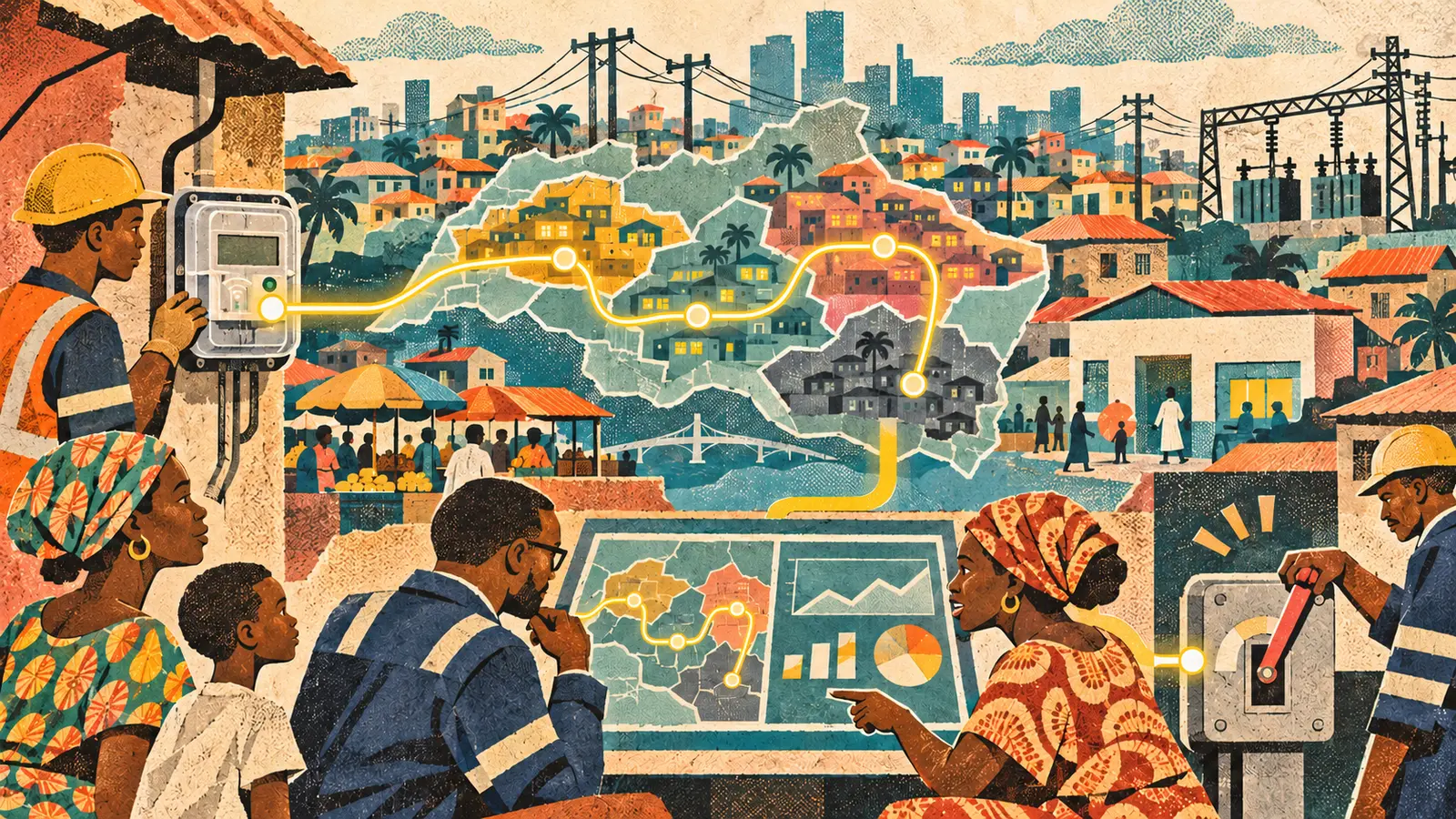
THE SIGNAL IN ONE SENTENCE
A smart meter can count electricity. It cannot explain why a neighborhood went dark. That missing explanation sits at the center of Lagos State's proposed Electric Eye of Lagos, an AI-enabled monitoring system described by Energy and Mineral Resources Commissioner Biodun Ogunleye at NIGERCON 2026. The IEEE Nigeria conference was held November 5 and 6 at the University of Lagos. UNILAG published its account on November 7. The pitch is straightforward. Combine smart-meter readings, geospatial mapping and analytics to give the state a real-time view of electricity trading and delivery. Use that view to improve transparency, detect losses and decide where investment is needed. Lagos has a very large problem to see. Ogunleye told the conference that the state's estimated electricity demand is about 12 gigawatts while roughly one gigawatt arrives through the national grid. He said Lagos aims to mobilize as much as six gigawatts of additional generation through gas, solar and other sources, alongside grid and service improvements. Those numbers come from the commissioner's keynote as reported by UNILAG. They are not an independent power-flow audit, and the Electric Eye is not the missing 11 gigawatts in software form. That distinction matters. A dashboard can expose a failing feeder, a suspicious loss pattern or a district that is always served last. It cannot generate electricity, replace a transformer, secure a substation or make a repair crew arrive. When a city is short of power, better measurement can direct scarce capacity. It can also become a polished way to document scarcity without fixing it. The right test is therefore not whether the screen looks live. It is whether a resident can follow one reading all the way to a fair and useful decision. Start at the meter. A reading needs a timestamp, device identity, location, firmware version and quality flag. The system should say whether the value arrived on time, was estimated, was corrected or went missing. It should separate an actual zero from a communications failure. A neighborhood with weak connectivity must not disappear from the map and then be mistaken for a neighborhood with no demand. Next comes validation. Is the meter certified? Has it recently been replaced? Did voltage collapse? Did the network clock drift? Is the reading consistent with nearby devices, feeder measurements and the customer's own history? If the system repairs or imputes missing data, the original value and the repair method should remain visible. Then comes the model. An anomaly score is not a verdict. A sudden change might signal theft, a damaged meter, a new tenant, a small business adding equipment, a hospital switching power sources, a storm, a feeder fault or a perfectly ordinary change in life. The score should expose which signals moved it, the threshold used, the model version and the uncertainty. Then a person decides what happens. That decision might be harmless, such as sending a technician to inspect a transformer. It might change investment priorities. It might trigger a meter test, a loss investigation, a billing correction or a disconnection process. The more serious the consequence, the stronger the evidence and review should be. This is the meter-to-decision trail. It is a public receipt showing how a raw reading moved through validation, analytics, human review and action. It records who approved the intervention, what evidence they saw, what rule they applied, when the customer was notified and how the decision can be challenged. It also records the outcome, so Lagos can learn whether the alert found a real fault or merely created paperwork. Nigeria's electricity rules already provide useful anchors. The Nigerian Electricity Regulatory Commission says customers have rights to safe and reliable supply, a properly installed and functional meter, transparent billing, refunds for overbilling, complaint investigation and the ability to contest a bill. Its October 13 metering factsheet explains that customers can escalate unresolved disputes through the applicable regulator, including a state electricity regulatory commission where jurisdiction has transferred. The 2026 Metering Code treats smart metering as security infrastructure, not a decorative gadget. It calls for protections around personal data, security credentials, firmware integrity, communications interfaces and security-event logs. That is exactly the right instinct for an AI monitoring layer sitting above the meters. The Electric Eye should inherit those controls and add a few of its own. The billing ledger and the anomaly engine should be separate. A model flag should not silently alter a bill. A suspected loss should create a review case, not an automatic accusation. The customer should see the relevant meter interval, correction, rule and human finding before money or service is affected. The system should also publish what it cannot see. Coverage maps need data-age and missingness layers, not just colorful demand zones. If informal settlements, rental compounds, markets or peri-urban communities have fewer working meters or weaker communications, the dashboard should mark that gap. Otherwise the best-connected areas will look like the most important areas simply because they produce cleaner data. The same applies to investment. A geospatial model may recommend projects with the best financial return. Public infrastructure has another obligation: find where unreliable power harms clinics, schools, markets, homes and small businesses most. Lagos should publish both the commercial score and the service-equity score, plus the rule used to balance them. Cybersecurity belongs in the first diagram, not the final procurement appendix. In October, NERC warned that digitized power systems create sector-wide risk and called for stronger cybersecurity compliance, incident coordination and consideration of an emergency response mechanism. A real-time citywide monitoring system expands the number of devices, interfaces and people that an attacker can target. Every credential needs an owner and expiry. Every model and rule change needs approval and rollback. Every remote command needs stronger protection than a read-only dashboard view. The system should keep an independent audit log that an operator, vendor or compromised model cannot quietly rewrite. Human oversight must mean more than placing a person after the algorithm in an organizational chart. Reviewers need time, authority, local context and a way to disagree. Residents need notice in plain language and a reachable appeal channel. Field crews need the ability to report that the map is wrong. Regulators need access to the underlying evidence, not only the vendor's summary. There is a strong case for building this well. Lagos is developing an intrastate electricity market under the Electricity Act 2023 and Lagos State Electricity Law 2024. The Lagos State Electricity Regulatory Commission is publishing operational factsheets and exercising licensing and consumer-protection duties. A shared monitoring layer could help the regulator compare service, trace losses, audit claims and send money toward the weakest part of the network. But the public record reviewed for this article does not show a completed Electric Eye system. It does not name a vendor, model, budget, procurement, data architecture, coverage map, privacy assessment, deployment date, validation study or measured result. Earlier public reporting described targets and proposed pilot timing, but the November conference account still presents the system as proposed. That is not a failure. It is the moment when the rules can still be written before the dashboard becomes difficult to change. Build the trail first. Make every reading legible, every correction reversible, every serious action reviewable and every appeal visible. Then let the eye open. A city does not need an all-seeing machine. It needs a trustworthy way to turn incomplete electricity data into decisions that people can inspect, contest and improve.
01
WHAT ACTUALLY CHANGED
Lagos State publicly described a proposed AI-enabled electricity monitoring system at NIGERCON 2026. Commissioner Biodun Ogunleye called it the Electric Eye of Lagos. UNILAG's November 7 report says the system would combine smart meters, geospatial mapping and advanced analytics for real-time electricity-market monitoring. The stated goals are greater transparency, loss detection and better investment decisions.
The proposal sits inside a much larger power-supply gap. Ogunleye estimated Lagos demand at about 12 gigawatts and national-grid supply at roughly one gigawatt. He said the state aims to mobilize up to six gigawatts of additional generation through gas, solar and other solutions. Those figures were reported from his keynote. They are planning claims, not independently verified operating results.
Lagos is building the institutions of an intrastate electricity market. The conference report points to the Electricity Act 2023, the Lagos State Electricity Law 2024, the Lagos State Electricity Regulatory Commission and the Lagos Independent System Operator. LASERC has also published operational factsheets and regulatory material covering metering, feeder performance, licensing and consumer protection.
Nigeria's current metering framework already treats connected meters as security-sensitive systems. The 2026 Metering Code requires protections for personal data, security credentials, firmware integrity, device interfaces and security logs. It also addresses physical access and communications security. An AI monitoring layer should preserve those controls and keep its own model, rule and decision logs.
Consumer rights create a necessary boundary around automated monitoring. NERC says electricity customers have rights to functional meters, transparent billing, refunds for overbilling, complaint investigation and the ability to contest a bill. Its current metering factsheet explains how disputes move from a service provider to the applicable regulator. An Electric Eye alert should therefore create evidence for review. It should not become an automatic bill, accusation or disconnection.
02
WHY THIS MATTERS
Real-time visibility can improve reliability only when it leads to a real intervention. A useful system connects an alert to inspection, repair, generation, network investment or customer resolution. Alert volume alone is not a public benefit.
Missing data can reproduce missing service. Neighborhoods with fewer meters, weaker communications or incomplete address data may look quiet on a dashboard. The system must publish coverage and data age so absence is not misread as low need.
Loss detection can easily become accusation automation. An unusual load profile has many possible causes. Treating correlation as theft can expose residents and businesses to field visits, penalties or disconnection without sufficient evidence.
Billing and monitoring need separate controls. A model may help prioritize a meter test, but the regulated billing record should change only through an authorized, documented process with customer notice and a dispute route.
A citywide power-data layer is critical infrastructure. Compromised credentials, manipulated readings, poisoned models or unsafe remote commands could distort investment, hide outages, create false cases or disrupt service. Security needs independent logs and rehearsed recovery.
The map can reveal whether reform reaches the people who need it. Publishing reliability, metering gaps, complaints, repairs and investment by area can show whether clinics, schools, markets, homes and underserved communities receive measurable improvement.
03
WHERE IT COULD HELP
- Assign every meter reading a receipt with device identity, timestamp, firmware version, communications path, quality flag and source record.
- Show data age and missingness on every map. Never display a neighborhood as current when its readings are stale, estimated or absent.
- Preserve the raw reading beside any corrected or imputed value. Record the method, reason, author and time of every change.
- Separate the anomaly engine from the billing ledger. A model flag may open a review case but must not silently change a charge.
- Expose the model version, threshold, input features, confidence and alternative explanations for each consequential alert.
- Require human review before inspection, penalty, service restriction or customer accusation. Give the reviewer authority to reject the model.
- Notify the customer in plain language. Show the relevant interval, evidence, rule, decision maker and deadline for challenge.
- Connect disputes to the existing complaint ladder. Track resolution time, reversals, refunds and repeated errors by operator and model version.
- Publish neighborhood coverage, outage duration, voltage quality, repair time, complaint volume and investment, while protecting individual household data.
- Use separate commercial and service-equity scores for investment. Explain how clinics, schools, markets and underserved areas are weighted.
- Keep remote-control authority narrower than monitoring access. Use strong identity, expiring credentials, independent approval and tested rollback.
- Measure outcomes instead of alerts. Report verified faults found, losses reduced, outages shortened, billing errors corrected and communities still missing from the data.
KEEP A HAND ON THE WHEEL
The Electric Eye of Lagos was described at a conference as a proposed AI-enabled monitoring system. The reviewed public record does not establish a completed deployment, operating pilot, procurement, vendor, model, budget, data architecture, privacy assessment, coverage map, validation result or measured public benefit. The roughly 12-gigawatt demand and one-gigawatt national-grid supply figures were attributed to Commissioner Biodun Ogunleye in UNILAG's conference report. They should be read as his estimates in that setting, not as an independent audit or a claim that demand and supply remain fixed at every hour. The state goal of mobilizing up to six gigawatts is a stated objective, not delivered capacity. Monitoring does not replace generation, transmission, distribution maintenance, fuel, finance or field crews. Smart-meter anomalies do not prove theft, tampering or customer misconduct. A change can come from equipment faults, communications failure, occupancy, business activity, weather, outages, voltage problems, data processing or legitimate changes in consumption. Examples in this article such as anomaly scores, missingness maps, model cards, equity scores and independent audit logs are editorial recommendations. They are not features confirmed in the Electric Eye proposal. Nigeria's national electricity regulations and NERC consumer guidance provide relevant baselines, but Lagos now has an intrastate regulator. The applicable complaint and appeal path depends on jurisdiction, regulatory transfer and the service provider involved. This article does not offer legal advice. Publishing neighborhood-level performance can improve accountability, but overly granular electricity data may reveal household routines, business activity, medical-device use or vacancy. Public reports should aggregate and protect personal data. Cyber controls can reduce risk without eliminating it. A secure meter can still feed an unsafe analytics layer, and a secure dashboard can still support an unfair policy. Technical assurance, customer rights and public oversight must travel together. Finally, a system can be accurate and still optimize the wrong objective. Lagos should judge the Electric Eye by reliable power, fair billing, faster repair, stronger customer resolution and visible improvement in underserved communities, not by the number of devices connected or alerts generated.
04
TERMS WORTH KEEPING
SOURCES AND VERIFICATION STATUS
This article was written from the materials below. Product claims and dates were checked against those sources on November 8, 2026.
THE PUBLICATION ENGINE
WANT A SIGNAL OF YOUR OWN?
We build source-grounded publications, private briefings, and editorial systems for organizations with something useful to say.
WORK WITH US