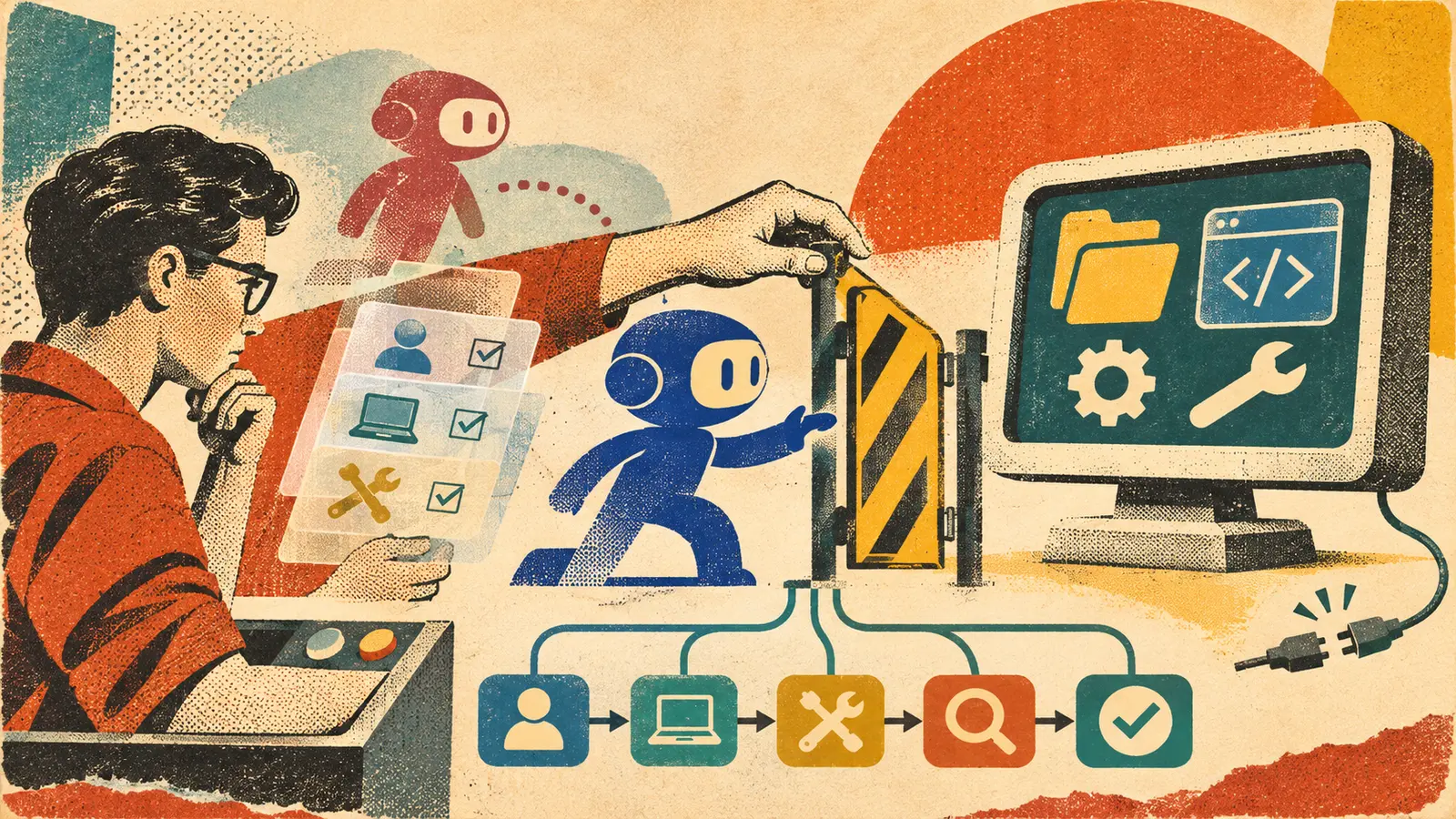
THE SIGNAL IN ONE SENTENCE
A model picker used to answer a simple question: which model do you want to talk to? Open WebUI 0.13.1 turns that menu into something more consequential. Coding agents exposed through Open Terminal, including Claude Code, Codex and Pi, can now appear beside regular chat models. A user can start an agent conversation, choose reasoning effort and service tier where supported, approve tool requests inside the chat and even talk to the agent by voice. That sounds like a tidy interface improvement. It is actually a change in authority. A chat model drafts text. A coding agent may inspect a repository, edit files, run commands, install packages, open network connections and leave behind changes that outlive the conversation. When those two things occupy the same familiar picker, the interface has to communicate the difference before the user clicks. Open WebUI's November 8 release notes describe several guardrails and several rough edges. Each agent conversation is bound to one agent. Agent messages cannot be regenerated, and a user cannot edit and resubmit an earlier prompt in the ordinary chat pattern. If the connected terminal disappears, existing and new agent conversations can fall back to the default model, while earlier replies keep the original agent name. That fallback detail deserves more attention than it will probably get. If a conversation begins with an agent that can act on a computer and later continues with a model that cannot, the identity on screen can become historically true but operationally stale. The user needs to know which system produced each answer, which system currently holds the turn and whether any pending tool action survived the handoff. The same release introduces Tether, a desktop companion for macOS, Windows and Linux. Open WebUI says Tether connects a computer outward to an Open WebUI instance, so no inbound port needs to be opened. Once connected, models, agents and automations can work with real files, repositories and local tools from a browser or phone. The project says output can resume after a temporary drop and that unused sessions expire after 90 days by default. That is a useful architecture. It also means the browser can become a remote control for a machine that contains unfinished code, credentials, customer material and personal files. The correct mental model is not chat with extra buttons. It is a remote execution system wearing chat's comfortable clothes. Open WebUI also adds an optional Auto tool permissions mode. It is off by default. When enabled, a configured scoring model can review a requested tool call and decide whether to allow it automatically. The release notes say that review can include the tool name, its arguments and recent conversation context. If the scoring request fails, times out or cannot fit the needed context, the interface falls back to asking the user. This can reduce approval fatigue. It can also create permission laundering if the human sees fewer requests without receiving a durable explanation of what the scoring model allowed. An automatic reviewer is still a model making a judgment from selected context. It may miss that a path contains production secrets. It may approve a command that is safe in one repository and destructive in another. It may not know that the user asked for analysis, not modification. It may receive sensitive recent messages through a separate API path. So every consequential action needs a permission receipt. The receipt starts with identity. Name the agent, provider, model and version. Show the Open Terminal session and the Tether device that will execute the action. If either identity changes, stop and ask again for actions that were approved under the old identity. Then show scope. Display the exact tool, arguments, working directory, files and network destinations. Summaries such as access files or run command are too vague. A user should be able to tell the difference between reading package.json and recursively rewriting an entire workspace. Next comes consequence. Label whether the action is read-only, creates a file, changes tracked code, installs software, sends data, uses credentials, changes a remote service or can delete material. A plain-language risk class is more useful than a wall of shell syntax, but the exact syntax should remain available. Then record the decision. Was the request approved by the user, a standing rule or the Auto tool permissions model? Which policy and scoring model version were used? What recent context was sent for review? What reason did the reviewer give? When will the grant expire? Finally, record execution. Approval does not prove that a command ran, and a command's exit code does not prove that the intended result occurred. The receipt should keep the start time, end time, output summary, changed files, network calls, errors, retries and final repository state. If a tool loop stops after the same failure twice, as version 0.13.1 now does, the receipt should show both failures and the stop. This is not bureaucracy for its own sake. It is how a person reconstructs a surprising change on Tuesday that began as a casual request on Monday. The release includes other useful improvements. Open WebUI says it no longer rewrites tool definitions on every round, which can improve prompt-cache reuse and reduce cost. Tool Search calls can be batched, tool labels are clearer and search scoring has changed. These are performance and usability improvements, not permission guarantees. Version 0.13.2 followed later on November 8 with targeted fixes, including UUID-related problems. That quick patch is ordinary software practice. It is also a reminder that this is a fresh integration surface. Teams should expect identity, state, reconnection and compatibility bugs while the feature settles. There is a strong reason to try it. Open WebUI gives teams a self-hostable place to reach multiple models and tools. Putting coding agents into the same workspace can make them easier to compare, easier to share and easier to supervise. Tether can let a person start a task from a phone while the actual work happens on a chosen computer. A visible approval panel can be much safer than burying permission questions in a terminal scrollback. The interface can become the control room, provided it behaves like one. That means the picker should distinguish an answer-only model from an acting agent before selection. A persistent badge should show the current agent and device. Pending actions should pause if the terminal disconnects. Reconnection should require proof that the same session and workspace returned. A fallback model should never inherit an old action grant simply because it inherited the conversation. Standing rules need tight boundaries. Allow reading inside one repository, not the whole home directory. Permit tests, not arbitrary package installation. Allow network access to named registries, not the open internet. Expire every grant. Make the emergency stop independent of the agent and the scoring model. Privacy also needs a map. A local computer can send file contents through the selected agent provider, a tool service, Open WebUI, a scoring API, logs and backups. Tether's outbound connection avoids exposing an inbound port, but it does not make every data path local. Administrators should document which system receives prompts, files, tool arguments, recent context, outputs and telemetry. The public release notes verify that the features exist and describe their intended behavior. They do not certify a particular installation, network policy or provider configuration. They do not prove that an automatic reviewer will approve the right actions. They do not remove the need to test the real system with a disposable repository before connecting it to important work. The model picker has become a power picker. That can be excellent. Just make the power visible. Put the agent, machine, action, reviewer, result and fallback identity on one receipt. Then the person can approve the work, inspect the consequences and know exactly which machine in the room moved first.
01
WHAT ACTUALLY CHANGED
Open WebUI 0.13.1 places coding agents exposed through Open Terminal in the regular model picker. The release names Claude Code, Codex and Pi as examples. Agent conversations can use chat or voice, expose supported reasoning and service-tier controls, and request tool approval inside the conversation.
The release adds Tether, a desktop companion for macOS, Windows and Linux. Open WebUI says Tether makes an outbound connection from a computer to the server, allowing models, agents and automations to use local files, repositories and tools without opening an inbound port.
Tool approval can now be reviewed automatically by a configured scoring model. Auto tool permissions are off by default. The reviewer may receive the requested tool, its arguments and recent conversation context. Errors, timeouts and context limits are designed to fall back to human approval.
Agent conversation behavior is deliberately narrower than ordinary chat. One conversation uses one agent, and agent messages cannot be regenerated or edited and resubmitted. If a terminal is lost, the conversation can move to the default model while earlier agent labels remain attached to their original messages.
Open WebUI also changed tool-loop and prompt-cache behavior. The project says repeated identical failures now stop after two attempts, Tool Search requests can be batched and tool definitions are no longer rewritten on every round. Version 0.13.2 followed later November 8 with targeted fixes.
02
WHY THIS MATTERS
A familiar chat surface can now authorize changes to a real computer. The interface must clearly separate a model that suggests code from an agent that can read, write and execute it.
Permission fatigue can become permission laundering. Automatic review may reduce interruptions, but every approval still needs a visible reason, scope and accountable reviewer.
Fallback changes the identity of the system mid-conversation. A user should never assume that the model currently answering has the same tools, context or authority as the agent that started the thread.
An outbound connection is not the same as a local-only data path. Files and recent context may still travel through agent providers, scoring APIs, tools, logs or backups, depending on configuration.
Reconnection creates state risk. If a terminal drops and returns, the system must prove which device, workspace, process and pending action came back before continuing.
A receipt turns a surprising change into an inspectable event. Teams can see what was requested, approved, executed and modified, then reproduce or reverse the result without guessing from chat history.
03
WHERE IT COULD HELP
- Give every acting agent a persistent identity badge showing provider, model, version, Open Terminal session and Tether device.
- Separate answer-only models from tool-using agents in the picker with a clear capability and consequence label.
- Show the exact tool, arguments, working directory, files, paths and network destinations before approval.
- Classify requests as read-only, local write, code execution, package install, credential use, network transmission, remote change or destructive action.
- Keep automatic approval off until the scoring model, policy, context sent for review and fallback behavior have been tested with disposable work.
- Pause pending actions when the terminal disconnects. Require identity and workspace revalidation after reconnection.
- Invalidate unexecuted approvals when the agent, model, device, repository, branch, working directory or tool arguments change.
- Scope standing grants to one repository, named commands, explicit destinations and short expiration times.
- Record the reviewer, decision, reason, policy version, scoring model and the portion of conversation context shared for each approval.
- After execution, attach exit status, changed-file summary, network activity, errors, retries and repository diff to the same receipt.
- Run Tether through a dedicated operating-system account with minimal file access and no production credentials by default.
- Provide an emergency stop outside the agent, terminal and review model, then test it during a simulated disconnect and runaway tool loop.
KEEP A HAND ON THE WHEEL
Open WebUI 0.13.1 and 0.13.2 were released November 8. The reviewed evidence is the project's own release documentation and public repository. This article does not independently certify the security, privacy or reliability of a particular Open WebUI, Open Terminal or Tether installation. The release notes describe coding-agent support and Tether behavior, but actual capabilities depend on the connected agent, provider, operating system, permissions, tool configuration, network policy and Open WebUI deployment. A model appearing in the picker does not mean every listed integration works identically. Tether uses an outbound connection, according to Open WebUI. That can reduce exposure compared with opening an inbound port, but it does not make the entire workflow local. Prompts, files, tool arguments, recent context, outputs and telemetry may still reach other services. Auto tool permissions are off by default. The scoring model's decision is probabilistic and context-limited. It can miss destructive intent, approve an unsafe path or receive sensitive context. It should be treated as a review aid, not a security boundary or compliance certificate. The release says failures, timeouts and context limits fall back to human approval. Administrators should test those paths rather than assuming the fallback works under every outage or provider error. Agent conversations have editing and regeneration limits, and a terminal loss can cause fallback to the default model. Teams should verify how identity, pending requests, session state and audit history behave across a disconnect before using the system on important work. Version 0.13.2 followed with targeted fixes on the same day. Fast patching is normal, but it also means teams should pin and record exact versions instead of referring only to 0.13. Examples in this article such as risk classes, permission receipts, identity revalidation, independent emergency stops and dedicated operating-system accounts are editorial recommendations. They are not all confirmed features of the release. Finally, a complete audit log can contain secrets, file paths, code and conversation material. Protect the receipt itself with access controls, retention limits and redaction that preserves accountability without copying sensitive data into a second risky store.
04
TERMS WORTH KEEPING
SOURCES AND VERIFICATION STATUS
This article was written from the materials below. Product claims and dates were checked against those sources on November 9, 2026.
THE PUBLICATION ENGINE
WANT A SIGNAL OF YOUR OWN?
We build source-grounded publications, private briefings, and editorial systems for organizations with something useful to say.
WORK WITH US