THE SIGNAL IN ONE SENTENCE
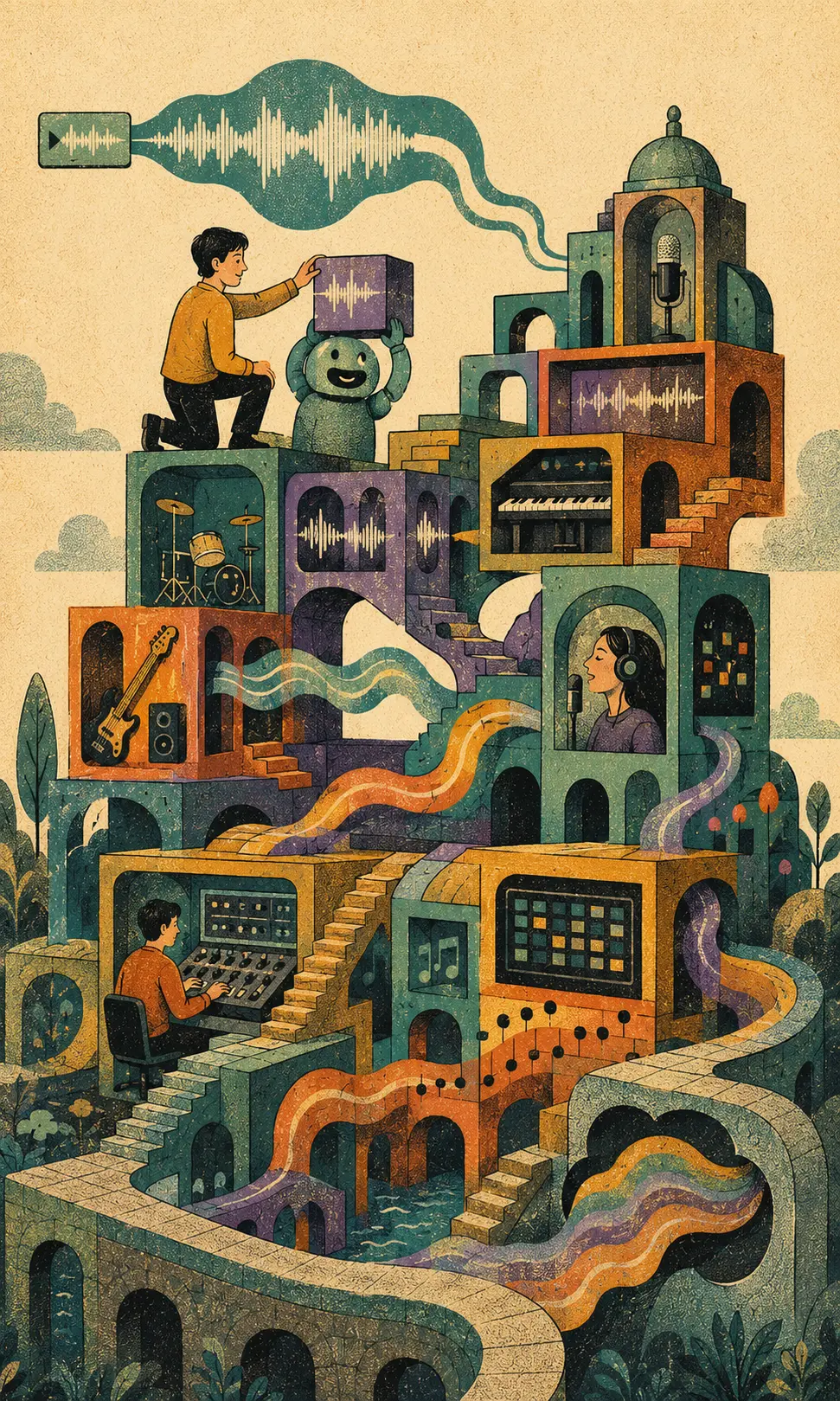
Google’s new music model can maintain verses, choruses, bridges, lyrics, and vocals across a complete song instead of producing only a short musical fragment.
01
WHAT ACTUALLY CHANGED
Google released Lyria 3.5 in public preview through the Gemini API. Developers can provide text or image prompts and request full-length songs containing multiple verses, choruses, bridges, lyrics, and vocals.
The model returns 44.1 kHz stereo audio as an MP3, plus lyrics as text. Its documentation describes fine-grained control over song duration and structure, with a 131,072-token input limit for unusually detailed creative instructions.
Google says the release improves musical coherence and produces more natural vocals than earlier Lyria versions. Those are quality claims from the model maker. The public preview makes independent listening and workflow testing possible, but it does not make subjective quality a settled fact.
The current model is specialized rather than a general Gemini tool user. Its documentation does not list function calling, code execution, structured output, file search, or caching. The product is the generated song, not an autonomous music-production agent.
02
WHY THIS MATTERS
Length changes what a music model can be used for. A polished twenty-second clip works as a demo or transition. A song that keeps its structure together for several minutes can enter songwriting, editing, game design, advertising, and soundtrack prototyping.
The human value is fastest iteration. A creator can test whether a scene wants sparse strings, a crooked synth pulse, or an enormous chorus before committing a production budget. Used well, the model becomes a sketchbook for sound rather than a replacement claim disguised as software.
The obligations grow with the output. Full songs raise sharper questions about training provenance, stylistic imitation, artist consent, ownership, disclosure, and how platforms distinguish generated work from music made through other processes.
03
WHERE IT COULD HELP
- Prototype soundtracks before commissioning final music
- Build adaptive music for games and interactive stories
- Translate visual mood boards into musical references
- Explore arrangements and song structures during early composition
KEEP A HAND ON THE WHEEL
Lyria 3.5 is a public preview, and Google’s quality descriptions require independent listening. Buyers and creators should also inspect terms covering commercial use, attribution, generated-content labeling, stylistic imitation, and ownership before shipping the output.
04
TERMS WORTH KEEPING
OPEN GLOSSARY CARD
Inference
The moment a trained model uses what it learned to produce an answer.
OPEN GLOSSARY CARD
Public preview
An early release that people can try while its maker continues testing and changing it.
OPEN GLOSSARY CARD
Generative model
A model that produces new material such as text, images, audio, or code from instructions and learned patterns.
SOURCES AND VERIFICATION STATUS
This article was written from the materials below. Product claims and dates were checked against those sources on September 4, 2026.
PUBLICATION RECEIPT: Revision 1. Approved by Zak and published September 4, 2026.
THE PUBLICATION ENGINE
WANT A SIGNAL OF YOUR OWN?
We build source-grounded publications, private briefings, and editorial systems for organizations with something useful to say.
WORK WITH US