THE SIGNAL IN ONE SENTENCE
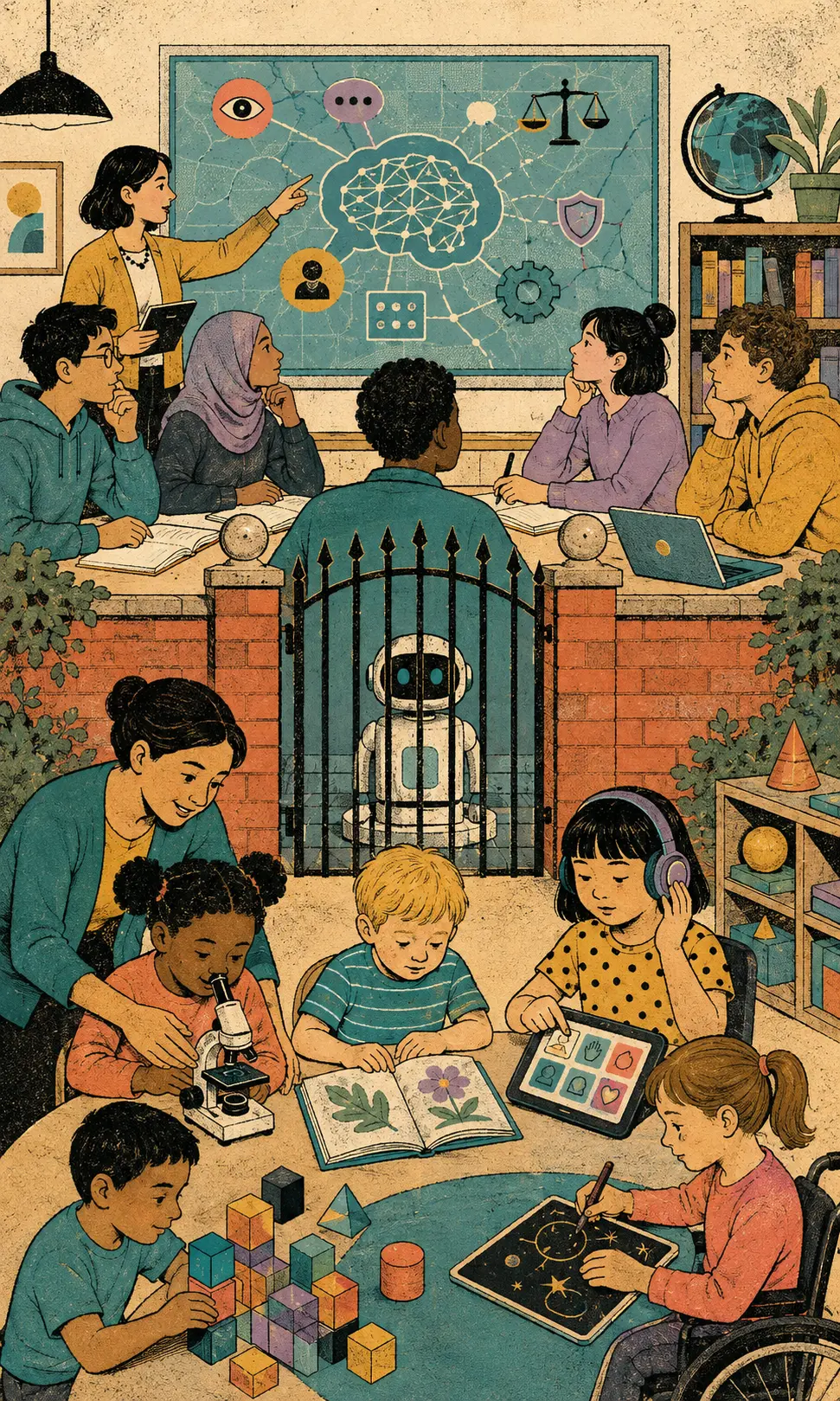
New York City is drawing different AI boundaries by age, purpose, supervision, and consequence instead of treating every classroom use as the same thing.
01
WHAT ACTUALLY CHANGED
New York City announced a one-year moratorium on student-facing generative AI for students from 2-K through eighth grade during the 2026-27 school year. The policy affects nearly 600,000 students in the nation’s largest public school system.
Companion chatbots are prohibited across every grade. Schools also cannot use AI to make decisions about grading, behavior monitoring, placement, promotion, or graduation. Those restrictions matter because a classroom helper and an automated judgment about a child are not remotely the same risk, despite sharing the convenient label of AI.
High school students will receive two AI-literacy modules each year. Up to 50,000 students may participate in limited, teacher-supervised pilots. Assistive technologies required by an IEP or 504 plan remain protected, preventing the broad restriction from quietly removing tools that some students need to participate at all.
A coalition of students, educators, parents, advocates, unions, and experts is expected to publish recommendations in April 2027. The moratorium therefore creates a defined period for gathering evidence rather than declaring a permanent answer before the experiment begins.
02
WHY THIS MATTERS
Most school AI rules have been blunt: block one website, permit everything, or leave every teacher to improvise. New York City is attempting something more granular. Age, educational purpose, supervision, accessibility, and the consequence of a decision each change the boundary.
The policy could protect the slow, social work of learning for younger students while giving older students a structured way to understand the systems they will encounter outside school. It could also deprive classrooms of useful tools if the pilots are timid or the evaluation is vague. The quality of the evidence collected during the pause will determine whether this is policy or merely a long timeout.
The most important design choice may be the protected accessibility exception. Responsible AI policy should distinguish between optional convenience and a tool that gives a student access to communication, reading, writing, or participation.
03
WHERE IT COULD HELP
- Protect hands-on learning and teacher interaction in younger grades
- Teach AI literacy before encouraging routine classroom use
- Run bounded high school pilots against defined learning goals
- Preserve required accessibility tools while restricting general chatbots
KEEP A HAND ON THE WHEEL
The policy is clear, but the educational outcomes are not known yet. Watch how schools define approved tools, train teachers, measure pilot results, enforce the companion-chatbot ban, and prevent accessibility exceptions from becoming either loopholes or casualties.
04
TERMS WORTH KEEPING
SOURCES AND VERIFICATION STATUS
This article was written from the materials below. Product claims and dates were checked against those sources on September 2, 2026.
PUBLICATION RECEIPT: Revision 1. Approved by Zak and published September 2, 2026.
THE PUBLICATION ENGINE
WANT A SIGNAL OF YOUR OWN?
We build source-grounded publications, private briefings, and editorial systems for organizations with something useful to say.
WORK WITH US