THE SIGNAL IN ONE SENTENCE
Speech recognition has a habit of getting the sentence mostly right and the important bit spectacularly wrong. Salesforce has released SOV-Transcribe-1, an open-weight model for non-streaming speech recognition. The model card lists an Apache 2.0 license, seven languages and support for natural-language instructions that control how a transcript is written. Developers can ask for verbatim speech or cleaned-up text, choose punctuation and capitalization, and specify how numbers should be formatted. They can also provide context: names, technical vocabulary or a short description of the subject. The model uses those hints to improve recognition of difficult terms. That is useful. It is also where the evaluation needs to get more serious than a single average. Salesforce says SOV-Transcribe-1 has 26.6 billion total parameters, with 4.6 billion active parameters, including the audio encoder. Its architecture combines a Whisper large-v3 audio encoder with a Gemma 4 mixture-of-experts language model. It accepts 16 kHz audio, optional instructions and context, and produces transcript text. The model card lists English, French, German, Spanish, Italian, Portuguese and Dutch. Audio up to 30 minutes has been tested. The model is designed for batch transcription rather than live streaming. Salesforce reports that it ranked first among open-weight non-streaming speech systems on an Artificial Analysis leaderboard snapshot and second among 23 systems on VoiceCodeBench as of November 12. Those rankings are project-reported evidence, not a guarantee for a particular microphone, room, accent or workflow. The company also publishes prompts and evaluation procedures for reproducing public benchmark tests. That is good practice. The plain-language signal is this: do not grade a transcript only by how many words it got right. Grade the words that can change the outcome. That means building a critical-entity scorecard. Start with names. A transcript can preserve every filler word and still fail if it changes a patient's name, a witness, a customer, a company, a medicine or a town. Names are hard because they are unevenly represented, pronounced differently across languages and often acoustically similar. They are also easy to normalize into the wrong familiar spelling. Build a test set from the names that actually appear in the work. Include common names, rare names, names from relevant communities, double surnames, hyphenated names, initials and names spoken with different accents. Do not publish the test set from live customer or patient records without permission. Use consented recordings, synthetic examples and carefully protected internal evaluation where necessary. Score exact spelling, not only whether the transcript produced something name-shaped. Then test numbers. Phone numbers, dates, times, prices, account numbers, measurements, dosages and quantities can carry more operational weight than the surrounding paragraph. The model can be instructed to write numbers as words or digits. That formatting control should be tested separately from recognition. If someone says fifteen and the transcript writes 15, that may be an acceptable normalization. If it writes 50, the format is not the problem. Score the spoken value, the displayed value and the transformation rule. A clean-looking transcript should never hide a changed quantity. Then test contact information. Email addresses are a small torture chamber for speech systems. Letters, dots, underscores, uncommon domains and words such as at or dash can all be interpreted as ordinary language. Create exact-match tests for emails, phone numbers, web addresses and identifiers. Mark a failure if the result cannot be used without a person replaying the audio. Then test domain terms. Every workplace has vocabulary that a general benchmark barely sees: product names, equipment, legal citations, medical terms, chemical names, software packages, fishing lakes, street names and internal acronyms. SOV-Transcribe-1 supports context biasing, which lets a developer provide likely terms or a description of the domain. That does not end the test. It creates two new ones. First, does the hint help when the term is actually spoken? Second, does the hint cause the model to insert the term when the speaker said something else? A vocabulary list can improve recall and create suggestion bias at the same time. Test both presence and absence. Keep hints focused. Salesforce's own best-practice guidance recommends relevant names, terms or a short domain description. A giant keyword dump can turn context into noise. Next, test style instructions. Verbatim and cleaned-up transcripts serve different purposes. A verbatim record may need fillers, repetitions, unfinished phrases and the speaker's exact grammar. A cleaned record may be more useful for notes or publication. The danger arrives when the cleaned version is treated as if it were a literal record. Store the instruction with the transcript. Label the output clearly: verbatim, lightly cleaned, edited summary or another defined mode. Preserve the original audio and, for consequential work, a raw transcript beside the cleaned version. Do not let punctuation quietly become meaning. The sentence let's eat, Grandma is not the same thing as let's eat Grandma. Speech models are allowed to understand commas. Records are not allowed to forget that the comma was inferred. Now add conditions. Test each critical entity across microphones, rooms, background noise, distance, compression and speaking speed. Include speakers who overlap, hesitate, whisper, shout, use code-switching or speak through a poor connection. The Salesforce model card reports robustness to accents and noise. A team still needs to define which accents, which noise and which error rates are acceptable in its own setting. Average word error rate can hide subgroup failure. If ninety-nine routine sentences are easy and one medication name is wrong, the average may look excellent while the workflow remains unsafe. Break results out by language, accent, speaker condition, entity type and consequence. Do not merge seven languages into one comforting number. Language support also does not imply equal performance. Publish the sample count and error rate for each tested language. Include regional varieties and code-switching when the product will encounter them. State which language conditions were not tested. Then grade the workflow, not only the model. A transcript may pass through audio preprocessing, segmentation, a vocabulary service, the model, repetition cleanup, formatting and a downstream summary. Any stage can change the result. SOV-Transcribe-1's model card notes that rare repetition loops can continue until the output limit and describes a cleanup step. If cleanup runs in production, preserve its version and test whether it ever removes legitimate repetition. A person saying no, no, no may be repeating a character sequence. They may also be refusing something three times. Measure the audio that entered the model, the prompt, the hints, the raw output, the cleanup result and the final record. Without that chain, a team cannot tell whether a bad entity came from the microphone, the model or post-processing. The scorecard should have a severity column. Not every error needs the same response. Changing um to nothing may be harmless in a cleaned meeting note. Changing 13 to 30 can be serious. Changing a medicine, bank amount, legal deadline or person's identity can require the transcript to stop before it becomes a record. Define severity before evaluation. Do not wait for a failure to decide that the word was important. For each critical entity, record: What was spoken. What the model returned. Whether a context hint was used. Whether formatting changed the surface form. Whether a human corrected it. How long correction took. What would have happened without correction. That last field connects accuracy to consequence. The human review rule should follow the risk. An internal draft of a casual meeting can tolerate more automation than a clinical note, legal deposition, financial instruction or emergency call. High-impact workflows need a reviewer who can replay the exact audio segment, see the model's hints and change the record before it acts on anyone. Do not make the reviewer hunt through thirty minutes of audio. Link each flagged entity to its timestamp. Show nearby words. Make uncertainty visible. If the model does not provide trustworthy confidence for the entity, use application-level rules and targeted rechecks rather than inventing a percentage. Open weights make some controls easier. An organization can run SOV-Transcribe-1 on its own infrastructure, inspect the model package, pin a version and keep audio inside an environment it controls. That can matter for privacy, data location and customization. Open weights do not make the deployment small. Salesforce's serving examples use substantial GPU hardware. Its published speed tests include an NVIDIA RTX PRO 6000 Blackwell with 96 GB of memory. The model card reports throughput and latency under specific software, precision and test conditions. Those are useful engineering results, not a universal performance promise. Budget memory, hardware, energy, operations, model loading, concurrency and fallback behavior. Test what happens when the audio is too long, the GPU is unavailable, the output truncates or the transcript begins repeating. Self-hosting also moves responsibility. The organization must patch dependencies, protect stored audio, restrict model access, log administrative actions, monitor failures and delete data on schedule. Keeping audio on your own machines is valuable only if your own machines are well governed. Before production, run a paired evaluation. Compare SOV-Transcribe-1 with the current transcription system on the same consented audio. Do not change the microphone, normalization, prompts or scoring rules between systems. Measure ordinary word error rate, then the critical-entity scorecard. Measure correction time, not only automatic accuracy. A system that makes fewer errors but hides them may create more work than a system that flags uncertainty honestly. Run context-bias tests with correct hints, misleading hints, irrelevant hints and no hints. Run style tests with verbatim, cleaned and number-formatting instructions. Run failure tests with silence, music, clipped audio, multiple languages, long pauses and recordings near the tested duration limit. Run privacy tests to confirm that one user's hints, audio and transcript cannot appear in another user's job. Run version tests whenever weights, plugins, prompts, decoding parameters or cleanup code change. Then publish the scorecard where the people using the transcript can see it. State the languages, conditions, entity types and hardware tested. State the errors that remain. State which uses require human review and which uses are prohibited. A model can be open-weight and still be a black box to the person harmed by a bad transcript. SOV-Transcribe-1 gives developers more control over where speech is processed and how a transcript is shaped. The critical-entity scorecard makes that control visible where it matters: the exact name, number or term that someone will act on next.
01
WHAT ACTUALLY CHANGED
Salesforce released SOV-Transcribe-1 as an Apache 2.0 open-weight model for non-streaming automatic speech recognition.
The model card lists 26.6 billion total parameters and 4.6 billion active parameters, including the audio encoder.
The architecture combines a Whisper large-v3 audio encoder with a Gemma 4 mixture-of-experts language model.
Developers can use natural-language instructions to request verbatim or cleaned transcripts and control punctuation, capitalization and number formatting.
Context biasing lets developers provide names, domain vocabulary or a short topic description.
The listed languages are English, French, German, Spanish, Italian, Portuguese and Dutch.
The model card says audio up to 30 minutes has been tested and documents vLLM and Hugging Face Transformers workflows.
Salesforce publishes benchmark prompts, metrics and reproduction procedures alongside company-reported rankings.
02
WHY THIS MATTERS
Average word error rate can hide mistakes in names, numbers and technical terms that change a real outcome.
Context hints can improve recognition and can also bias a model toward words that were never spoken.
Style instructions can turn a literal record into cleaned prose unless the transformation remains visible.
Open weights give organizations more control over deployment and audio data, while moving security and operational responsibility to them.
Performance can vary across languages, accents, rooms, microphones and background noise.
High-impact transcripts need timestamps, replayable evidence and authorized human correction before downstream action.
03
WHERE IT COULD HELP
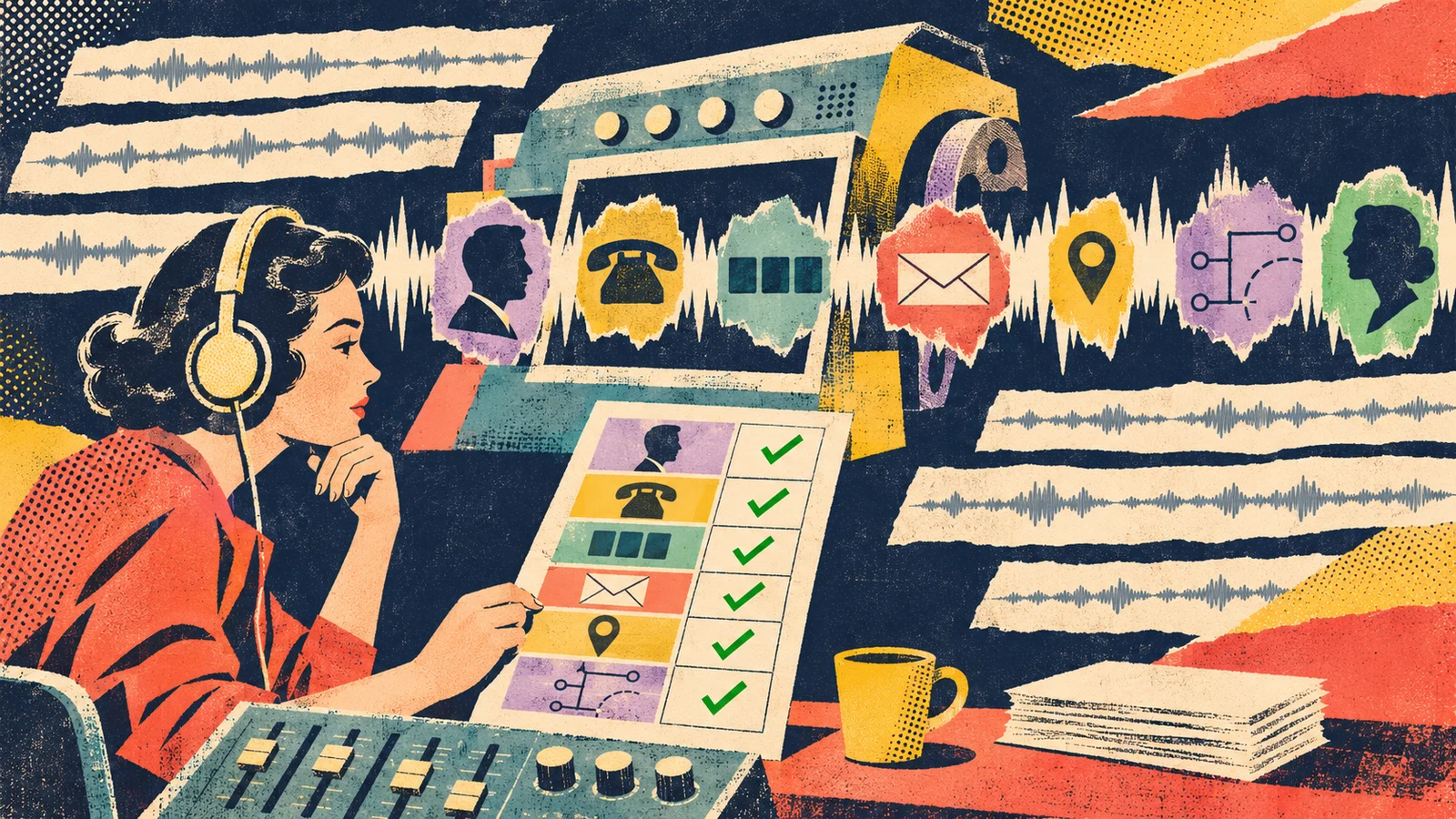
- Build a consented test set from names, numbers and domain terms used in the real workflow.
- Score names, emails, phone numbers, dates, amounts and measurements by exact value.
- Separate recognition accuracy from formatting and normalization accuracy.
- Test context hints when the suggested term is present and when it is absent.
- Store the transcription instruction with every output.
- Label transcripts as verbatim, cleaned, summarized or another defined mode.
- Preserve raw output before repetition cleanup or formatting.
- Break error rates out by language, accent, speaker condition, noise and entity type.
- Assign severity before testing and require review for high-impact entity errors.
- Link flagged entities to replayable audio timestamps and nearby words.
- Compare model versions on identical audio, prompts and scoring rules.
- Test silence, clipping, music, long recordings, code-switching and overlapping speech.
- Protect audio, prompts and vocabulary hints with application-level access controls.
- Publish hardware, latency, correction time, known failures and prohibited uses with the scorecard.
KEEP A HAND ON THE WHEEL
Salesforce's ranking, accuracy, latency and throughput figures are project-reported and reflect specified benchmark or hardware conditions. They are not independent field tests for every language, accent or environment. The model is designed for non-streaming transcription. It should not be described as a live speech system without a separate tested architecture. The listed language support is English, French, German, Spanish, Italian, Portuguese and Dutch. Support does not establish equal performance across languages or regional varieties. The model card says audio up to 30 minutes has been tested. Production limits can also depend on serving software, memory, output length and configuration. Context biasing can help difficult terms and can create suggestion bias. Test hinted terms when present and absent. Apache 2.0 licensing and local deployment do not guarantee low hardware cost, privacy, security, accuracy or fitness for legal, clinical, financial or safety-critical use. Original release date: November 12, 2026. Verified November 13, 2026.
04
TERMS WORTH KEEPING
SOURCES AND VERIFICATION STATUS
This article was written from the materials below. Product claims and dates were checked against those sources on November 13, 2026.
THE PUBLICATION ENGINE
WANT A SIGNAL OF YOUR OWN?
We build source-grounded publications, private briefings, and editorial systems for organizations with something useful to say.
WORK WITH US