THE SIGNAL IN ONE SENTENCE
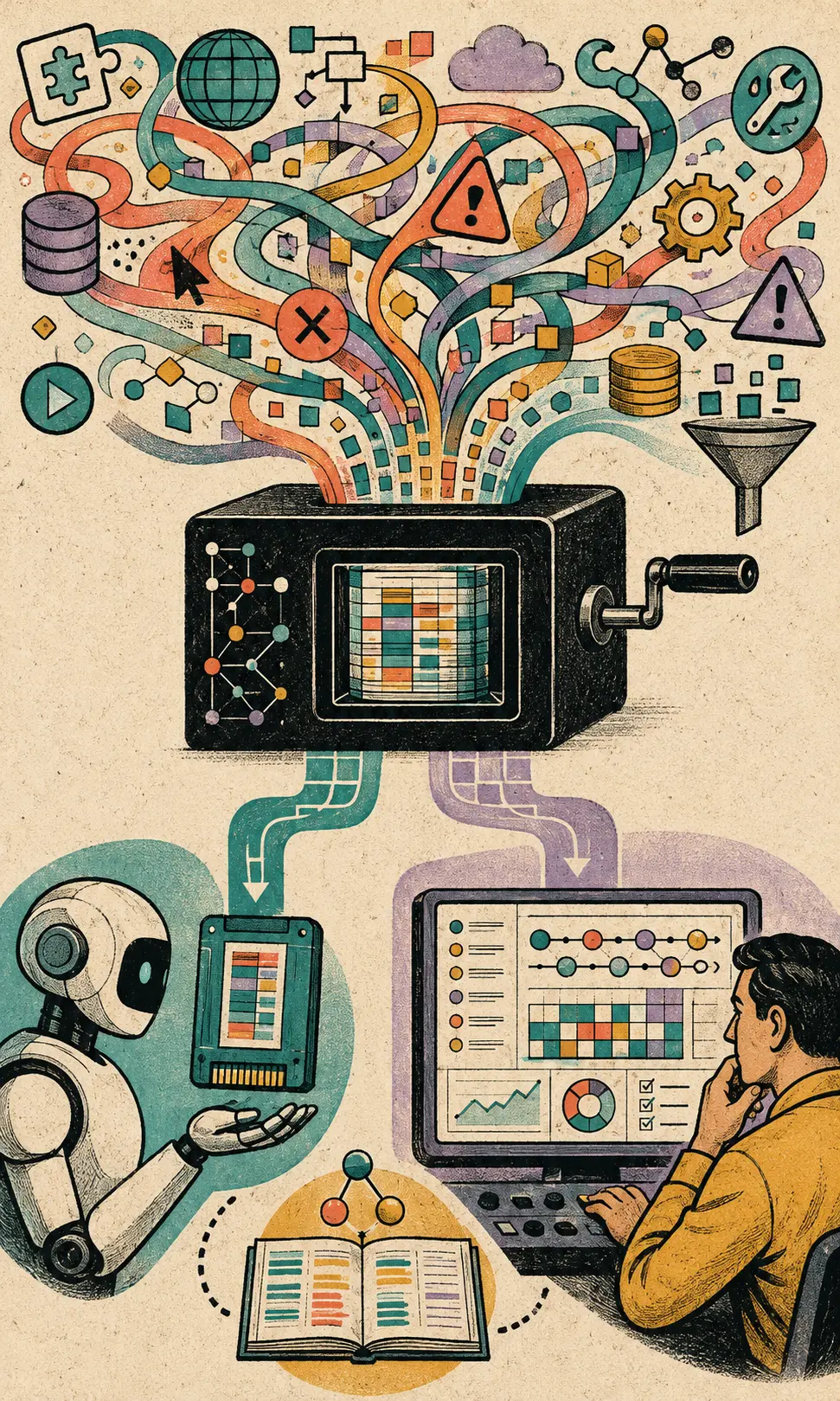
TraceLab preserves an agent’s raw history as structured state, then compiles smaller views for the machine doing the work and the person trying to understand it.
01
WHAT ACTUALLY CHANGED
Salesforce AI Research released TraceLab, an open-source system for managing the activity stream produced by long-running agents. Tool calls, decisions, failures, costs, outputs, and unresolved work enter an append-only ledger instead of being flattened into one enormous conversation transcript.
The same ledger can produce different compiled views. The agent receives compact state that helps it continue within a limited context window. A human observer receives a readable monitoring view designed to answer practical questions about what happened, what changed, and where the task may need intervention.
In the accompanying research, the compressed observer view answered monitoring questions with about 14 to 15 times fewer input tokens and at five to seven times lower cost than a budget-capped reading of the raw trace. Reported accuracy was 0.85 to 0.87, compared with 0.48 for the raw-trace approach.
The repository includes 99 tests, benchmark results, spending records, synthetic traces, and a reproducible dataset. The authors also disclose a meaningful limitation: the observer questions were designed alongside the schema, so the reported advantage may shrink on workflows with very different needs.
02
WHY THIS MATTERS
Long-running agents create more history than either the model or its supervisor can sensibly reread. Replaying the whole transcript is expensive. Summarizing it into free-form prose can erase the one exact decision or failure that matters during an incident.
TraceLab treats history as structured state rather than a very long bedtime story. That makes agent memory and human observability two views of the same infrastructure. One helps the machine continue. The other helps a person judge whether it should.
The append-only design also preserves evidence. A compiled view can be regenerated for a different question without pretending the older events never happened. That matters in regulated, expensive, or simply complicated workflows where a neat answer is not enough and someone eventually asks for the receipt.
03
WHERE IT COULD HELP
- Monitor coding agents that run across hours or days
- Preserve decisions, failures, costs, and unresolved work
- Feed compact state back into an agent with limited context
- Create auditable incident records for regulated workflows
KEEP A HAND ON THE WHEEL
The public materials are unusually reproducible, but the evaluation uses synthetic traces and questions shaped alongside the schema. Teams should test TraceLab on their own agents, failure modes, observer questions, and retention requirements before relying on the reported gains.
04
TERMS WORTH KEEPING
OPEN GLOSSARY CARD
Context window
The amount of input and generated material a model can consider during one call.
OPEN GLOSSARY CARD
Context window
The amount of information a model can actively consider at one time.
OPEN GLOSSARY CARD
Audit trail
A durable record of actions, changes, identities, and times that lets someone reconstruct what happened.
SOURCES AND VERIFICATION STATUS
This article was written from the materials below. Product claims and dates were checked against those sources on September 2, 2026.
PUBLICATION RECEIPT: Revision 1. Approved by Zak and published September 2, 2026.
THE PUBLICATION ENGINE
WANT A SIGNAL OF YOUR OWN?
We build source-grounded publications, private briefings, and editorial systems for organizations with something useful to say.
WORK WITH US