THE SIGNAL IN ONE SENTENCE
The system begins with a guided conversation about what the student wants, then uses AI to turn those goals into options and an educator-ready plan.
01
WHAT ACTUALLY CHANGED
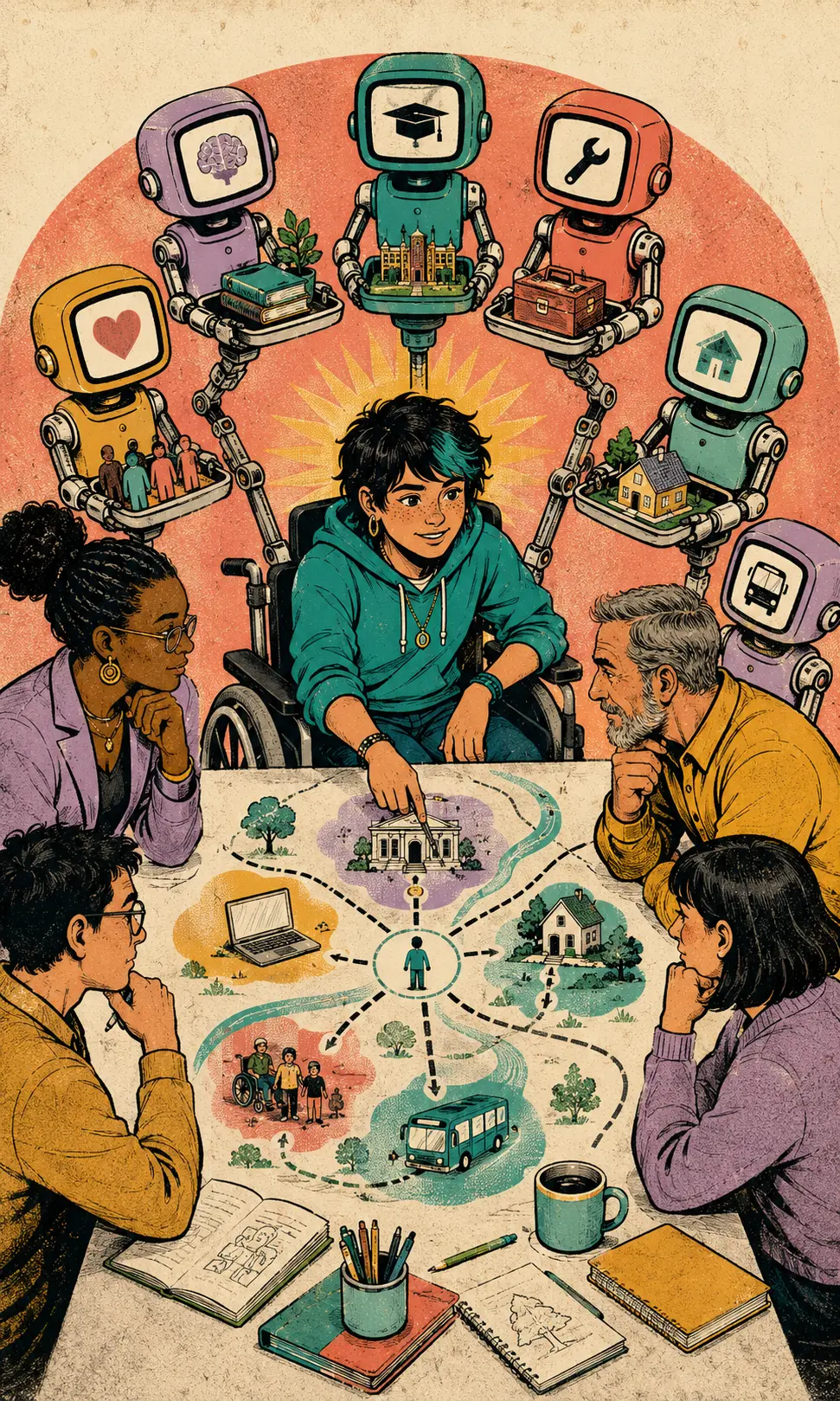
University Startups and its partners published the production architecture behind Trinity, an AI-assisted transition-planning system for students with disabilities. Rather than beginning with adults writing a plan about a student, the workflow invites the student to discuss strengths, interests, education, employment, community, and independent-living goals.
Six specialized agents divide the work across discovery, career exploration, postsecondary options, independent living, compliance, and document generation. The system searches more than 30,000 college records, 1,000 occupations, and 5,000 training programs, then produces an IDEA-aligned transition-plan PDF for educator review.
Speech input and audio output support different interaction needs. The architecture also includes field-level encryption, role-based access, and retention controls for sensitive student information. The company says Trinity is operating across more than a dozen states and can create a draft plan in five to ten seconds.
Speed is useful, but the more meaningful shift is authorship. The student’s own account of interests and goals becomes the starting material. The machine organizes options and paperwork around that voice instead of using automation to make an adult-centered process merely faster.
02
WHY THIS MATTERS
Transition plans sit at an awkward intersection of identity, education, employment, accessibility, local opportunity, family support, and legal compliance. This is one of the cases where several specialized agents may reflect genuine complexity rather than an architecture diagram suffering from enthusiasm.
The system could widen a student’s view of what is possible and reduce the paperwork burden on educators. It could also narrow choices if the underlying records are incomplete, the conversation nudges students toward familiar paths, or adults treat the generated plan as a conclusion rather than a draft.
The test is not how quickly Trinity fills a form. It is whether students feel accurately heard, discover options they value, can challenge the output, and retain meaningful control over a plan that describes their future.
03
WHERE IT COULD HELP
- Support student-led postsecondary transition planning
- Find careers and training programs matched to goals and support needs
- Offer speech and audio interaction for different accessibility needs
- Generate a compliance-aware draft for educators to review and revise
KEEP A HAND ON THE WHEEL
The architecture and deployment details come from an AWS customer case study and participating vendors. Independent research still needs to test student outcomes, bias, data quality, privacy in daily school use, and whether students actually experience greater agency.
04
TERMS WORTH KEEPING
OPEN GLOSSARY CARD
Grounding
Connecting an AI answer to specific outside information that can support it.
OPEN GLOSSARY CARD
PHI
Protected health information that can identify a person and relates to their health or care.
OPEN GLOSSARY CARD
Agent orchestration
Coordinating several agents, tools, or specialist roles across one larger task.
SOURCES AND VERIFICATION STATUS
This article was written from the materials below. Product claims and dates were checked against those sources on September 2, 2026.
PUBLICATION RECEIPT: Revision 1. Approved by Zak and published September 2, 2026.
THE PUBLICATION ENGINE
WANT A SIGNAL OF YOUR OWN?
We build source-grounded publications, private briefings, and editorial systems for organizations with something useful to say.
WORK WITH US