THE SIGNAL IN ONE SENTENCE
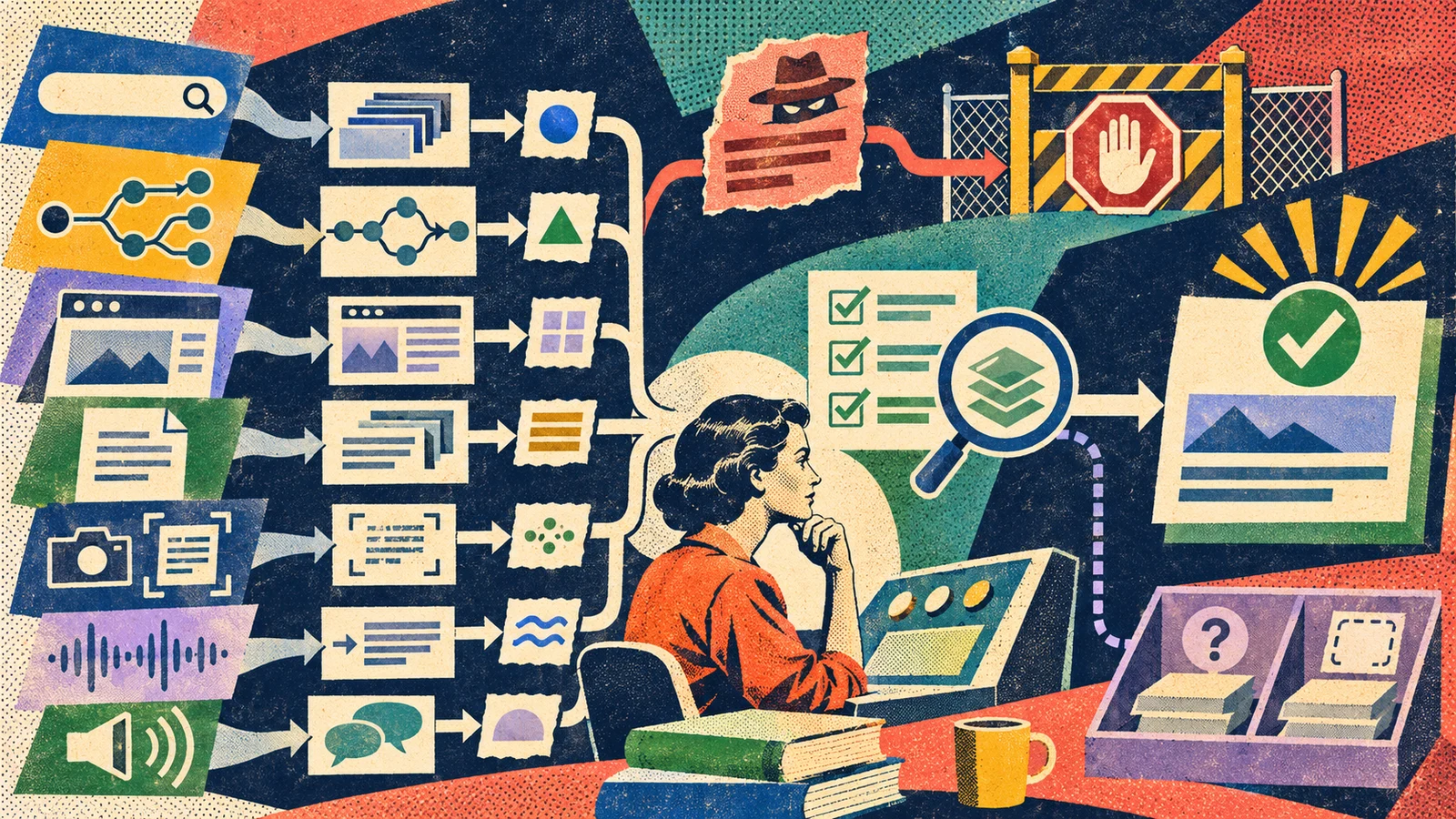
DeepSeek has opened the tool cabinet behind its app. Developers can now enable web search, multi-step search, file input, URL reading and a model safety check around the deepseek-flash model. DeepSeek says those capabilities work through its Messages, Responses and Chat Completions APIs. It also offers Search and Fetch, optical character recognition, speech recognition and text-to-speech as standalone APIs. The company released an open-source demo chat client built on the same pieces. That is a lot of context machinery in one release. It is also a good way to lose the plot. When a model can search, choose a result, fetch a page, parse a PDF, read text from an image, transcribe speech and then write an answer, the final paragraph is the least interesting part of the evidence chain. The important work happened before the first sentence appeared. Which query did the system run? Which results did it see? Which pages did it fetch? What content did the parser omit? Did an image become text through OCR? Did a recording become text through speech recognition? Did the model follow an instruction hidden inside a page instead of the user's request? If a developer cannot answer those questions, a cited response can still be a very tidy mystery. The plain signal is simple. Preserve the search and file trail. Start before search. Record the user's original question, the application instruction, the model name and version, the enabled tools, the time, the locale and any limits placed on sources, dates or domains. Then preserve every search query exactly as it was sent. Multi-step search makes this especially important. A model can reformulate a question, narrow it, broaden it, translate it or chase a phrase from one result into another. That can be useful. It can also create quiet query drift. A user asks about a proposed law. The first query searches for the bill. A second query searches for commentary. A third searches for criticism of one provision. By the end, the system may have assembled a persuasive answer from material selected by its own intermediate framing. Keep each query, its order, the reason it was run and the stop condition. Show which query found each source. If the system abandons a path, record that too. Search results need their own receipt. Save the rank, displayed title, publisher, result URL, canonical URL where available, snippet, publication date, update date, retrieval time, language and result type. Preserve whether the result was an ordinary webpage, image, document, forum post or generated summary. Do not treat a snippet as the source. A snippet is a clue produced by a search system. It can be clipped, stale or assembled from text that is not visible on the current page. A model should not turn that clue into a factual claim unless the underlying material supports it. Fetching is a separate event. Record the requested URL, every redirect, final URL, response status, content type, fetch time, cache state and content hash. Mark whether the page was complete, truncated, blocked, paywalled, dynamically rendered or unavailable. If the fetch failed, say so. An empty page is not evidence that the claim is false. A blocked page is not permission to rely on the search snippet. A stale cache is not today's policy. A login page is not the private account page the user thought the tool had read. URL reading also needs a security boundary. Treat every fetched page as untrusted input. A page can contain instructions aimed at the model, invisible text, misleading metadata, poisoned citations or links to internal addresses. It can try to make the agent reveal a secret, ignore the user, call another tool or send data somewhere else. That is prompt injection, and it does not become harmless because it arrived wearing a footnote. Fetch in a quarantine. Block private and local network ranges. Restrict redirects. Validate the scheme, host, content type and size. Strip active content. Do not send cookies, session tokens or internal headers unless a narrowly authorized workflow requires them. Keep credentials out of page text and model context. Separate page content from instructions. The model may summarize a page. The page does not get to rewrite the system policy. Files need a provenance record before they need a summary. Save the original filename, source, owner, upload time, file type, byte size and cryptographic hash. Record who had permission to provide it and what the application was allowed to do with it. Then record the extraction method. DeepSeek says files can enter the conversation after plain-text extraction or rich-layout parsing. Those routes are not equivalent. Plain text can flatten tables, lose columns, detach footnotes and scramble reading order. Rich layout can preserve more structure while still misidentifying sections, captions or page boundaries. Show which pages were processed, which were skipped and where extraction failed. Preserve the extracted text separately from the original file. A reviewer should be able to compare them. Optical character recognition adds another transformation. OCR can misread a decimal point, swap a letter for a number, drop a minus sign or invent a word from a smudge. It can struggle with handwriting, low contrast, rotation, multiple columns, stamps, charts and mixed languages. Do not smooth those errors into confident prose. Keep page coordinates, confidence where available and the image crop behind consequential text. Flag low-confidence numbers and names for human review. If a table drives a conclusion, preserve the table structure rather than feeding the model a bag of cells. Speech recognition needs the same honesty. Keep the source recording, time codes, speaker labels, language, model version and any vocabulary hints. Mark uncertain passages. Test performance across accents, noise, overlap, microphone quality and domain terms. Names, dosages, account numbers, addresses and dates deserve a critical-entity check. A transcript can look fluent while getting the one word that matters exactly wrong. Text-to-speech sits at the other end of the chain. A synthetic voice can make an answer feel more settled than the evidence warrants. Disclose that the voice is generated. Preserve the exact text that was spoken. Do not let tone substitute for confidence reporting, and do not imitate a real person without authority. The evidence trail should survive the final synthesis. Bind each consequential claim to the specific passage that supports it. Store the source URL or file hash, the relevant excerpt location, the extraction method and the retrieval time. If a claim combines several sources, show that combination. A citation at the end of a long paragraph is not enough when only one sentence came from the source. Mark analysis as analysis. The official DeepSeek change log establishes which tools the company says are available. It does not establish that the search results are complete, that citations support every claim, that extraction is accurate, that prompt injection is resisted or that the service is appropriate for a legal, medical, financial or public-sector decision. Those questions require testing. Build failure states into the interface. The system needs explicit states for no results, contradictory results, undated material, fetch failure, partial page, unsupported file, extraction failure, low-confidence OCR, uncertain transcription, safety refusal and missing citation. Do not collapse them into a generic apology. Each one asks for a different next move. If sources disagree, show the disagreement. If a page has no publication date, say so. If only part of a file was parsed, identify the missing pages. If a model safety check refuses a request, preserve the refusal category without exposing sensitive internal logic. DeepSeek describes its model safety option as basic risk control. It says the input and output are reviewed and that a refusal marker is returned when risk is found. It also tells developers serving the public to meet their own duties around content review, model registration and AI labeling. That wording matters. A safety parameter is not a compliance department. It is not an accessibility review, privacy assessment, security test or professional judgment. Developers still own the service they put in front of people. Keep the legal and human boundary visible. Before sending private files or recordings, define the purpose, retention period, deletion path, processing location and people who can access logs. Minimize what enters the model context. Redact secrets and sensitive identifiers where the task does not require them. Respect access rights. A tool that can fetch a page does not automatically have permission to republish it, store it forever or bypass a restriction. Record the user or organization that authorized access. For consequential work, require a named person to review the evidence packet and own the decision. The human should see more than the model's answer. Show the question, search queries, selected and rejected sources, fetch status, file provenance, extraction warnings, citations, safety outcome and unresolved conflicts. That makes review slower than clicking a green check next to a polished paragraph. Good. The cost and performance receipt belongs in the same record. Log tool calls, model calls, input and output volume, latency, retries, cache use and charges. Search-heavy agents can quietly multiply requests. A system that finds the right answer after forty invisible searches may be too expensive or slow for the job. A system that stops after one weak result may be cheap and wrong. Evaluate the whole chain. Measure search coverage, result diversity, fetch success, citation support, extraction accuracy, OCR error, speech-recognition error, prompt-injection resistance, privacy leakage, refusal quality, latency, cost and human correction. Test by source type, language, file layout, recording condition and consequence. Publish the cases where the system fails, not only the demo where every pipe stays politely connected. The open-source demo client may help developers inspect how the pieces fit together. It is still a demonstration built by the vendor. It is not an independent evaluation of the service. DeepSeek has made a useful set of application tools easier to reach. That convenience moves the hard problem upstream. The question is no longer only whether a model can answer from the web, a file, an image or a recording. The question is whether the people using that answer can reconstruct what happened. Keep the sequence intact. Record the question. Preserve every query. Save the result set. Fetch in a quarantine. Hash the original. Record the extraction. Mark uncertainty and omissions. Bind claims to evidence. Keep the final human decision. If the trail disappears, the answer is not grounded. It is merely well dressed.
01
WHAT ACTUALLY CHANGED
DeepSeek opened application APIs for web search, multi-step search, file input, URL reading and model safety around the deepseek-flash model.
The capabilities are available through DeepSeek's Messages, Responses and Chat Completions APIs.
DeepSeek says ordinary web search can return cited answers, while deep thinking search can search and read links over multiple reasoning steps.
File input supports PDFs, office documents, images and other formats through plain-text extraction or rich-layout parsing.
URL reading lets the model detect links in a user message, fetch those pages and use them as context.
DeepSeek describes its safety option as a basic input and output risk check that can return a refusal marker.
Search and Fetch, OCR, speech recognition and text-to-speech are also available as standalone APIs.
DeepSeek released an open-source demo chat client built on the new APIs.
02
WHY THIS MATTERS
Bundling discovery, retrieval, extraction and generation makes it easy to lose the evidence path behind a polished answer.
Multi-step search can improve research while quietly changing the question or favoring sources found by an intermediate query.
Search snippets, fetched pages and model summaries are different artifacts with different failure modes.
File parsing, OCR and speech recognition can introduce errors before the language model begins reasoning.
Webpages and files can contain prompt-injection instructions designed to redirect an agent or expose data.
A citation is useful only when it identifies the specific evidence that supports a specific claim.
Basic safety filtering does not replace legal compliance, privacy controls, security engineering or professional review.
End-to-end evaluation is needed because a fluent answer can hide a failed fetch, partial extraction or wrong transcript.
03
WHERE IT COULD HELP
- Record the original question, model version, enabled tools, locale, time and source limits.
- Preserve every search query, its order, purpose and stop condition.
- Save result rank, title, publisher, URL, canonical URL, snippet, dates, language and result type.
- Record redirects, response status, content type, cache state, fetch time and content hash.
- Fetch untrusted pages in a quarantine with private-network blocking, redirect limits and active-content stripping.
- Keep page content separate from system and application instructions.
- Hash original files and preserve owner, authority, upload time, type, size and extraction method.
- Mark skipped pages, truncated material, unsupported formats and extraction failures.
- Keep OCR coordinates and confidence for consequential text, numbers and tables.
- Preserve speech time codes, speaker labels, uncertainty and critical-entity checks.
- Disclose synthetic speech and retain the exact text that was spoken.
- Bind each consequential claim to the exact source passage, file location and retrieval time.
- Show contradictions, missing dates, failed fetches and partial content as distinct states.
- Minimize private data in context and define retention, access, processing and deletion rules.
- Require a named human reviewer for consequential decisions.
- Measure citation support, extraction accuracy, injection resistance, privacy leakage, latency, cost and human correction.
KEEP A HAND ON THE WHEEL
DeepSeek's November 13 change log documents product capabilities and availability. It does not provide independent measures of search quality, source coverage, citation support, fetch reliability, file extraction accuracy, OCR error, speech-recognition error, prompt-injection resistance, privacy or uptime. DeepSeek says web search can return answers with citations and that deep thinking search can search and read links over multiple steps. These are product descriptions, not independent outcome measurements. DeepSeek says files can be processed through plain-text extraction or rich-layout parsing. The change log does not publish accuracy by format, language, layout or page condition. DeepSeek describes the optional model safety control as basic risk control. It also tells public-service developers to fulfill their own content-safety, registration and labeling duties. The company released an open-source demo client. Open source can improve inspection, but a vendor demo is not an independent validation of the underlying services. The retrieval receipt, quarantine design, provenance fields, claim-level citation rule, human review gate and outcome metrics in this article are Plain Signal analysis. Official announcement date: November 13, 2026. Verified November 14, 2026.
04
TERMS WORTH KEEPING
OPEN GLOSSARY CARD
Retrieval trace
An operational record of the searches, returned sources and planning steps used to collect evidence for an answer.
OPEN GLOSSARY CARD
Provenance
The documented origin and history of material, including who created, edited, translated, funded or transmitted it.
OPEN GLOSSARY CARD
Provenance
A traceable record of where an object or dataset came from, who held or changed it and how it reached its current form.
SOURCES AND VERIFICATION STATUS
This article was written from the materials below. Product claims and dates were checked against those sources on November 14, 2026.
THE PUBLICATION ENGINE
WANT A SIGNAL OF YOUR OWN?
We build source-grounded publications, private briefings, and editorial systems for organizations with something useful to say.
WORK WITH US