THE SIGNAL IN ONE SENTENCE
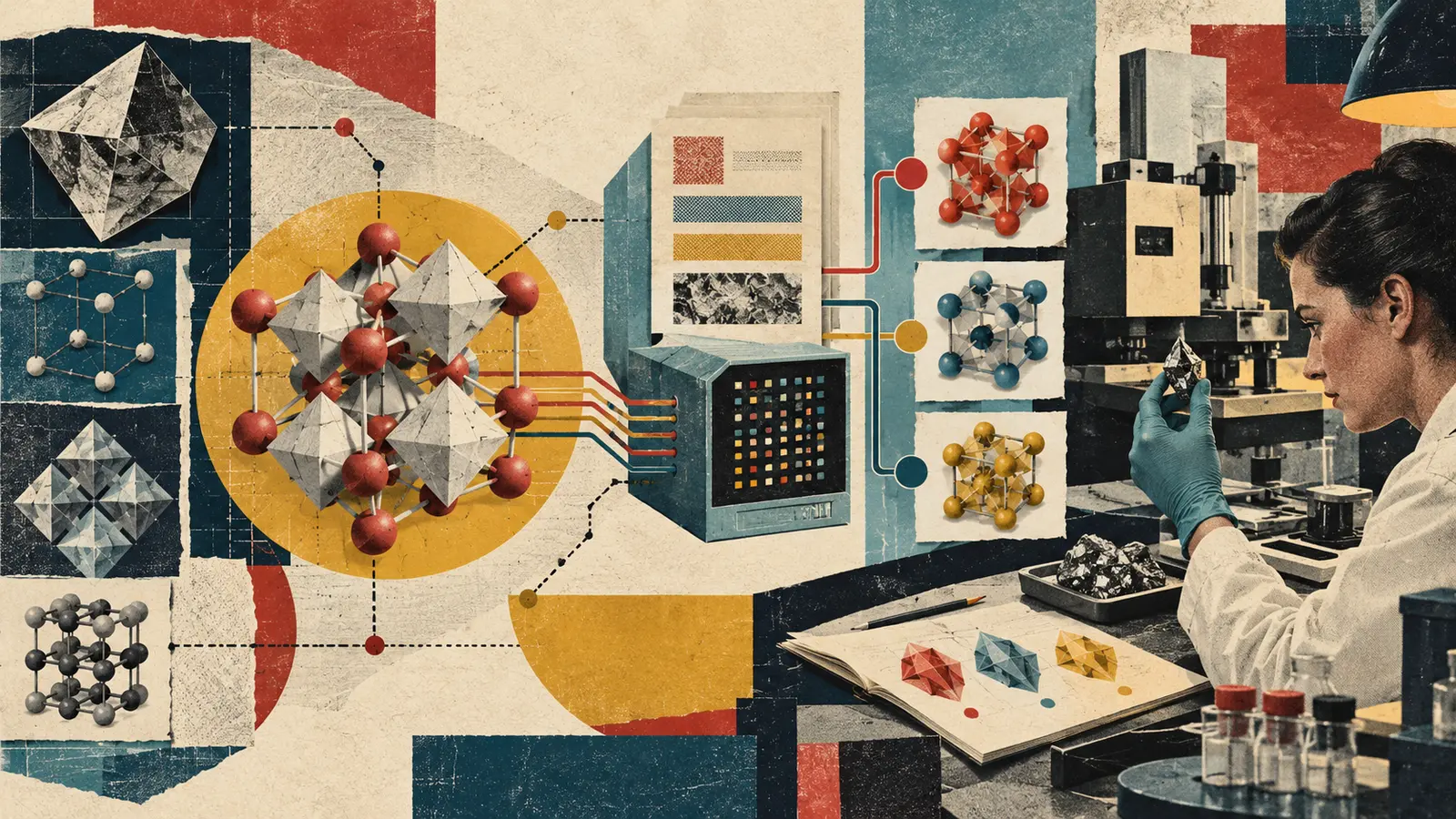
A useful materials model should be able to hear a sentence like "find a crystal that could conduct lithium ions" and look beyond the words that happen to appear in old papers. That sounds obvious until you remember that a crystal is not a paragraph. It is a three-dimensional arrangement of atoms. Its useful behavior depends on composition, geometry, bonds, defects, processing and conditions that language alone can flatten into a tidy sentence. Scientific publishing adds another distortion. Researchers write much more about fashionable and successful materials than about the enormous territory that was never tried, failed quietly or did not fit a journal story. MIT researchers have reported a model called CLaC, short for Contrastive Language-Crystal, that tries to bridge those two worlds. It places crystal graphs and language descriptions in a shared representation space. A person can describe a desired property in ordinary language, and the system can retrieve candidate structures whose computed properties align with the request. The plain signal is this: CLaC makes a materials database easier to ask questions of. It does not remove the laboratory from the answer. MIT highlighted the work on October 18. The underlying open-access Nature Communications paper was first published August 26 and reached its version of record on September 28. That date matters. This is a fresh university report about peer-reviewed work, not a brand-new model release pretending the calendar began yesterday. The research problem is real. The paper says the team collected 126,000 materials from the Materials Project. Each structure became a graph in which atoms and their relationships could be processed by a geometric encoder. The language side used descriptions grounded in computed properties rather than relying only on prose copied from publications. Those descriptions were synthetic narratives generated by language models. They could mention composition, structural features, properties, processing considerations and possible applications in a consistent format. The model then learned to pull matching structure and language representations closer together while pushing mismatched examples apart. That is contrastive learning. It is the same broad idea behind systems that learn which image belongs with which caption, except the visual side here is a crystal graph rather than a photograph of a cat wearing sunglasses. The researchers compared versions trained on synthetic narratives with versions trained on text extracted from academic papers. They report that the synthetic version learned a more organized alignment between language and crystal geometry and performed better in zero-shot retrieval experiments. This is one of those findings that sounds backward until the data pipeline is visible. Published prose has prestige, but it is not automatically good supervision. A paper paragraph may mention several materials, skip routine properties, focus on one surprising result and assume the reader knows the rest. The distribution is also biased toward popular material families. A property-grounded synthetic description can be less literary and more useful to a learning system because every entry answers roughly the same questions. Clean consistency can beat a mountain of uneven prose for a narrowly defined alignment task. The paper says the synthetic narratives covered about 300 times as many distinct crystals as the materials located in its literature-derived text collection. That does not mean the synthetic data contain 300 times more truth. It means the database-grounded generator could describe many structures that academic papers did not happen to discuss in usable text. The distinction is important because synthetic data can sound authoritative while carrying errors from the generator, the database or the prompt. In this work, the narratives were conditioned on computed properties, which anchors them better than free-form invention. Anchoring is not immunity. The paper's strongest claim is not that CLaC invented a miracle substance. It is that the representation supports zero-shot language-guided search. Zero-shot means the model can attempt a new query without being trained specifically for that query. In the reported inverse-design experiments, a user supplies a property description and the system retrieves structures from the database. The authors compare the retrieved candidates with random retrieval and report lower property errors and more meaningful trends for the synthetic-data model. MIT points to a solid-state lithium battery example. The model's top results included structures that other research had independently identified as promising candidates. That is encouraging corroboration. It is not a prospective discovery trial. The model searched an existing materials space. The experiment did not ask a robot laboratory to synthesize every candidate, measure conductivity, cycle a battery, study degradation and confirm that the whole device works safely. The gap between retrieval and material is where a great deal of science lives. A database entry may describe an ideal crystal at a particular computed state. A real sample can contain defects, impurities, grain boundaries and phase changes. It may require a synthesis route that is expensive, hazardous or simply impractical. The property that looked attractive in isolation may collapse when the material is formed into a film, pressed into a pellet, joined to an interface or heated through a manufacturing process. Then there is stability. A candidate electrolyte is not useful because one number looks right. It has to survive contact with other battery components, remain mechanically and chemically stable, conduct ions under relevant temperatures and avoid creating a new safety problem. This is why a language interface should end in a laboratory queue, not a product catalog. The practical workflow is straightforward. Start with a natural-language request, but translate it into explicit property targets and constraints. Ask CLaC for candidates. Preserve the exact query, model checkpoint, database version and ranked list. Run independent computation on the shortlist. Check novelty and prior evidence. Let materials scientists reject candidates for known synthesis, stability or toxicity problems. Then make and measure the survivors. Every stage should be allowed to say no. That may sound less magical than ordering a perfect material from a chatbot. Good. Scientific tools become useful when they make the expensive part of a search smaller, not when they hide the expensive part behind a confident answer. The public artifacts help. The researchers released code under the GPL-3.0 license, evaluation scripts and the synthetic narratives. The repository documents zero-shot retrieval, inverse-design evaluation and training requirements. The Nature paper says the literature-derived corpus of about four million full-text papers cannot be redistributed because of publisher copyright and licensing restrictions. That creates a split reproducibility picture. An outside team can inspect the model code, obtain the public synthetic data and rerun parts of the evaluation. It cannot reconstruct the paper-text baseline from the published artifacts without separately obtaining access to the licensed literature collection. Open code is useful, but it does not make every comparison fully portable. The scope is also narrow. The authors state that the current model applies to crystalline materials. Real engineering materials may be polycrystalline, disordered or full of defects that strongly affect performance. A clean crystal graph is a powerful representation, but it is not every surface, grain boundary, manufacturing history or operating environment. Evaluation is another honest constraint. Materials science does not yet have a universal multimodal benchmark for language-to-structure alignment. The team designed zero-shot retrieval and property-query tests to probe the capability. Those tests are informative, but they do not provide one settled scoreboard that lets every model be compared under identical conditions. That is a reason to improve the evaluation, not to dismiss the system. Future tests should include prospective challenges. Freeze the model and database. Publish a set of desired property profiles before candidate selection. Let the system produce a shortlist. Have independent laboratories attempt synthesis and measurement without silently changing the target after seeing the results. Report failures, costs, hazards and near misses alongside successes. The negative results matter enormously. If ten attractive candidates cannot be made, that is not a footnote. It is evidence about where the representation, property calculations or synthesis assumptions break. Teams using CLaC or a similar system should also test language robustness. Does a query written by a battery chemist retrieve the same neighborhood as a plain-language version from an engineer? What happens when the request includes several competing constraints? Does the model understand that high conductivity is useless if the material is unstable, scarce or toxic? Does it expose uncertainty, or simply return a neat ranking? The interface can make this better or worse. A bad product would show one crystal with a green check mark. A better one would show the ranked candidates, relevant properties, database provenance, uncertainty, known evidence, missing measurements and reasons each candidate could fail. It would let a scientist adjust constraints and compare how the list changes. It would also keep the synthetic narrative visible. If the words are doing the alignment work, researchers should be able to inspect which description accompanied each structure and correct a misleading statement. This is where the project becomes more than a materials search demo. It offers a test of how synthetic language can organize a scientific space that human writing covers unevenly. The lesson is not that machines should replace papers with their own prose. It is that training text can be designed as an instrument. If a narrative is grounded in a database, consistent across examples, versioned and auditable, it can help a model connect human intent to a structured physical representation. That connection can save scientists time. It can surface candidates that sit outside the most fashionable material families. It can help students explore relationships between structure and property. It can give a laboratory a better first stack of possibilities. Then the beakers, furnaces, microscopes, safety reviews and stubborn pieces of matter get their turn. CLaC can help decide where to look. The material still has to exist.
01
WHAT ACTUALLY CHANGED
MIT published an October 18 report explaining the Contrastive Language-Crystal model
The underlying open-access Nature Communications paper was first published August 26, 2026
CLaC aligns three-dimensional crystal graphs with natural-language descriptions in a shared representation space
The training set includes 126,000 materials collected from the Materials Project
Property-conditioned synthetic narratives provide descriptions grounded in computed material data
The synthetic narratives cover far more distinct crystal structures than the literature-derived text collection
The model uses contrastive learning to bring matching language and structure representations together
The researchers report zero-shot text-to-crystal retrieval and language-guided property search
The synthetic-data model outperformed random retrieval and models trained only on paper text in the reported tests
Code, evaluation tools and synthetic data are public, while the licensed full-text paper corpus is not redistributable
02
WHY THIS MATTERS
Natural language can become a practical front door to large structured materials databases
A three-dimensional graph preserves information that text-only models do not directly represent
Consistent synthetic descriptions can reduce some of the uneven coverage found in scientific publications
Property grounding makes synthetic data more auditable than free-form generated prose
Zero-shot retrieval can narrow a search without requiring a custom model for every property request
Database candidates still require independent computation, synthesis and physical measurement
Defects, interfaces, processing and operating conditions can overturn a promising ideal-crystal result
Public code and data support inspection, although the paper-text baseline cannot be fully reconstructed from public artifacts alone
A retrieval benchmark is not evidence that a candidate material works inside a manufactured device
Prospective laboratory tests can reveal which model rankings survive contact with physical reality
03
WHERE IT COULD HELP
- Search crystal databases with plain-language property and application requests
- Create shortlists for solid-state electrolyte, catalyst, semiconductor or structural-material research
- Compare how candidate rankings change when several constraints are added to a query
- Teach the relationship between crystal geometry, composition and material properties
- Build a scientist-facing explorer that exposes properties, provenance and uncertainty for each result
- Use model rankings to prioritize expensive first-principles calculations
- Audit synthetic narratives for inaccurate or overstated material descriptions
- Design prospective laboratory challenges with frozen models and predeclared targets
- Measure retrieval robustness across technical, plain-language and multilingual queries
- Record synthesis failures as feedback for later model and database revisions
KEEP A HAND ON THE WHEEL
Watch for independent reproduction of the reported retrieval results; prospective experiments in which ranked candidates are synthesized and measured; direct comparisons with newer graph, language and multimodal baselines; uncertainty estimates attached to each candidate; tests involving defects, polycrystals, interfaces and processing histories; robustness to conflicting and multi-property requests; audit tools for synthetic narratives; clearer licensing paths for the literature baseline; checkpoint and dataset versioning; and evidence that the system reduces laboratory time or cost without hiding failed candidates.
04
TERMS WORTH KEEPING
SOURCES AND VERIFICATION STATUS
This article was written from the materials below. Product claims and dates were checked against those sources on October 19, 2026.
PUBLICATION RECEIPT: This article distinguishes MIT's October 18 report from the paper's August 26 publication date. It treats CLaC as a database-retrieval and representation system, not proof of autonomous discovery, successful synthesis or device performance.
THE PUBLICATION ENGINE
WANT A SIGNAL OF YOUR OWN?
We build source-grounded publications, private briefings, and editorial systems for organizations with something useful to say.
WORK WITH US