THE SIGNAL IN ONE SENTENCE
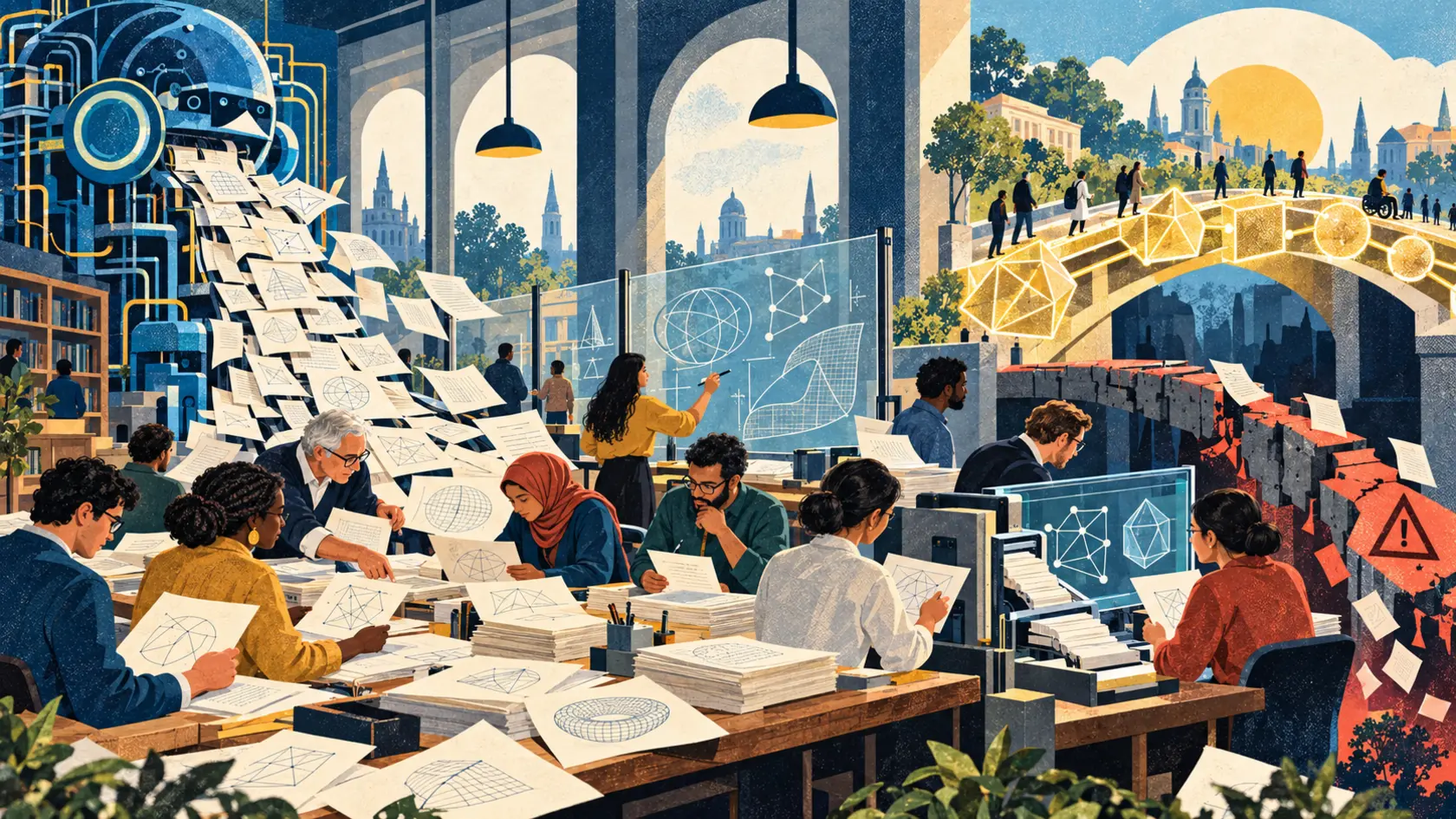
OpenAI just placed 722 mathematical manuscripts on the public internet. That sentence sounds like a library opening and a weather warning at the same time. The manuscripts are organized into 372 result families. A family can contain a principal result, related arguments, consequences or alternative proofs. OpenAI says the vast majority came from the same procedure using an unreleased internal frontier model. The model was given roughly 4,000 problems, and the average accepted result used compute equivalent to about three hours of ChatGPT Pro thinking. Those are remarkable numbers. They are not the same thing as 372 settled breakthroughs. OpenAI's own repository says the collection contains results at different stages of verification. Many proofs have Lean formalizations, but not all. It also says some unformalized results could have issues and promises to correct them when problems are found. That warning is not a footnote to the story. It is the story. Artificial intelligence can now produce mathematical output faster than the mathematical community can comfortably read, check, explain, cite and absorb it. The bottleneck has moved. Generating a candidate proof may take hours. Turning that candidate into shared human knowledge could take months or years. OpenAI published the material in a GitHub repository under an Apache 2.0 license. The release includes manuscript PDFs and source files, a map of the collection, Lean artifacts for many proofs, versioning and citation instructions, ten abridged reasoning summaries, estimates of compute use and information about the approximately 4,000 attempted problems. That is more disclosure than a glossy announcement and a benchmark chart. It is still not the publication system mathematicians normally use. The Advisory Group on Mathematics and Artificial Intelligence, an independent group formed after OpenAI approached several mathematicians, has been blunt about that gap. AGMAI says its advisory role is not an endorsement of the results or the process. It calls the public release a beginning rather than a completion and says only the mathematical community can assess the work. AGMAI's broader recommendations go further. The group asks AI labs to stop testing advanced mathematical problems on proprietary models. When substantial AI-generated results are released without immediate human understanding, it says labs should fund the community work needed to develop that understanding. It also recommends independent scholarly repositories, persistent citations, revision histories, literature checks, clear formalization status and disclosure of the model, prompts, summarized reasoning, time, compute cost, problem selection and failed attempts. The OpenAI release meets parts of that list. It publishes the manuscripts and source files. It preserves revisions. It discloses the rough scale of the attempted problem set and average compute. It includes formal proofs for many results and says more will follow. OpenAI also says it will fund workshops, conferences and special programs to help people understand major results. Other pieces remain incomplete. The model is not available. OpenAI calls it an internal frontier model and says it is working toward a responsible release. Only ten results come with abridged reasoning summaries. The collection is hosted in an OpenAI-controlled GitHub repository while the company explores community-hosted alternatives. The repository warns that citation quality, exposition and presentation still need improvement. Even a fully formalized proof does not finish the job. Lean can verify that a formal argument follows from stated definitions, assumptions and previously accepted components. That is powerful. It can catch gaps that prose and reputation miss. But formal verification does not decide whether a theorem matters, whether the assumptions capture the intended problem, whether an argument explains anything useful or whether a result has already appeared under different language in a forgotten paper. Correctness and understanding are neighbors, not twins. A proof can be formally valid and still be a terrible explanation. It can settle a narrow formulation while missing the question mathematicians actually care about. It can depend on a library lemma whose practical meaning is unclear to the people reviewing it. It can be new to the model and old to the literature. That last problem is especially important at this scale. Seven hundred twenty-two manuscripts create a citation and priority audit large enough to overwhelm normal scholarly attention. Each family needs subject experts who can compare it with existing work, identify hidden dependencies, test edge cases, translate unfamiliar terminology and decide whether the claimed advance is significant. GitHub stars cannot perform peer review. Neither can a single leaderboard, a press release or the fact that a proof compiles. The useful response is not to dismiss the entire collection because some papers may fail. Mathematics already advances through conjectures, preprints, revisions and mistakes. Nor should anyone count every manuscript as an established discovery because it arrived in a large repository with formal artifacts. The useful response is a triage system. Every result family should have a public status record. At minimum, that record should state whether the natural-language proof has been read by a relevant expert, whether prior art has been checked, whether a Lean proof exists, whether the formal statement matches the prose claim, whether independent reviewers reproduced the result and which questions remain open. The status should change visibly as the work moves. A result might begin as model-generated and unreviewed. Then it could become literature-checked, expert-read, formally verified, independently reproduced and community-accepted. Corrections, withdrawals and disputes should be first-class outcomes rather than embarrassing exceptions buried in commit history. OpenAI has already created the beginnings of that record with version preservation, manuscript-specific citation instructions and a formalization catalogue. The next step is to make review status legible without requiring every reader to inspect hundreds of folders. Funding matters because verification is work. Asking mathematicians to absorb a corporate research dump for free would quietly transfer the cost of model evaluation from the lab to the academic community. The people best equipped to review a specialized proof may already be teaching, advising students, applying for grants and doing their own research. A flood of candidate results can consume attention even when many ultimately fail. OpenAI says it will fund workshops, conferences and special programs. The governance of that support will matter as much as the amount. AGMAI recommends that established nonprofit institutions, not AI labs or the advisory group itself, decide how community understanding work is funded. That separation is sensible. A company should help pay the bill without choosing which criticisms deserve oxygen. Access is the other unresolved piece. OpenAI is publishing outputs from a model that mathematicians cannot use. That creates an odd scientific relationship. Researchers can inspect the papers, but they cannot pose their own questions to the instrument that produced them. The lab chooses the problem set, runs the model, filters the outputs and controls the timing of release. AGMAI warns that this can create a two-tier system in which private labs outrun the field whose knowledge they are mining. OpenAI says it is working to responsibly release the model, but it gives no date, access plan, price or technical requirement in the announcement. Until access changes, the collection is open output from a closed instrument. That does not make the output worthless. It makes the power relationship part of the evidence. There are practical applications here right now. Mathematicians can search the catalogue for results in their fields, inspect available Lean artifacts and test whether a claimed advance survives expert attention. Proof-assistant developers can study how natural-language manuscripts and formal libraries diverge. Publishers and repositories can prototype status labels for AI-generated work. Universities can build paid reading groups that pair domain experts with formalization specialists. Funding agencies can support independent replication without treating the model maker's priorities as the research agenda. The release could also teach labs how not to flood a field. Future collections should arrive with independent repositories, richer reasoning records, clearer failed-attempt data, literature audits, machine-readable status files and a funded verification plan already in place. The release interface should help experts find the handful of papers most likely to matter rather than presenting raw volume as evidence of importance. The deepest question is not whether AI can write a proof. It plainly can write things that look enough like proofs to demand serious attention, and many of these results may survive that attention. The deeper question is who owns the work between plausible output and human knowledge. Right now, OpenAI owns the model. The public owns access to the manuscripts. The mathematical community has inherited the burden of deciding what they mean. The plain signal is simple. Seven hundred twenty-two manuscripts are not 722 conclusions. They are 722 invitations to verify, understand, dispute, correct and, where the evidence holds, learn something genuinely new.
01
WHAT ACTUALLY CHANGED
OpenAI released 722 mathematical manuscripts organized into 372 related result families
The company says an unreleased internal frontier model attempted roughly 4,000 problems, with accepted results using about three hours of ChatGPT Pro thinking compute on average
The repository includes manuscript source files, citation instructions, revision history, ten abridged reasoning summaries and Lean formalizations for many but not all results
OpenAI says it will fund workshops, conferences and special programs to support human understanding of major results
The repository explicitly warns that some unformalized results could contain issues
02
WHY THIS MATTERS
AI can now generate candidate research faster than expert communities can verify and absorb it
Formal verification can establish logical consistency without establishing novelty, importance, interpretation or adequate citation
A proprietary model chooses and attacks research questions that the wider mathematical community cannot ask it directly
Reviewing a large corporate release creates real labor and attention costs for universities and independent researchers
Scientific publishing needs status records that distinguish generated, checked, formalized, reproduced and accepted work
03
WHERE IT COULD HELP
- Build a public verification ledger for each result family with expert review, literature checks, formalization and reproduction status
- Create paid reading groups pairing domain mathematicians with Lean specialists
- Use the collection to improve tools that connect prose proofs with machine-checkable formal statements
- Prototype independent repositories and review workflows for high-volume AI-generated research
- Study failed and corrected papers to improve model evaluation without mistaking manuscript count for scientific impact
KEEP A HAND ON THE WHEEL
Watch for independent expert reviews, corrected or withdrawn manuscripts, completion of additional Lean formalizations, migration to a community-controlled repository, publication of richer prompts and reasoning summaries, details about the promised workshops and funding, a transparent review-status ledger, evidence of prior-art checks, and any access plan for the internal model that produced the results.
04
TERMS WORTH KEEPING
OPEN GLOSSARY CARD
Result family
A group of related mathematical manuscripts built around a principal result, companion arguments, consequences or alternative proofs.
OPEN GLOSSARY CARD
Formalization
The process of translating a mathematical claim and proof into precise statements that a proof-checking system can verify.
OPEN GLOSSARY CARD
Proof assistant
Software that helps people write and mechanically verify formal mathematical proofs.
SOURCES AND VERIFICATION STATUS
This article was written from the materials below. Product claims and dates were checked against those sources on October 7, 2026.
THE PUBLICATION ENGINE
WANT A SIGNAL OF YOUR OWN?
We build source-grounded publications, private briefings, and editorial systems for organizations with something useful to say.
WORK WITH US